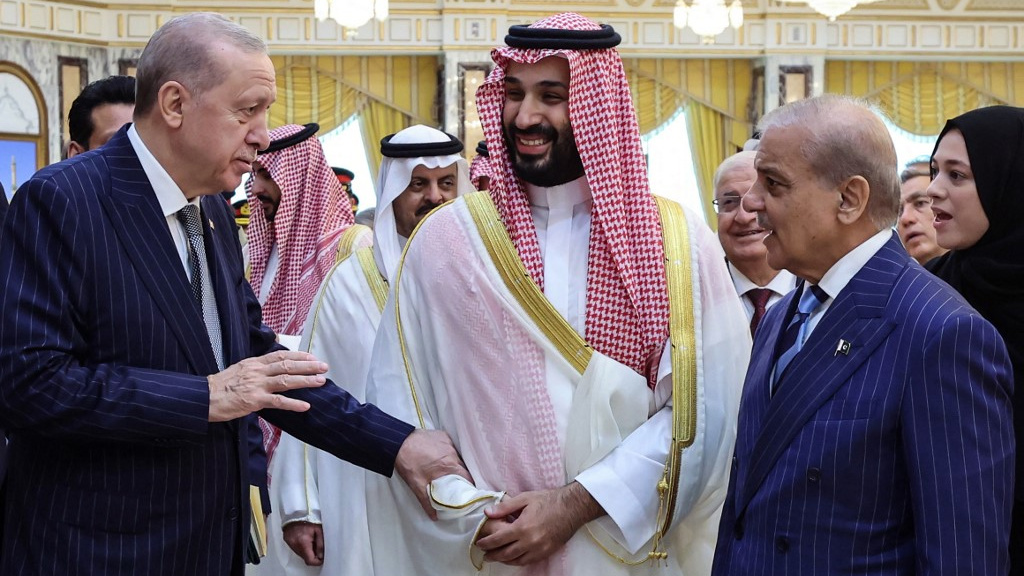
As Houthi forces in Yemen make rapid territorial gains across the Red Sea coast and step up attacks on Saudi Arabian infrastructure, Pakistan has clarified that it is not currently considering a military response under its newly signed trilateral joint defence agreement with Saudi Arabia and Turkey. The confirmation came Thursday from Pakistan’s Foreign Ministry spokesperson Sajjad Haider Khan, during his weekly press briefing for reporters.
The landmark trilateral defence accord, which was signed just one month prior to this announcement, includes a mutual defence clause that frames any armed aggression against one of the three signatory nations as an attack against all three. Khan emphasized that while no military mobilization or intervention is under active discussion at this stage, Pakistan stands ready to uphold its commitments under the agreement if changing circumstances demand action in the future.
“There is no such thing under discussion right now,” Khan stated, addressing press questions that arose in the wake of recent Houthi strikes on Saudi urban centers and critical energy infrastructure. He added that Pakistan would move forward with any required action only when “the time comes.”
The broader regional context has shifted dramatically in recent months, as the long-dormant Yemeni civil war between Houthi fighters and the Saudi-backed Yemeni government reignited over the summer. Houthi forces have since advanced at a striking pace along the country’s Red Sea coastline, securing key strategic positions that put them in control of access to the critical Bab el-Mandeb shipping choke point, a major global trade route connecting the Mediterranean Sea to the Indian Ocean via the Red Sea.
According to maritime security experts, this territorial advance has not only strengthened Houthi military standing but also boosted Iran’s geopolitical leverage in its ongoing standoff with the United States. “The Houthis have pulled off a military victory that puts them one step closer to being in full control of the Bab el-Mandeb,” explained Corey Ranslem, chief executive officer of maritime security firm Dryad Global, in an interview with Middle East Eye. Ranslem added that controlling the Bab el-Mandeb would be far easier for the Houthis than Iran’s efforts to exert influence over the Strait of Hormuz, noting that the U.S. maintains far fewer direct military assets in the Bab el-Mandeb region to counter Houthi control.
In just the latest round of territorial gains, Houthi forces defeated Saudi-aligned Yemeni government forces on Thursday to seize the historic, strategically vital Red Sea port city of Mocha following days of intense fighting across the Tihama coastal plain. Arab media outlets have reported additional Houthi advances across the region in the hours after the capture of Mocha. Just days before this seizure, Houthi media released images purporting to show the wreckage of a Saudi military reconnaissance drone that was shot down over northwestern Yemen’s Hajjah province, underscoring the escalating intensity of clashes.
Pakistan has already publicly condemned the recent Houthi attacks on Saudi territory, and has called on Iran to rein in its Yemeni allies. At the same time, Islamabad has maintained a role as a diplomatic mediator between the United States and Iran, as rising regional tensions continue to disrupt global energy supplies. Khan also confirmed Thursday that Pakistan has no current plans to expand the so-called Mecca alliance, the regional bloc of mostly Sunni Muslim nations led by Saudi Arabia, amid ongoing regional volatility.