博客

  • Kyrgios suspended after positive cocaine test

    Kyrgios suspended after positive cocaine test

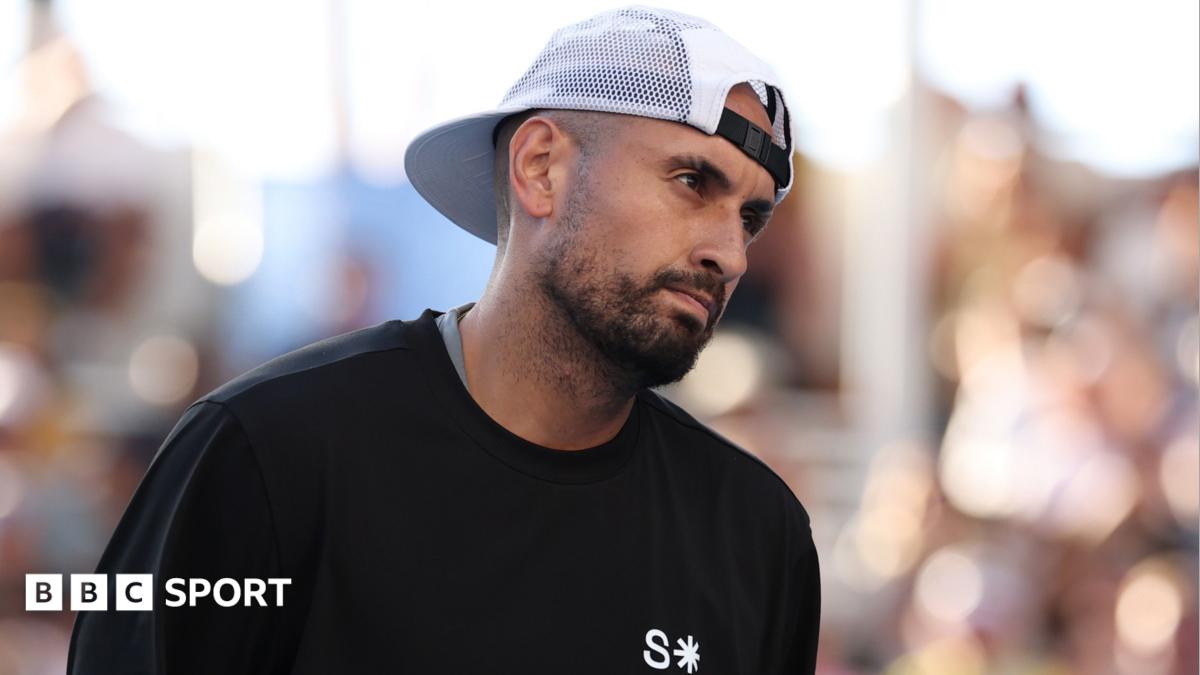
    Professional tennis star Nick Kyrgios has been issued a provisional suspension from all international tennis competition after testing positive for benzoylecgonine, a primary cocaine metabolite, according to an announcement from the International Tennis Integrity Agency (ITIA).

    The positive sample was collected from the 31-year-old Australian during the Mallorca Open on June 22, where he competed in the tournament’s singles draw. The suspension officially went into effect on August 4, and the ITIA confirmed Kyrgios retains the right to appeal the ruling — though no appeal has been filed as of the current update.

    Under the terms of the suspension, Kyrgios is barred from competing, coaching, or even attending any Grand Slam tournaments or events sanctioned by the men’s and women’s professional tennis tours until a formal tribunal completes its review of the case.

    In a public statement shared to his Instagram account, Kyrgios acknowledged he made a serious error and accepted full accountability for his actions. The former world No. 13 opened up about the severe physical and mental strain caused by years of recurring injuries that have limited his playing time in recent seasons. This year alone, he has appeared in just four singles matches, compiling a 1-3 win-loss record, with his most recent competitive appearance coming in men’s doubles at Wimbledon, where he and partner Alexander Bublik exited in the first round.

    Kyrgios wrote, “My body hasn’t been able to do what my mind expects it to do. Coming to terms with being near the end of my career has been harder than I ever imagined. None of that excuses what I did.” He added that he would step away from social media and public life for 28 days to prioritize his recovery and get his personal well-being back on track.

    The Australian also extended apologies to his support network, saying, “I’m sorry to my fans, my family, my sponsors and everyone close to me. Above all, I’m sorry to the kids who follow me. I know the example this sets and I’m deeply disappointed in myself.”

    Cocaine is categorized as a prohibited stimulant and substance of abuse on the World Anti-Doping Agency (WADA)’s official banned list. While reduced sanctions are typically available for athletes who test positive for the substance out of competition, Kyrgios’ positive test occurred during an in-competition setting. He lost his opening-round singles match at the Mallorca Open to Adam Walton shortly after the sample was collected.

    Kyrgios has been one of the most polarizing figures in men’s tennis throughout his career. His on-court conduct, including repeated racket smashes, verbal outbursts against umpires, and audible obscenities, has drawn widespread criticism and resulted in dozens of heavy fines. Off the court, his history includes a 2023 admission of assaulting a former girlfriend in 2021, a case that ended with no criminal conviction. He has also faced backlash for misogynistic comments and a 2024 social media share of content from controversial influencer Andrew Tate, a post he later walked back to distance himself from Tate’s views. Most recently, Kyrgios publicly condemned the handling of high-profile anti-doping cases involving top players Jannik Sinner and Iga Swiatek, calling the outcomes “disgusting” for the sport of tennis.

    Despite his controversies, Kyrgios has built a notable career resume: he has claimed seven ATP Tour singles titles, reached the 2022 Wimbledon singles final where he lost a four-set match to Novak Djokovic, and won the 2022 Australian Open men’s doubles title alongside compatriot Thanasi Kokkinakis. He has also been open about his long-standing struggles with mental health, revealing that he “genuinely contemplated” suicide and spent time in a London psychiatric facility following a 2019 Wimbledon exit.


  • Man, 21, arrested after allegedly repeatedly attacking 82yo in Melbourne while riding e-scooter

    Man, 21, arrested after allegedly repeatedly attacking 82yo in Melbourne while riding e-scooter

    A major development has emerged in the shocking investigation into an alleged assault on an 82-year-old Melbourne pensioner who confronted an e-scooter rider over dangerous speeding, with Victoria Police announcing the arrest of a 21-year-old suspect this Wednesday.

    The violent incident unfolded on 6 July in the leafy Melbourne outer suburb of Ferntree Gully, leaving the elderly victim hospitalized with injuries that, while not life-threatening, have left him deeply traumatized. According to police allegations, the confrontation began on the popular Blind Creek Trail when the retired senior asked the young e-scooter rider to reduce his speed for the safety of other trail users. Instead of complying, the rider launched into a verbal tirade against the 82-year-old before physically shoving him to the ground multiple times, then fleeing the scene immediately.

    Worse still, investigators allege the same attacker followed the pensioner to nearby Rankin Road, where he carried out a second unprovoked assault on the elderly man before leaving the area for good. Shaken and injured, the victim was rushed to hospital for urgent medical assessment and treatment.

    After days of investigation, Victoria Police executed an arrest at a residential address in Scoresby, a nearby suburb, taking the 21-year-old suspect into custody. Law enforcement confirmed the man is set to receive a summons to face court on multiple assault charges connected to the attack. The case highlights growing community tensions around shared use of public trails and paths between pedestrians, cyclists, and e-scooter riders, with many calling for clearer safety guidelines and enforcement of speed limits to prevent similar violent conflicts.

  • Mushroom murderer trial undermined by ‘catastrophic’ hotel mix-up, court told

    Mushroom murderer trial undermined by ‘catastrophic’ hotel mix-up, court told

    One of Australia’s most high-profile murder cases has returned to the courts this week, as Erin Patterson — the 51-year-old woman convicted of poisoning three of her relatives with toxic death cap mushrooms in 2023 — challenges her life sentence, while state prosecutors separately push for a harsher punishment.

    Patterson was found guilty of orchestrating a fatal poisoning at her regional Victoria home, where she served guests a beef Wellington laced with death cap mushrooms during a family lunch. The attack killed her 70-year-old in-laws Don and Gail Patterson, and Gail’s 66-year-old sister Heather Wilkinson. Heather’s husband Ian Wilkinson, the only person who ate the meal and survived, was present in the Melbourne Court of Appeal for the first day of hearings on Wednesday. Patterson herself did not appear in person, instead joining the proceeding via video link from her prison, where she is currently serving her life sentence. Her estranged husband Simon Patterson — who avoided the lunch by cancelling at the last minute, having long suspected his wife was attempting to poison him — was also absent from the court.

    The most serious allegation raised by Patterson’s legal team centers on a serious procedural error during the original trial: while the jury was deliberating on a verdict, all jurors were housed in the same hotel as the prosecution team, a key police witness, and reporters covering the case. Patterson’s senior barrister Richard Edney labeled the incident a “catastrophic” breakdown in procedure that irreparably damaged the integrity of the guilty verdict, arguing the convictions must be overturned and a full retrial ordered. “Justice must not only be done, it must be seen to be done,” Edney told the court.

    Representing the state, Director of Public Prosecutions Brendan Kissane acknowledged the overlapping accommodation was regrettable, but stressed it was an unintended accident, not a deliberate breach of procedure. He added that no evidence has emerged to prove any improper communication occurred between jurors and the prosecution or witness, meaning the incident does not qualify as a fundamental trial irregularity that would justify overturning the verdict.

    Beyond the hotel mix-up, Patterson’s legal team has outlined multiple other grounds for appeal. They argue that prosecution speculation linking Patterson to the foraging of death cap mushrooms should never have been presented to the jury. Prosecutors had argued during the original trial that Patterson targeted the mushrooms after finding reports of local death cap sightings on the citizen science platform iNaturalist, pointing to cell tower data that placed her phone in the areas where the mushrooms were spotted. But defense lawyer Veronika Drago told appeal judges the prosecution had inflated thin, circumstantial evidence into an incriminating narrative. Drago noted there is no proof Patterson ever accessed or viewed the iNaturalist posts, and the cell tower data only provides a possible location, not definitive proof of her presence. “Speculation was invited by the prosecution,” she said, arguing the unfair prejudice of the evidence far outweighs any limited value it could have had. Crown prosecutor Jeremy McWilliams pushed back against this claim, defending the use of cell tower expert testimony and noting the jury was properly permitted to use that evidence to assess whether Patterson had the opportunity to source the toxic mushrooms as alleged.

    The defense also argues that damaging Facebook messages Patterson sent months before the lunch, in which she harshly criticized her estranged husband and his parents, were irrelevant to the case and should have been excluded from trial. They further claim the original chief prosecutor engaged in overly aggressive, improper conduct during cross-examination, and identify 35 separate issues with the prosecution’s closing address to the original jury. When Justice Peter Kidd, one of the three appeal judges, asked why these issues were not raised during the original trial, Edney explained that the original defense team was operating under intense time and pressure, and the additional issues only became clear once the dust settled after the verdict.

    In pre-hearing filings, prosecutors have rejected all of the defense’s claims, arguing the guilty verdicts were inescapable given the overwhelming body of evidence. They noted multiple incriminating circumstances: the suspicious arrangement of the lunch invitation, Patterson’s decision to serve her own meal on a separate plate from the guests, and the fact that Patterson suffered no adverse health effects while all other guests became seriously ill. “Taken together, these circumstances point overwhelmingly to a deliberate act of poisoning,” prosecutors said.

    The appeal hearing is set to continue on Thursday, where prosecutors will continue responding to the defense’s arguments, and will also bring forward their own appeal against Patterson’s sentence. Currently, Patterson is eligible to apply for parole after serving 33 years of her life sentence, but the Director of Public Prosecutions argues this parole period is manifestly inadequate, and says the original trial judge acted inappropriately by setting any fixed parole term. The three appeal judges have indicated they will reserve their decision after concluding the hearing, meaning a ruling on the appeals is not expected for many weeks.

  • Afghan farmers turn their grapes into raisins after border closures slash fruit exports to Pakistan

    Afghan farmers turn their grapes into raisins after border closures slash fruit exports to Pakistan

    It is peak harvest season in Kandahar, Afghanistan’s southern grape heartland, and 2024 has delivered a plump, abundant crop that should be a reason for celebration across the region’s agricultural communities. Instead, this year’s bounty has become a devastating economic burden, as months of cross-border fighting between Afghanistan and Pakistan have sealed off the primary export market for Kandahar’s world-famous grapes.

    For months, sporadic armed exchanges along the two nations’ rugged, 2,600-kilometer shared border have killed hundreds of civilians and service members on both sides. The conflict stems from Islamabad’s accusation that Afghanistan’s ruling Taliban government shelters militant groups carrying out cross-border attacks inside Pakistan — a claim the Taliban-led Kabul administration has repeatedly and vehemently denied.

    As fighting escalated, Pakistan closed key border crossings, severing a critical trade artery that for decades has carried the bulk of Afghanistan’s fresh fruit exports to international and regional markets. Trapped with thousands of tons of perishable fresh grapes that cannot reach Pakistani buyers, Kandahar’s producers have been forced to flood the small domestic market with excess supply, sending fresh grape prices plummeting overnight.

    To avoid letting their entire harvest go to waste, many growers have pivoted to drying bunches of fresh grapes to make long-lasting raisins, a lower-value product that can be stored and sold gradually. Even that adaptation has failed to deliver relief: glutted domestic markets have pushed raisin prices down to a fraction of their usual levels.

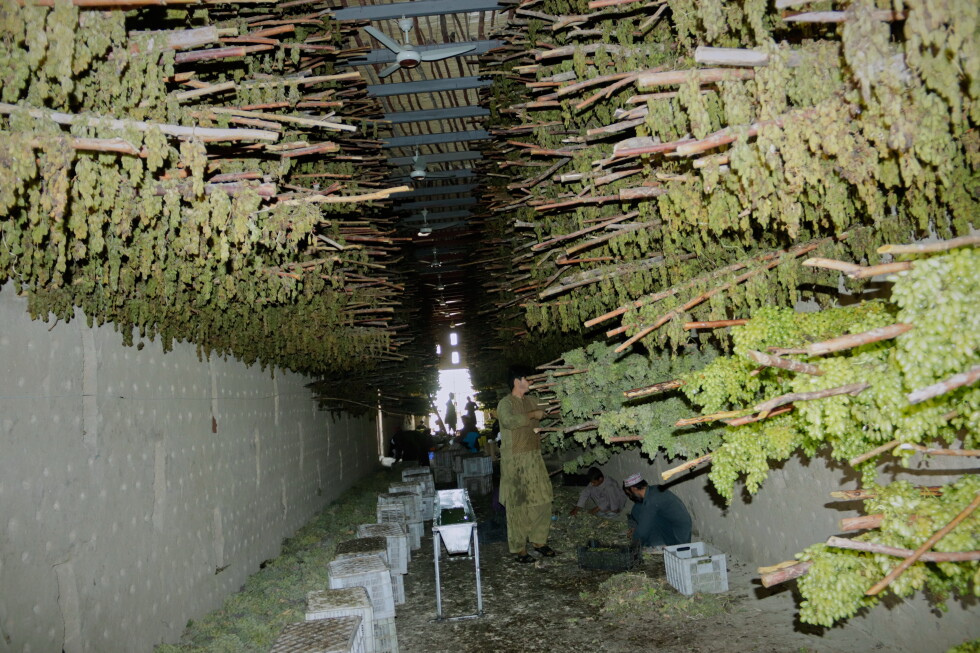
    Inside a sprawling storage warehouse in Kandahar’s Zhari District, rows of fresh green grapes hang from wooden drying racks, as large ceiling fans circulate hot summer air to speed the curing process. For orchard owner Sakhi Jan, who supports a household of 10 people in Zhari, the price collapse has left him on the brink of financial ruin. Where 7 kilograms of raisins once sold for 1,000 to 1,200 afghanis (equal to $13 to $16), that same volume now fetches just 400 to 450 afghanis, or roughly $5 to $6.

    In a nation already grappling with widespread systemic poverty and chronic malnutrition that disproportionately harms children and vulnerable households, even small income losses can push families into hunger. Jan says the daily struggle to make ends meet has become far more severe than anything he experienced in previous years.

    “We are grateful for the harvest, but things aren’t like they used to be. The struggle is much harder now,” Jan explained. “In the past, work was steady, we could sell our grapes at a fair price, and people generally got by. Now the hardship is immense.” He stressed that reopening border crossings to restore trade flow is the only solution to the crisis, adding: “We urge both our government and Pakistan to open these routes and reach an agreement. The current situation is causing great hardship for all of us.”

    Abdul Baqi Bina, deputy director of the Kandahar Chamber of Commerce and Investment, confirmed that the border shutdown has devastated Afghanistan’s entire fresh fruit export sector, hitting pomegranate producers as hard as grape growers. He shared stark trade data to illustrate the collapse: in 2023, Afghanistan’s five southern grape-growing provinces exported a total of 44,225 tons of grapes worth $13.8 million. Nearly 98% of that volume — 43,000 tons — was shipped through Pakistan to domestic and international buyers, with just the remaining 1,225 tons exported to Bangladesh, Iraq and India. So far in 2024, total grape exports from the region amount to only 256 tons, valued at just $100,000.

    For veteran grape exporter Haji Abdul Hai, who has worked in the trade for decades, the current shutdown is unprecedented. “In my 50 years of life, I have never seen these roads closed to the extent they are now,” he said. He noted that past border disputes only resulted in short-term closures of a few days, and alternate crossings usually remained open to allow trade to continue. “But now, we are facing truly major difficulties that we have no way to navigate on our own,” he added.

    Even seasonal farm workers, who rely on grape harvest season for the bulk of their annual income, have been hit hard. Qudratullah Popal, a harvest worker at a large local orchard, said the farm employed roughly 1,500 seasonal pickers during last year’s harvest. This year, that number has plummeted to just 15, as the orchard’s owners have no reason to harvest large volumes of grapes they cannot sell.

    “There have been good harvests. Grapes turned out well, but the issue is they cannot be exported to other countries. They are being sent to domestic locations … where there is already an abundance of grapes,” Popal said. “When routes are blocked and trade halts, everyone’s livelihood is paralyzed: traders, laborers and orchard owners alike.”

  • Congo’s Ebola outbreak reaches 5,000 cases as it outpaces response efforts at unprecedented speed

    Congo’s Ebola outbreak reaches 5,000 cases as it outpaces response efforts at unprecedented speed

    BUNIA, Democratic Republic of Congo – New government health data released this Wednesday has marked a grim milestone in the country’s ongoing Ebola crisis: total confirmed and suspected cases have surpassed the 5,000 threshold, with response teams warning the virus is spreading at an unmatched rate that is outrunning containment efforts in one of Central Africa’s most isolated, volatile regions. As of Sunday, the Ministry of Health’s official tally stood at 5,021 total cases, including 2,378 fatalities, with the outbreak intensifying amid a perfect storm of unfavorable conditions: widespread insecurity, mass population displacement, and constant cross-community movement that has made tracking and isolating cases extremely difficult. This outbreak has already outpaced every previous Ebola event in both the speed of transmission and the scale of infection and death. Since the first case was detected, it has spread roughly three times faster than the 2014-2016 West African Ebola epidemic, which held the previous record as the deadliest outbreak on record, claiming more than 11,000 lives across the region. During a special coordination meeting convened by the World Health Organization this Tuesday, WHO Director-General Tedros Adhanom Ghebreyesus issued a stark warning about the trajectory of the crisis. “The outbreak has spread rapidly and the risk of further national and international spread remains high,” Tedros stated. “We must be frank: the epidemic is far from being under control.” Ongoing safety risks have severely constrained containment operations, as frontline health workers have repeatedly become targets of violence, particularly in Ituri province – the region currently bearing the brunt of the outbreak. Just this week, new details emerged of an attack on a public health team that underscored the dangers responders face. On Monday, local residents attacked a health deployment in Aru territory after authorities announced a suspected Ebola case in the area. A rioting mob set fire to an ambulance and caused significant damage to two additional vehicles, according to Michael Wani, president of the Union of Cultural Associations for the Development of Ituri. The attack is the latest in a series of incidents that have hampered response work, alongside additional complicating factors including the presence of mobile gold mining populations across eastern Congo that are hard to reach and monitor. Exhausted response teams have already reported struggling to keep up with contact tracing demands, as new infections emerge faster than workers can identify and quarantine potential exposures, pushing the crisis further beyond the capacity of existing public health efforts.

  • Michael Cheika to return as Waratahs head coach in Super Rugby

    Michael Cheika to return as Waratahs head coach in Super Rugby

    One of rugby’s most decorated international coaches is making a nostalgic return to where he claimed one of his greatest club successes. Michael Cheika, the 59-year-old rugby strategist who led the New South Wales Waratahs to their only Super Rugby championship back in 2014, has been confirmed as the franchise’s new head coach, set to take up the role this November.

    Before stepping into his new post with the Sydney-based side, Cheika will complete his current commitment leading Lebanon at the Rugby League World Cup, wrapping up a multi-sport coaching stint that has kept him busy across global rugby circuits in recent years.

    Cheika’s coaching career is marked by a string of high-profile achievements that extend far beyond his 2014 Super Rugby win. After leaving the Waratahs following his title run, he took the helm of Australia’s national men’s side, the Wallabies, and steered the team all the way to the 2015 Rugby World Cup final in England. He departed the Wallabies post after a quarterfinal exit at the 2019 World Cup, but quickly bounced back to top international coaching, leading Argentina’s Los Pumas to an unexpected semifinal finish at the 2023 Rugby World Cup hosted in France.

    His success is not limited to southern hemisphere rugby, either. Early in his club coaching career, Cheika led Irish side Leinster to lift the European Cup title in 2009, cementing his reputation as a coach who can deliver silverware at the highest club level.

    In a statement following his appointment, Cheika emphasized the emotional weight of his return to the Waratahs. “The Waratahs have always occupied a special place for me — it’s my home state and I feel ready to return as head coach ahead of an important year for the Waratahs and also for Australian rugby in the lead up to the home Rugby World Cup,” he said.

    BJ Mather, the Waratahs’ high performance manager, highlighted Cheika’s proven track record of winning as a core reason for the franchise’s decision to bring him back. While the organization is not focused on reliving past glory, Mather noted that Cheika remains the last Waratahs head coach to claim a Super Rugby title, bringing both experience and a winning culture that the side has lacked in recent seasons.

    The Waratahs have struggled to compete at the top level of Super Rugby in recent years, failing to qualify for the competition playoffs over the past three consecutive seasons under previous head coaches Dan McKellar and Darren Coleman. With the 2027 Rugby World Cup set to be hosted in Australia, the franchise’s leadership is betting on Cheika’s leadership experience and winning pedigree to rebuild the side and return it to championship contention, just as he did 12 years ago.

  • Tokyo opposes US sanctions on Japanese ICC chief Akane

    Tokyo opposes US sanctions on Japanese ICC chief Akane

    A fresh wave of United States sanctions targeting the top leadership of the International Criminal Court (ICC) has triggered international condemnation, with close US ally Japan leading criticism of the measures against its own national, ICC President Tomoko Akane.

    On Tuesday, the second Trump administration imposed economic and travel restrictions on Akane and Senegalese Senior Trial Lawyer Abdoulaye Seye, expanding a long-running US campaign against the Hague-based judicial body. Washington frames the ICC as a “corrupt and fatally politicised” institution that oversteps its authority to threaten national sovereignty. US Secretary of State Marco Rubio claimed in a statement that the two sanctioned officials directly participated in ICC investigations, detentions and prosecutions of officials from governments that have not granted the court jurisdiction, though he provided no specific evidence to support the allegation.

    Japan, which is the ICC’s largest financial contributor and has long backed the court’s mission to hold perpetrators of the world’s worst atrocities accountable, formally rejected the sanctions the following day. “Japan has consistently supported the ICC in its efforts to prosecute and punish the most serious crimes of concern to the international community and to uphold the rule of law,” foreign ministry press secretary Toshihiro Kitamura said in an official statement. “From this standpoint, the announced measures are very unfortunate.”

    The ICC itself pushed back sharply against the punitive measures, warning that they pose a fundamental threat to the global legal order. “When judicial actors are threatened for applying the law, it is the international legal order itself that is placed at risk,” the court said in a response. The Netherlands, which hosts the ICC at its headquarters in The Hague, also joined the criticism, with Dutch Foreign Minister Tom Berendsen writing on X that the country “disapproves of the latest sanctions against officials and staff of the ICC,” adding that “international courts and tribunals must be able to freely carry out their mandates.”

    Israeli Prime Minister Benjamin Netanyahu, meanwhile, praised the US action, echoing Washington’s hostility toward the court. The ICC issued an arrest warrant for Netanyahu earlier in 2024 over alleged war crimes committed during the Gaza war, making the court’s investigations into Israel a core driver of the latest US sanctions. Netanyahu called the ICC a “kangaroo court that cloaks its abuse of power in the language of international law” in an X post Tuesday evening.

    This sanctions announcement is the latest escalation in a broader US diplomatic offensive against the ICC launched last month. At that time, Washington accused the court of threatening US national interests and called on partner nations to withdraw from the Rome Statute, the founding treaty that established the court. To date, Chad and the post-Maduro Venezuelan government, which has aligned with the US, have already announced their withdrawals. The ICC has warned that these exits weaken global collective efforts to pursue accountability for mass atrocities.

    Founded in 2002, the ICC operates as a court of last resort, only stepping in to prosecute genocide, crimes against humanity and war crimes when national legal systems are unwilling or unable to deliver justice. The US is not a member state: it signed the Rome Statute but never ratified the treaty, joining Israel, Russia and China in remaining outside the institution.

    Human rights groups have roundly condemned the new sanctions, with four organizations already filing a lawsuit against Trump in a New York federal court over existing ICC sanctions, arguing the measures block war crime victims from accessing justice. Balkees Jarrah, Middle East and North Africa director at Human Rights Watch, one of the plaintiffs, called the latest action “just the latest example of the Trump administration’s utter contempt for international law and a naked attempt to shield American and Israeli officials implicated in serious crimes from justice.”

    Akane, a 70-year-old Japanese jurist who has served as an ICC judge since 2018 and was elected court president in March 2024, has already been targeted by sanctions from another country: Russia issued an arrest warrant for Akane and other senior ICC officials after the court issued an arrest warrant for Russian President Vladimir Putin over the forced deportation of Ukrainian children in 2023. At that time, Akane downplayed the impact of such targeting, noting “Even if one judge were to die, we are easily replaceable, so there is really no value in targeting us.”

    The new US sanctions bar Akane and Seye from entering the US and prohibit any transactions involving the pair through the US financial system, marking the fifth round of punitive measures against ICC officials since Washington first launched its campaign against the court.

  • Ousted Ukraine defense minister urges wartime elections, warning of a governance crisis

    Ousted Ukraine defense minister urges wartime elections, warning of a governance crisis

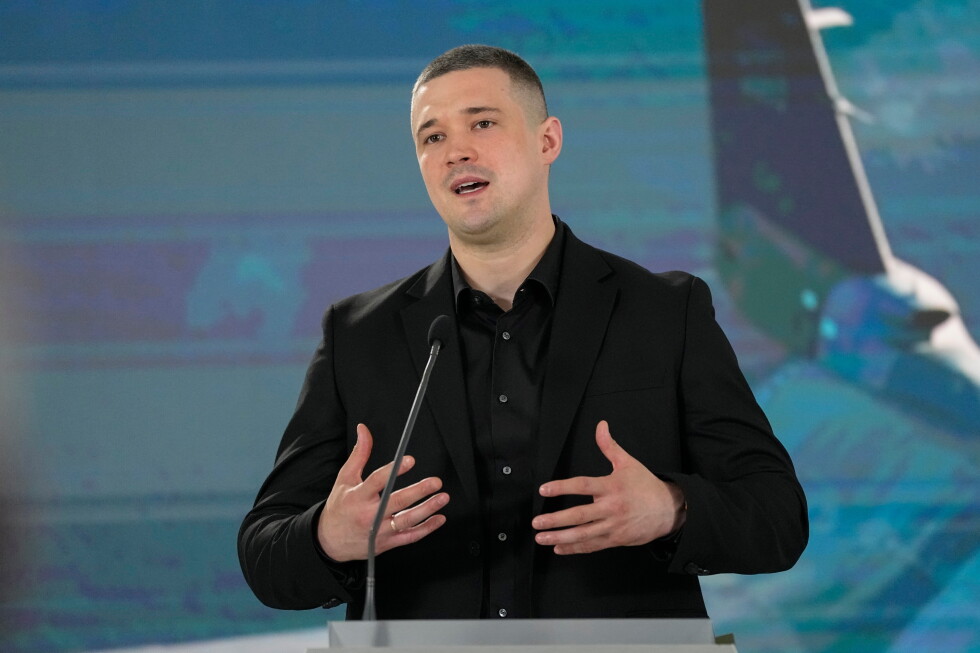
    KYIV, Ukraine — In a surprise and potentially destabilizing move that marks one of the most significant domestic tests for Volodymyr Zelenskyy since Russia launched its full-scale invasion nearly three years ago, ousted Ukrainian Defense Minister Mykhailo Fedorov has publicly called for national elections to proceed despite the ongoing active conflict, warning that the country is currently trapped in a deep-rooted governance crisis.

    Fedorov, who until his dismissal in July was counted among Zelenskyy’s closest and longest-serving most loyal political allies, laid out his demands in a pre-recorded video address published to YouTube this Tuesday. The former minister stressed that Ukrainian leadership must move quickly to develop a legitimate, secure and logistically feasible framework to restore the country’s full democratic process, even while the nation remains locked in a prolonged full-scale war with Russia.

    “We must find a legal, safe, and realistic mechanism that will allow Ukraine to restore a full democratic process even amid a prolonged war,” Fedorov stated in the address.

    As of Tuesday evening, Zelenskyy’s office had not issued any immediate public response to Fedorov’s appeal.

    Under current Ukrainian legislation, all national elections are banned during the period of martial law, which has been in continuous effect since February 24, 2022 — the exact day Russia launched its large-scale invasion of Ukrainian territory.

    Fedorov went further than his call for elections, alleging that Ukraine is now facing a systemic breakdown in its governing structures. He argued that the current ruling system is primarily focused on self-preservation and actively blocks any meaningful reform. He also publicly decried widespread corruption among government officials, stopping short of naming specific individuals or agencies, and claimed that this graft has directly eroded Ukraine’s capacity to defend itself against Russian forces.

    The former defense minister claimed that his own removal from office was tied to the sweeping overhaul he spearheaded of the Defense Ministry’s procurement system — a department that manages billions of dollars in military equipment purchases for Ukraine’s armed forces.

    “Corruption in wartime is not merely a financial issue. It is a matter of our capability to survive and win,” Fedorov said. “Every single hryvnia intended for defense must work for defense. Not for a private pocket.”

    Fedorov’s video address was released just hours after Ukraine’s Parliament confirmed it had received a formal nomination from Zelenskyy to appoint Yevhenii Khmara as the new permanent defense minister, Parliament speaker Ruslan Stefanchuk announced via his official Facebook page on Tuesday.

    Since Fedorov’s sudden ouster in July, large-scale public demonstrations in support of the former minister have drawn significant crowds across Kyiv over the past month. While the protest movement has seen a slight decline in turnout from its initial peak, weekly weekend marches still bring thousands of demonstrators onto the capital’s streets, many carrying handcrafted signs calling on Zelenskyy to reverse Fedorov’s dismissal and reinstate him to the defense minister post.

  • India edges closer to win in 1st cricket test against Sri Lanka despite Sonal Dinusha’s 65

    India edges closer to win in 1st cricket test against Sri Lanka despite Sonal Dinusha’s 65

    GALLE, SRI LANKA – As India closes in on the four remaining wickets that would seal a win in the opening Test against Sri Lanka, batter Sonal Dinusha’s resilient unbeaten innings has kept the host nation in the contest heading into lunch on the fifth day of play. When play resumed Wednesday morning, Sri Lanka started at 84 for 4, still trailing India by a daunting 287 runs. Dinusha, who notched up a century in Sri Lanka’s first innings, returned to the crease not out on 25 alongside captain Dhananjaya de Silva, who sat on 31 overnight.

    The pair had already built a steady 54-run partnership across 12.2 overs in the final session of Day 4, and they entered Wednesday’s morning play with a clear game plan: limit risky shots to protect their wicket and extend their stand. The strategy paid off through the first hour, as the partnership added another 54 runs, and both batters crossed the 50-run milestone. De Silva reached his half-century first from 125 patient deliveries, with Dinusha following just shortly after from 77 balls.

    Dinusha survived the entire morning session unscathed, advancing to 65 not out off 112 total deliveries, with six confident fours and one six to his name. It was Indian spinner Ravindra Jadeja who finally broke the threatening 108-run stand, trapping de Silva caught at short fine leg when the Sri Lankan skipper attempted a sweep shot. De Silva departed for a gritty 59, leaving Sri Lanka at 162 for 5.

    Just four overs after removing de Silva, India claimed a second wicket when Prasidh Krishna bowled a delivery that caught Niroshan Dickwella’s edge, with the wicketkeeper out for 10 caught behind. That left Sri Lanka at 168 for 6, and the hosts reached the lunch break at 175 for 6, with bowler Keshara Nuwantha holding firm to remain unbeaten after facing 27 deliveries, partnering Dinusha through to the interval.

    Set a 372-run target to win, Sri Lanka still trails India by 197 runs heading into the afternoon session. For Sri Lanka, an outright victory remains a highly improbable outcome, while the home side needs to bat through 65 remaining overs to salvage a draw and deny India the win. The match has followed a tight narrative so far: India posted 462 in its first innings, dismissed Sri Lanka for 284 in reply, then added 193 in its second turn at bat to set the challenging chase.

  • China arrests local official over assault on woman at business event

    China arrests local official over assault on woman at business event

    A high-profile sexual assault case in eastern China has ignited widespread public fury and sparked urgent national conversations about power abuse, workplace gender safety, and long-criticized business drinking culture, after local authorities announced the arrest of a local government official and a state-owned enterprise businessman over the attack. According to official announcements, the incident unfolded following a formal company dinner attended by multiple corporate executives and public officials, when the unnamed female victim was allegedly assaulted at a nearby karaoke bar in Hangzhou, Zhejiang province.

    Local investigative statements confirm that the victim was sexually assaulted by both suspects. One suspect pushed her to the ground during the attack, leaving her with visible injuries to her lower back. Following the completion of initial investigative procedures, both accused have already been removed from their official and professional positions, and are now in legal custody awaiting further judicial processing.

    While incidents of sexual misconduct linked to business entertainment events are not unprecedented in China, legal arrests in such cases — especially those involving sitting public officials — remain relatively rare. What has amplified public anger in this particular case is the combination of the severe harm inflicted on the victim and the alleged abuse of hierarchical workplace power by the two accused: one a serving public official, the other a senior executive at a state-owned enterprise.

    The case quickly dominated public discourse on Chinese social media, cementing its place as one of the most discussed topics nationwide. On Wednesday alone, seven of the top 50 most trending topics on Weibo, China’s leading microblogging platform, were tied to the incident. After local authorities released their official investigative findings, public attention surged even further: one related discussion thread accumulated more than 68 million views, while multiple other connected topics racked up between one and six million views each.

    Across social media, users have widely voiced solidarity with the victim and condemned the attackers. “Attending a work social event with drinks never equals consent to be harmed, and drinking alcohol never equals voluntary consent to abuse,” one widely liked Weibo comment read. Much of the public conversation has also centered on China’s long-debated “drinking table culture”, after early reports emerged that the victim was pressured to consume large volumes of alcohol before being taken to the karaoke lounge where the assault occurred. “What is the logic behind forcing women to accompany men for drinking at business events? We hope this harmful practice can be stamped out entirely,” another popular comment read.

    State-run China Women’s News also weighed in on the case in an editorial, arguing that punishing the individual perpetrators alone would not be enough to address the root problems exposed by the incident. The commentary argued that institutional measures are urgently needed to draw clear boundaries for appropriate business interactions, and eliminate the ambiguous grey areas where public power becomes tangled with coercive social obligations that enable abuse.