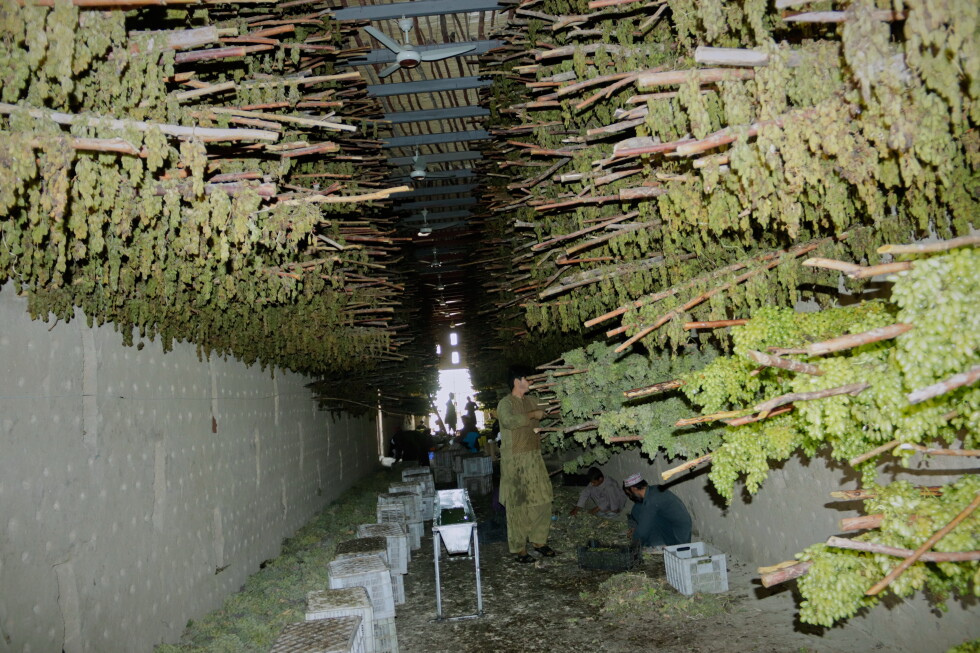
It is peak harvest season in Kandahar, Afghanistan’s southern grape heartland, and 2024 has delivered a plump, abundant crop that should be a reason for celebration across the region’s agricultural communities. Instead, this year’s bounty has become a devastating economic burden, as months of cross-border fighting between Afghanistan and Pakistan have sealed off the primary export market for Kandahar’s world-famous grapes.
For months, sporadic armed exchanges along the two nations’ rugged, 2,600-kilometer shared border have killed hundreds of civilians and service members on both sides. The conflict stems from Islamabad’s accusation that Afghanistan’s ruling Taliban government shelters militant groups carrying out cross-border attacks inside Pakistan — a claim the Taliban-led Kabul administration has repeatedly and vehemently denied.
As fighting escalated, Pakistan closed key border crossings, severing a critical trade artery that for decades has carried the bulk of Afghanistan’s fresh fruit exports to international and regional markets. Trapped with thousands of tons of perishable fresh grapes that cannot reach Pakistani buyers, Kandahar’s producers have been forced to flood the small domestic market with excess supply, sending fresh grape prices plummeting overnight.
To avoid letting their entire harvest go to waste, many growers have pivoted to drying bunches of fresh grapes to make long-lasting raisins, a lower-value product that can be stored and sold gradually. Even that adaptation has failed to deliver relief: glutted domestic markets have pushed raisin prices down to a fraction of their usual levels.
Inside a sprawling storage warehouse in Kandahar’s Zhari District, rows of fresh green grapes hang from wooden drying racks, as large ceiling fans circulate hot summer air to speed the curing process. For orchard owner Sakhi Jan, who supports a household of 10 people in Zhari, the price collapse has left him on the brink of financial ruin. Where 7 kilograms of raisins once sold for 1,000 to 1,200 afghanis (equal to $13 to $16), that same volume now fetches just 400 to 450 afghanis, or roughly $5 to $6.
In a nation already grappling with widespread systemic poverty and chronic malnutrition that disproportionately harms children and vulnerable households, even small income losses can push families into hunger. Jan says the daily struggle to make ends meet has become far more severe than anything he experienced in previous years.
“We are grateful for the harvest, but things aren’t like they used to be. The struggle is much harder now,” Jan explained. “In the past, work was steady, we could sell our grapes at a fair price, and people generally got by. Now the hardship is immense.” He stressed that reopening border crossings to restore trade flow is the only solution to the crisis, adding: “We urge both our government and Pakistan to open these routes and reach an agreement. The current situation is causing great hardship for all of us.”
Abdul Baqi Bina, deputy director of the Kandahar Chamber of Commerce and Investment, confirmed that the border shutdown has devastated Afghanistan’s entire fresh fruit export sector, hitting pomegranate producers as hard as grape growers. He shared stark trade data to illustrate the collapse: in 2023, Afghanistan’s five southern grape-growing provinces exported a total of 44,225 tons of grapes worth $13.8 million. Nearly 98% of that volume — 43,000 tons — was shipped through Pakistan to domestic and international buyers, with just the remaining 1,225 tons exported to Bangladesh, Iraq and India. So far in 2024, total grape exports from the region amount to only 256 tons, valued at just $100,000.
For veteran grape exporter Haji Abdul Hai, who has worked in the trade for decades, the current shutdown is unprecedented. “In my 50 years of life, I have never seen these roads closed to the extent they are now,” he said. He noted that past border disputes only resulted in short-term closures of a few days, and alternate crossings usually remained open to allow trade to continue. “But now, we are facing truly major difficulties that we have no way to navigate on our own,” he added.
Even seasonal farm workers, who rely on grape harvest season for the bulk of their annual income, have been hit hard. Qudratullah Popal, a harvest worker at a large local orchard, said the farm employed roughly 1,500 seasonal pickers during last year’s harvest. This year, that number has plummeted to just 15, as the orchard’s owners have no reason to harvest large volumes of grapes they cannot sell.
“There have been good harvests. Grapes turned out well, but the issue is they cannot be exported to other countries. They are being sent to domestic locations … where there is already an abundance of grapes,” Popal said. “When routes are blocked and trade halts, everyone’s livelihood is paralyzed: traders, laborers and orchard owners alike.”