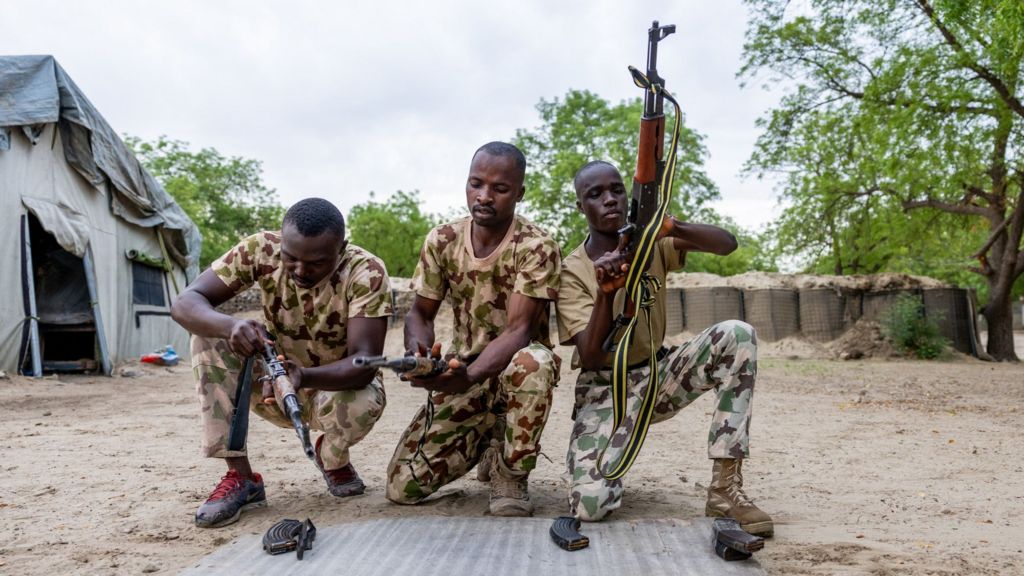
Nigeria is pushing forward with its most ambitious military expansion in modern history, as President Bola Tinubu has signed off on a major restructuring and personnel boost to address the persistent security crises that have shaken communities across the country. The new executive order authorizes the recruitment of an additional 28,000 soldiers and the establishment of four new army divisions, bringing the service’s total number of divisions to 12. Three new regional army headquarters will also be constructed in Nigeria’s violence-plagued northeast and central regions, hotspots that have long battled Islamist militant insurgency, widespread banditry, and recurring resource conflicts between farming and pastoral communities.
The expansion comes as the Nigerian government faces mounting public and international pressure to rein in the rising tide of violence carried out by a loose network of armed groups, ranging from jihadist insurgents and separatist militants to criminal kidnapping gangs that target civilians for large ransoms. Just one week before the announcement of the military restructuring, two high-profile attacks underscored the ongoing threat: an armed gang massacred at least 20 villagers in northwestern Nigeria’s Zamfara State, and 46 school students were abducted from a campus in Borno State in the northeast. While all 46 students were rescued by Nigerian army forces within hours of their kidnapping, the incidents highlighted how criminal and militant groups continue to operate with relative impunity across large swathes of the country.
Nigerian government officials argue that the current military structure has struggled to keep pace with evolving security threats. Under the existing framework, existing army divisions are forced to cover massive, cross-state territories that leave operational resources stretched thin when responding to coordinated or sudden attacks. The new divisions and regional headquarters, officials say, will streamline inter-unit coordination, improve cross-regional intelligence sharing, and cut critical response times when violence erupts. In recent years, violence that was once concentrated in northern and central Nigeria has also spread to southern parts of the country, amplifying urgency for reform: in May, coordinated attacks on schools in southwestern Oyo State left 44 pupils and teachers abducted.
While Nigerian security forces have made incremental progress pushing back against armed groups in recent months – including killing senior Islamic State leader Abu-Bilal al-Minuki during a months-long counter-insurgency operation centered on the Lake Chad Basin – criminal and militant networks have grown more sophisticated in their tactics, and violence remains a daily reality for millions of Nigerians. Analysts note that the global Islamic State movement has increasingly shifted its operational focus to sub-Saharan Africa over the past five years, with roughly 90% of all IS-linked attacks now occurring in the region. Nigeria’s IS-affiliated branch is the most active jihadist network on the continent, continuing to carry out regular attacks despite recent counter-insurgency gains. In December 2025, Nigerian and U.S. forces concluded a joint counter-terrorism operation that targeted the Lakurawa militant group in northwestern Nigeria, including Christmas Day strikes, but jihadist cells have continued to launch attacks in the months since the operation wrapped up early this month.
Even with the government’s plan to expand force numbers, security experts warn that a major hurdle remains: convincing young Nigerians to enlist amid the heavy casualties the military has suffered in recent months of counter-insurgency operations. This latest military expansion is just one part of the Tinubu administration’s broader security push. Before approving the military restructuring, President Tinubu issued a public ultimatum to all armed groups operating in Nigeria, ordering them to surrender or face the full military force of the state. Last month, Tinubu also announced plans to recruit more than 50,000 new police officers and signed a national budget that allocates a record 5.41 trillion naira ($4 billion USD) to national defense and security – the largest ever single-year investment in the country’s security apparatus.