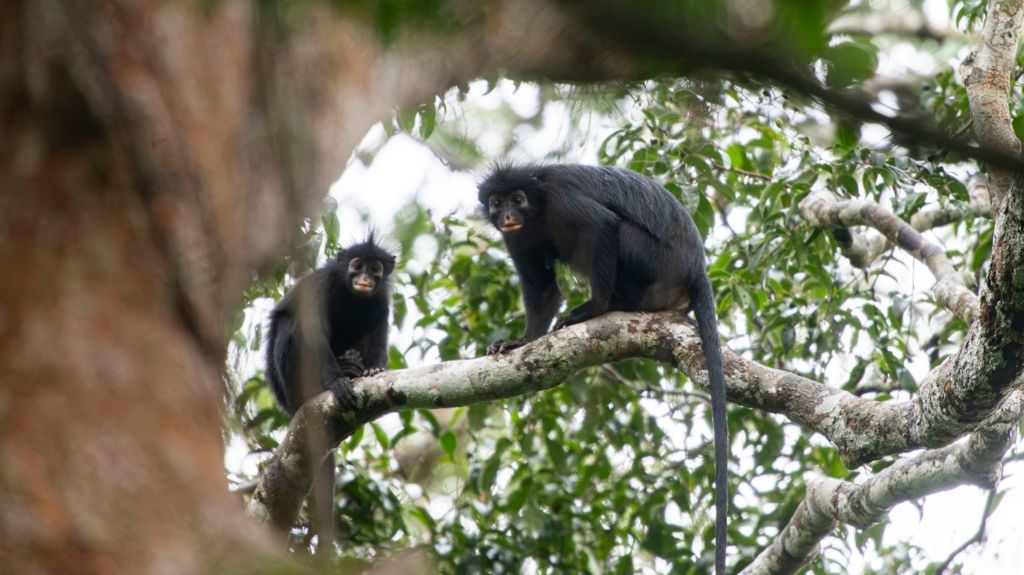
Deep in the dense tropical tree canopy of central eastern Democratic Republic of Congo’s Lomami National Park, an elusive, black-furred monkey with eye-catching pinkish-orange lips has been formally confirmed as a species new to global science. Only the fifth new African monkey species identified in the last 75 years, this discovery marks a major milestone for primate research and highlights the unstudied biodiversity remaining in one of the world’s most intact tropical forest ecosystems.
Local communities have long recognized the shy primate, calling it ‘Likweli’, but it took nearly 15 years of collaborative work between researchers from the DRC, the United States, and Germany to formally confirm it as a genetically distinct species. Conservation teams working in the park first documented an unusual primate matching Likweli’s description back in 2008, but only captured one low-resolution, blurry photograph that was insufficient for formal classification. A second confirmed sighting a decade later gave the international research team the opening they needed to launch a targeted study, combining field observations, audio recording of the monkey’s distinctive calls, high-resolution photography, and in-depth genetic analysis to prove the species was previously unknown to science.
Junior Amboko, a PhD candidate at Florida Atlantic University who led the field work for the project, described the moment of seeing the little-known primate clearly as an ‘amazing feeling’. Unlike many new species discoveries that find entirely unknown organisms in remote regions, this confirmation formalizes what local people already knew, but it fills a major gap in scientific understanding of African primate evolution.
Formally named *Colobus congoensis* by the research team, to honor the DRC’s extraordinary natural biodiversity, the new primate belongs to the colobus monkey group, a set of distinctive African primates defined by their lack of thumbs. As canopy-dwelling herbivores, these monkeys play a critical ecological role: they process tree seeds and support forest regeneration through their feeding habits, making them key to maintaining the health of the tropical forest ecosystem.
Lead researcher Professor Kate Detwiler, also of Florida Atlantic University, notes that the species’ unique bright pink-orange facial markings likely serve an important social function, acting as a visual signal to help individual monkeys identify one another or attract potential mates. Like many canopy primates, *Colobus congoensis* is more often heard than seen: it produces a distinctive, resonant roaring call that allows researchers to detect its presence, even when the shy animals remain hidden high in the treetops.
Field interviews with 52 local villages near the monkey’s range illustrate just how elusive the species is: only residents of eight villages reported ever having seen a Likweli monkey. Researchers currently believe the new species is rare, with a limited range restricted to a specific section of forest that provides the specialized habitat and food sources it requires. The species is also at risk from subsistence hunting for bushmeat, so the formal classification as a distinct species is a critical first step toward securing official protected status for the population.
The research team’s findings were published this week in the peer-reviewed journal *PLoS One*. Much remains unknown about this secretive new primate, and the team plans to conduct follow-up surveys to estimate the total population size and observe the species’ social and feeding behavior in its natural habitat.