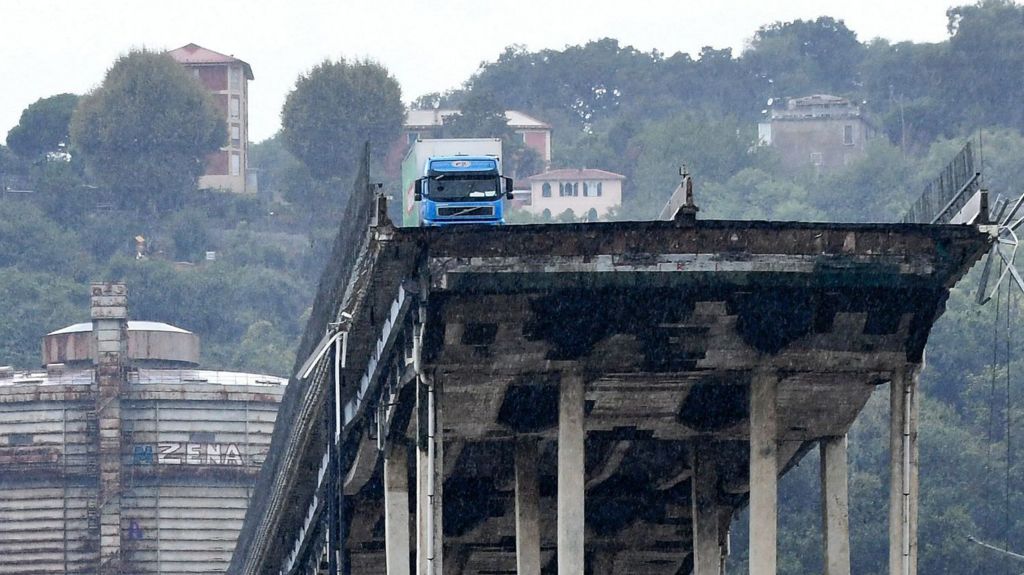
It has been almost eight years since Italy suffered one of its deadliest modern infrastructure disasters, when a section of the 1960s-era Morandi Bridge in the northern port city of Genoa collapsed during a summer storm at the peak of 2018’s holiday travel season. On Thursday, a Genoa courtroom will finally deliver the first-instance verdict in a years-long trial that has gripped the nation, with dozens of defendants facing charges linked to the tragedy that claimed 43 lives.
Among those set to attend the hearing is Egle Possetti, whose sister Claudia, Claudia’s new husband Andrea, and the couple’s two children aged 12 and 16 died when their vehicle plunged from the collapsed viaduct onto the railway tracks below. The family had just married and was en route to a holiday on the Italian Riviera when disaster struck. Claudia’s first husband, father to the two children who died, will also join Egle in court Thursday.
In an interview with the BBC, Possetti, who also serves as a representative for the committee of victims’ families, described her conflicting emotions heading into the verdict: “I feel anxious, worried, very emotional. After so many years, so many hearings, we may be able to see some light. It would be so important for us to know if someone’s been held accountable.” For nearly a decade, Possetti says, families have been told the collapse was an unavoidable accident with no culpable party. A clear ruling on responsibility, she adds, would bring a long-awaited measure of peace and justice to grieving relatives who have lived with uncertainty for years.
The disaster triggered a years-long investigation that ultimately led to 57 people going on trial starting in July 2022. Defendants include former senior executives of Autostrade per l’Italia (Aspi), the toll road operator that managed the bridge, executives from Aspi’s former parent company Atlantia, lead engineers from maintenance contractor Spea, and former Italian transport ministry officials. Charges against the accused range from multiple counts of manslaughter to document falsification, and all 57 defendants have repeatedly denied any wrongdoing. Several lesser charges, including some counts of forgery, have already been dropped due to Italy’s statute of limitations.
At the core of the case is a fundamental dispute over what caused the bridge, a critical transit link connecting Genoa to the French border, to fail. Prosecutors argue the collapse was entirely preventable: they claim warnings of structural degradation were repeatedly ignored for years, while critical maintenance work was deliberately delayed to protect corporate profits. Defense teams, by contrast, argue the disaster stemmed from an inherent design flaw in the concrete-encased stay cable that failed, and that no feasible maintenance program could have averted the collapse.
The trial, which has spanned nearly four years and required 284 separate hearings, has drawn widespread criticism over its plodding pace, which has exposed deeper structural issues within Italy’s judicial system. Francesco Pinto, the former deputy chief prosecutor who led work on the case, has noted that even after Thursday’s first-instance ruling, additional appeals and a final Supreme Court decision could add another two and a half years to the process. Defense attorneys, including Giovanni Paolo Accinni who represents former Atlantia CEO Giovanni Castellucci, counter that the lengthy proceedings stem from the prosecution’s years of complex pre-trial technical investigations, most of which needed to be revisited after the trial formally began. Castellucci is already serving a six-year prison sentence for his role in a separate 2013 viaduct collapse in southern Italy that killed 40 people.
Ahead of Thursday’s verdict, Aspi broke its long silence to issue the first formal public apology to victims’ families. In an open letter published in two major Italian newspapers, current CEO Arrigo Giana — who took over leadership of the company last year, when it came under new ownership and management — called the lack of an earlier apology a “further, incomprehensible wound” for a community already shattered by grief. While acknowledging no apology can undo the pain of losing loved ones, Giana called the apology a long-overdue moral duty. Both Aspi and Spea have already stepped down as defendants in the criminal case after reaching a settlement agreement that pays out roughly €30 million (£25 million) in damages to victims.
Beyond the trial, the 2018 collapse sparked a sustained national debate over the state of Italy’s aging infrastructure, bringing long-neglected issues of delayed maintenance and structural safety to the forefront of public discourse. The wreckage of the original Morandi Bridge was demolished via controlled explosion in June 2019. Just 18 months later, a new replacement span — the Genoa San Giorgio Bridge, designed by celebrated Genoa-born architect Renzo Piano, with sail-like white pillars that pay homage to the city’s maritime heritage — opened to traffic in August 2020. Even with the physical replacement complete, families of the victims say closure will only come once clear accountability is delivered for the disaster. Following Thursday’s verdict, the victims’ families committee will hold a public press conference in Genoa to address the ruling.