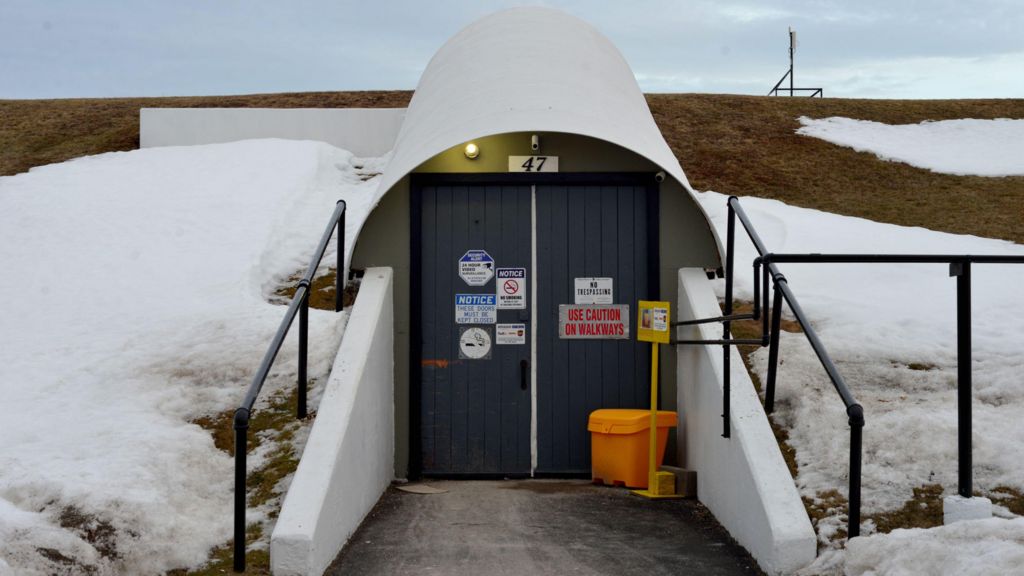
Tucked 70 miles north of Halifax in Nova Scotia’s Debert Business Park, a sprawling, overgrown grassy mound hides a piece of Cold War history that is about to get a very modern, luxury-focused second life. Once a World War II military training base and later a decommissioned nuclear fallout shelter built during the height of Cold War tensions, the 64,000-square-foot structure known locally as the Diefenbunker is now being reimagined as a crisis-resilient condo development for the world’s ultra-wealthy.\n\nThe transformation is the brainchild of Canadian crypto entrepreneur Jonathan Baha’i, who acquired the site back in 2015 for just C$31,300, roughly $22,000 in current U.S. currency. For years after the purchase, Baha’i operated the space as a mixed-use attraction, offering laser tag experiences, historical heritage tours, and hosting a small-scale data center. But shifting global events over the last two years, marked by growing geopolitical instability and increasing frequency of extreme weather events, have pushed the project in an entirely new direction.\n\nUnder the development arm of Baha’i’s Fallout Complex Inc., the shelter will be converted into 50 high-end private condos packed with luxury amenities designed for long-term sheltering during any global cataclysm. Planned features include farm-to-table gourmet dining from on-site, self-sustaining food production, biometric secure access control, 24/7 perimeter surveillance, full-time on-site medical facilities, and even private aircraft access via the nearby small Debert Airport. Renovation blueprints also add high-end leisure offerings: a full-service spa, a dedicated yoga studio, a premium cigar lounge, and modern OLED lighting systems that mimic natural sunlight to combat the psychological effects of extended underground stays. When condo owners are not occupying their units, the spaces will be rented out as boutique luxury hotel rooms, with profits split between the development company and unit owners. If a global crisis occurs while renters are occupying a unit, however, tenants will be required to vacate to make space for the unit’s owner. Both purchase prices and rental rates for the condos have not been released to the public.\n\nThe development team has partnered with German security firm Bespoke Home and Yacht Security, a company that project co-owner Paul Mansfield says has previously provided private security services to high-profile clients including U.S. Vice President JD Vance and celebrity Kim Kardashian, though the firm does not publicly disclose its client roster. Recommended security upgrades from the firm include automated drone patrols to monitor the bunker’s outer perimeter. To date, 11 of the 50 condo units have already been sold, indicating strong early demand for the unique offering.\n\nMansfield framed the project as a response to growing global anxiety last autumn during a presentation to local government leaders. “There’s more uncertainty in the world in the last two years than in the last 50 years,” he explained. “That uncertainty has sparked a renewed interest in having a personal safety insurance policy, which is exactly what these bunkers are.”\n\nBaha’i, for his part, pushes back against the common label of the development as a “doomsday bunker.” He argues the project is far more than a refuge for the end of the world, framing it instead as practical, forward-thinking preparedness for any kind of crisis, natural or manmade. During Hurricane Fiona, which devastated Nova Scotia in 2022, Baha’i opened the then-unrenovated bunker to his employees and their families, and he highlighted the structure’s fully off-grid, self-sufficient capabilities as its core value. “If a massive storm hits, condo owners know they have a guaranteed warm, safe space with consistent power, ample food, and every resource they need to ride it out,” he said. Beyond the condos, Baha’i also plans to expand the site’s existing data center to 15,000 square feet, equipped with cutting-edge energy efficiency technology to keep power costs low and offer ultra-high-security data storage for corporate clients. Baha’i emphasizes the project will also bring tangible economic benefits to Debert, creating more than 40 new local jobs in hotel operations and data center management, with a preference for hiring local workers. The full renovation is scheduled for completion by early 2025, and while most early interest has come from people across Canada’s East Coast, the development has already drawn inquiries from potential buyers around the globe.\n\nTo understand the uniqueness of Baha’i’s project, it is important to look at the history of Canada’s Diefenbunker network. The seven bunkers across Canada were commissioned between the late 1950s and mid-1960s under former Prime Minister John Diefenbaker, designed to host a skeleton crew of senior government officials to maintain continuity of government in the event of a full-scale nuclear war. The Debert bunker was engineered to withstand a near-miss from a nuclear detonation and sustain up to 329 people for a minimum of 30 days of isolation. By the time the network was completed, however, rapid advances in long-range missile technology and the growing destructive power of nuclear weapons had already rendered the bunkers obsolete. The Debert site was later repurposed as a provincial emergency warning center before it was permanently shuttered in 1990 as a provincial government cost-cutting measure.\n\nMost other former Diefenbunkers across Canada have fared far worse than the Debert site. The Ontario Borden bunker remains locked and abandoned, the Manitoba Shilo bunker is buried underground, the British Columbia Nanaimo bunker was intentionally flooded after years of derelict abandonment, and an Alberta bunker in Penhold was demolished entirely over unfounded fears that the outlaw biker gang Hells Angels would purchase it for use as a clubhouse. That makes the Debert project one of the few successful repurposing efforts for this unique piece of Cold War heritage. According to estimates from comparable sites, the original construction of the Debert bunker would have cost between C$2 million and C$3 million in 1960s currency, equal to roughly C$30 million today, and the site currently costs roughly C$60,000 per year to maintain. Industry experts note that repurposing options for Cold War-era bunkers are generally limited to tourism operations, high-security facilities, or data centers, matching Baha’i’s mixed-use model.\n\nThe Debert project fits into a much larger global trend of growing disaster preparedness and luxury bunker development. In the United States, the private disaster preparedness industry is already worth at least $500 million by some projections, with estimates that between 20 million and 70 million American households now engage in some form of disaster prepping. A growing number of developers across North America are repurposing decommissioned military infrastructure into luxury survival properties: a former Air Force base in Virginia’s Black Hills has been converted into Vivos, a gated survival condo community, while a decommissioned Army missile silo in Kansas is now home to the Atlas luxury survival condo development.\n\nDespite the clear business demand for the project, it has not been without local critics. Annette Sharpe, secretary of the Debert Military Museum, says the conversion of the historic site into private luxury property has erased a key piece of local Cold War heritage that museum visitors regularly ask to tour. “It breaks my heart that this piece of history is now private property, refurbished for a use that has nothing to do with its history,” Sharpe said. She also questioned the economic logic of the luxury development in Debert, a small community that has seen its population plummet from more than 60,000 (including military personnel) when the base was active to just 1,400 residents today. With average local apartment rents sitting at just C$2,000 per month, Sharpe questions who can afford the ultra-luxury condos. “Who’s gonna afford to buy one of those Hollywood-style luxury units here?” she asked.\n\nLocal councillor Marie Benoit has also raised concerns that the boutique hotel’s rates, which are estimated to be higher than most luxury hotels in downtown Halifax, will be out of reach for the vast majority of local residents. “Looking at average local wages, I don’t know if this is something that most people in this community will ever be able to access,” Benoit said.\n\nStill, local political leadership has broadly embraced the project. Debert Mayor Blair called the development “a novel and unique opportunity” to bring attention and investment to one of the few remaining intact Diefenbunker sites in the country, and noted that there has been little public opposition from local residents. “To our knowledge, constituents don’t have any problem with the project. We haven’t had anyone come forward saying they don’t want this here,” Blair said.\n\nMany local business owners also share the optimism. Fady Farah, owner of Angelina’s Pizzeria in Debert, recalled that the previous iteration of the bunker as a tourist attraction for laser tag brought significant new foot traffic to the area, and he expects the condo project to do the same. When asked if he’d consider using the bunker if a crisis hit, Farah joked, “If the situation were to pop off, you’d see me there knocking on the doors. Someone’s gotta cook their food while they’re hiding out, right?”’