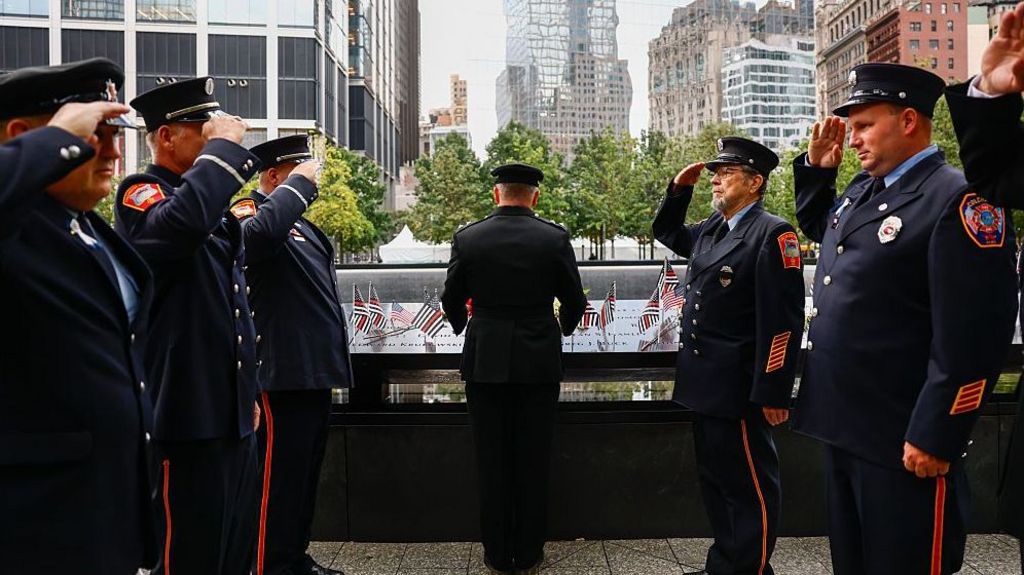
A quarter of a century after the deadliest terrorist attack on U.S. soil, communities across the United States and around the world gathered Friday to honor the nearly 3,000 people killed in the September 11, 2001 attacks, reflecting on lingering grief, unfulfilled justice demands, and the long-term health toll that continues to claim lives decades later.
Across three key attack sites, the nation’s highest political leaders joined survivors and bereaved families to mark the somber milestone. At the Pentagon, one of the four targets hit by hijacked planes that morning, sitting President Donald Trump led a formal commemoration alongside current cabinet members and Condoleezza Rice, who served as Secretary of State in the aftermath of the attacks. In his remarks, Trump tied the post-9/11 global fight against terrorism to his administration’s ongoing standoff with Iran, reaffirming a hardline pledge: “The Islamic Republic will never, ever have a nuclear weapon.” Echoing a core promise of every 9/11 commemoration, he added, “Today we renew the sacred oath that we first swore in their names a quarter of a century ago. We will never, ever forget. That’s why we fight today.”
At the ground zero memorial in lower Manhattan, built where the Twin Towers once stood, Vice President JD Vance joined an unprecedented gathering: all four living former U.S. presidents — George W. Bush, who held the presidency during the 2001 attacks, Bill Clinton, Barack Obama, and Joe Biden — alongside their respective first ladies. For nearly four hours, family members took turns reading the full roll of nearly 3,000 victims killed in the attacks, a ritual that has become the centerpiece of the annual memorial.
In Shanksville, Pennsylvania, hundreds gathered at the Flight 93 National Memorial, where the fourth hijacked plane crashed after passengers revolted against the hijackers, preventing an attack on the U.S. Capitol that morning. A silent tribute was held at the site’s Wall of Names, honoring the 40 passengers and crew who died.
For the first time in the 25 years of commemorations, this year’s memorial included a new, somber addition: a seventh bell toll, following the six traditional bells that mark the timelines of each plane crash and the collapse of the Twin Towers. The seventh bell pays tribute to the thousands of people who have since died from 9/11-related illnesses, most commonly cancers caused by exposure to toxic dust and smoke from the collapsing World Trade Center. U.S. health officials estimate that these secondary deaths have now outnumbered the nearly 3,000 people killed in the immediate attacks by more than three to one — a grim reminder of the attack’s long shadow that continues to affect communities.
Survivors also shared their harrowing firsthand accounts of the morning to mark the milestone. Janice Brooks, who had moved to New York just two weeks before the attacks to start a new job on the 84th floor of the South Tower, described the chaos and terror that unfolded after the first plane hit the North Tower. As she began evacuating, the second hijacked plane slammed into her tower: “There was an almighty thud. I heard one of those horror film screams as a woman was hit by debris. When I looked up, there was a big gaping hole where my office should have been.” Today, Brooks joins thousands of survivors and family members who return to ground zero every year to honor those who did not escape.
The 25th anniversary also brought renewed calls for accountability from family members of victims. Terry Strada, a 9/11 widow and national chair of 9/11 Families United, used her live-broadcast remarks to criticize the U.S. government’s failure to hold Saudi Arabia accountable for its alleged role in the attacks. “How can it be 25 years and still we have no justice for the role that Saudi Arabia played in your murder?” Strada asked, drawing loud applause from the gathered crowd. While a majority of the 9/11 hijackers were Saudi citizens and al-Qaeda leader Osama bin Laden — who planned the attacks — came from a prominent Saudi family, the 2004 9/11 Commission Report officially cleared the Saudi government of any involvement, a conclusion that many victim families continue to dispute to this day. Saudi officials have repeatedly denied any connection to the attacks.
Beyond U.S. borders, memorial events were held in major cities across the globe to honor the hundreds of foreign nationals killed in the attacks, and to stand in solidarity with the United States. In London, the UK Foreign Secretary Ed Miliband and U.S. Ambassador Warren Stephens joined a formal tribute at Buckingham Palace, with additional commemoration events held at Lloyd’s of London. The Toronto Stock Exchange held its own memorial for colleagues lost in the attacks. In Milan, Italy, a group of Italian and American firefighters held a symbolic stair climb at the Galfa Tower, climbing 110 floors up and down to match the number of stories in each of the original Twin Towers, honoring the hundreds of first responders who died rushing into the burning towers to save others.
Twenty-five years on, the commemorations remain anchored in the core promise that has defined the annual ritual: that the lives lost on September 11, 2001, will never be forgotten.