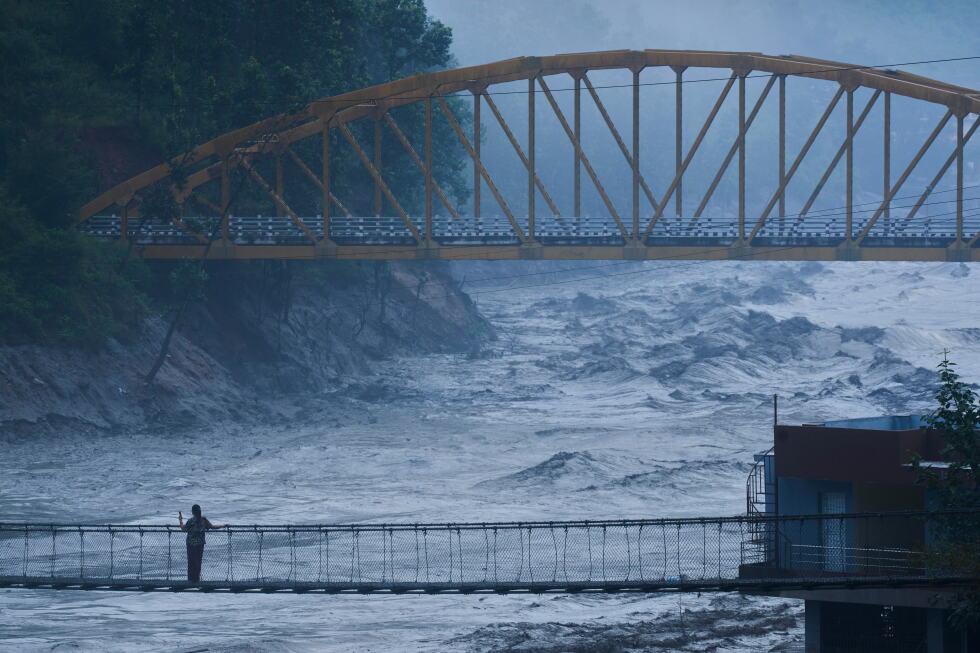
DHADING, Nepal – Fresh fears of additional catastrophic flooding are spreading across northern Nepal on Sunday, after disaster management authorities issued an urgent alert for at-risk communities following a sudden rise in water levels along the Bhotekoshi River. The warning comes days after catastrophic flash floods that have already claimed hundreds of lives and left thousands unaccounted for across the cross-border mountain region spanning Nepal and China’s Tibet Autonomous Region.
Throughout Sunday morning, emergency flood alert notifications were pushed to mobile phones across vulnerable districts, even as search and rescue teams worked to clear debris from the Prithivi Highway — Nepal’s critical transport artery that links the capital Kathmandu to the regions hardest hit by Wednesday’s disaster. In the riverside town of Galchhi, dozens of local residents have clustered on the elevated deck of a nearby bridge to escape low-lying flood zones, watching as churning, sediment-choked water roars past. Onlookers pointed to massive boulders tumbled downstream by the earlier flood surge, while safety officials blew warning whistles to clear people from a narrow suspension bridge spanning the swollen river, fearing it could be swept away.
The destructive power of the initial flood is visible along every stretch of the riverbank. Entire homes, passenger vehicles and farm tractors now jutt out from thick, grey-brown mud that has buried whole villages in the worst-affected zones. Terraced rice paddies that line the river have been damaged by landslides, with large sections of the fertile farmland collapsing into the rushing water. Multiple spans — large concrete bridges and small pedestrian suspension bridges alike — have been destroyed by the surge, cutting off isolated communities and trapping residents on both sides of the river.
As of Sunday’s latest official updates, the combined death toll across Nepal and Tibet has climbed to 750, with more than 3,000 people still reported missing. Nepal’s national disaster management agency confirmed 734 deaths in the country, alongside 2,498 unaccounted-for residents. On the Chinese side of the border, authorities have recorded 16 deaths and 546 missing people, a group that includes more than 100 Nepali citizens and travelers from more than a dozen other countries.
Dharam Raj Uprety, chief executive of Nepal’s National Disaster Risk Reduction and Management Authority, told the Associated Press that the new flood warning was issued after Chinese officials notified Nepalese authorities of increased water flow in the river’s upstream section. But for local residents in already affected communities, the steady stream of alerts has brought persistent disruption and exhaustion. Local resident Govind Shrestha described the relentless cycle of evacuations, saying that warnings often force families to flee to higher ground repeatedly, sometimes in the middle of the night amid ongoing rain.
“It’s really difficult for me. I have a 72-year-old father and 70-year-old mom. I must carry them and I am exhausted. It’s going on like this for those who are still alive,” Shrestha said. Sattan Singh Tamang, a 47-year-old worker who was near a local bridge when Wednesday’s flood hit, noted that the destroyed bridges have split communities, leaving families and neighbors trapped on opposite sides of the river. “Those that are there are now stuck there. Those who are here are stuck here. It’s going to be very difficult,” Tamang said.
The damage has also wiped out critical local infrastructure: buildings and businesses that survived the initial flood surge remain without power on Sunday, as downed power poles and tangled utility lines lie half-buried in flood sediment. While most of the Prithivi Highway, which carries all key supplies of food, fuel and other essential goods to Kathmandu from across the country, has been reopened for traffic, significant stretches still face major repair challenges, leaving supply chains at risk of disruption.
AP writers Aijaz Hussain in New Delhi and Shristi Kafle in Kathmandu contributed reporting to this article. The Associated Press’ climate and environmental coverage receives financial support from multiple private foundations, with AP retaining full editorial control over all content.