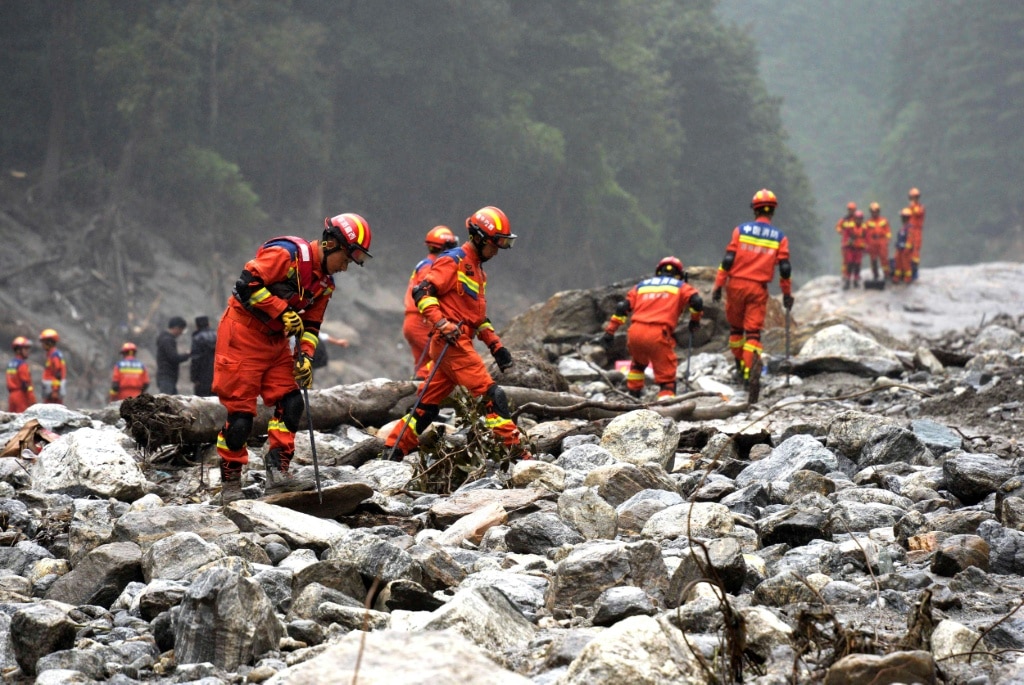
Rescue teams across Nepal and southern Tibet continued their life-or-death search operation Sunday, struggling through thick, sticky mud and the ever-present threat of new flood surges to locate victims of a catastrophic flash flood triggered by a glacial collapse that swallowed entire Himalayan villages earlier last week.
The latest joint death toll from both countries stands at 750 confirmed fatalities, with 3,044 people still unaccounted for as of Sunday. Reports indicate that some bodies may have been carried downstream by the powerful torrent as far as northern India, where local officials have already recovered seven bodies believed to be flood victims from transboundary rivers.
The disaster struck the remote China-Nepal border on Wednesday morning, when a massive glacial fracture sent a 10-story-high wall of mixed water, ice, and rock debris rushing downstream through mountain valleys, the U.S. Geological Survey confirmed. China’s official state news agency Xinhua clarified that the collapse originated on the southern slope of Nepal’s Lirung Peak, triggering an ice-rock avalanche that quickly morphed into a massive debris flow. The destructive surge traveled more than 20 kilometers before slamming into Gyirong Port, a key border crossing between China and Nepal, devastating communities and energy infrastructure along its path.
In Nepal, one of the most high-stakes rescue efforts is underway at the Trishuli 3A hydroelectric project, where multiple workers are believed to be trapped inside an under-construction tunnel. After days of digging, engineering teams managed to insert a pipe into the blocked passage, and rescuers have already begun pumping oxygen to potential survivors, Nepal’s Home Minister Sudan Gurung announced in an official statement. However, ongoing rainfall and swelling river levels have slowed progress, with national disaster authorities ordering all rescue teams to prioritize safety amid unstable conditions.
The region is a hub for large-scale hydropower development, and 933 of the missing in Nepal are workers at various energy infrastructure projects, according to official records. Among the unaccounted for are 589 foreign nationals, including trekkers and Hindu pilgrims traveling to Tibet’s sacred Mount Kailash. The Isha Foundation, an Indian spiritual organization led by guru Sadhguru, confirmed Saturday that 80 of its members were on a group trip in the affected area, and the organization said there were no hopeful signs of survival for the group near the border immigration checkpoint.
For survivors who escaped the initial flood, the aftermath has been devastating, with many left homeless and waiting anxiously for news of missing loved ones. “All the settlements near the river were swept away. There is nothing left,” said Buddhi Ram Dangol, a resident of Nepal’s Nuwakot district, speaking to AFP. At an army-run rescue coordination hub in Bidur, dozens of relatives gathered outside a base wall covered in lists of rescued survivors, scanning the pages for any trace of their family members. “I have come here looking for my son,” said Kalka Sharda, her voice thick with desperation.
The disaster has also sparked a global humanitarian response, with multiple countries and international organizations stepping forward to provide emergency aid. The U.S. and Canada have each committed $3.6 million in assistance to Nepal, while the UK has pledged $6.8 million. The UN has released $2.5 million in emergency funding, and the European Union promised $2.3 million Friday. The International Federation of Red Cross and Red Crescent Societies (IFRC) has allocated more than $1 million for immediate response and launched a global emergency appeal for $31 million to support long-term relief efforts.
Nepal’s already fragile economy, which has been under significant pressure in recent years, lacks the resources to handle a disaster of this scale. Nepali Foreign Minister Shisir Khanal estimated that the total reconstruction cost could reach “billions of dollars,” and he has made an urgent appeal for specialized international support. Key needs include heavy-lift drones and location technology to find trapped survivors, forensic testing kits to identify recovered bodies, and freezer units to store remains, as bodies submerged in warm river water decompose at an accelerated rate.
One ongoing secondary risk has complicated rescue operations on both sides of the border: the flood created massive natural dams of debris that formed new unstable lakes, one of which threatened to burst and trigger a second catastrophic flood. In Tibet’s hardest-hit Gyirong County, Chinese authorities temporarily paused rescue operations over the weekend due to this risk. But late Saturday, China’s state broadcaster CCTV reported that the lake had begun draining naturally and had been “essentially drained,” according to the country’s Ministry of Water Resources. More than 2,100 rescuers have been deployed to the Gyirong area, including over 500 working in the most devastated zones, Xinhua reported, and authorities have already evacuated 555 stranded tourists and 499 Chinese residents from affected areas.
As of Sunday, official data from Nepal puts the national death toll at 734, with 2,498 people still missing. Across the border in Tibet, 16 people have been confirmed dead and 546 remain unaccounted for, per Chinese official reports.
UN climate chief Simon Stiell called the disaster a devastating wake-up call for the international community. “The sudden glacial collapse and flash flood is a devastating reminder of how fragile these mountain environments can be,” he said in a statement, highlighting the growing risk of glacial disasters driven by global climate change in Himalayan regions.
Officials from both China and Nepal confirmed that the two countries’ foreign ministers held a telephone conversation Saturday to coordinate response efforts, agreeing to share real-time satellite imagery and hydrological data to monitor ongoing flood risks and support rescue operations.