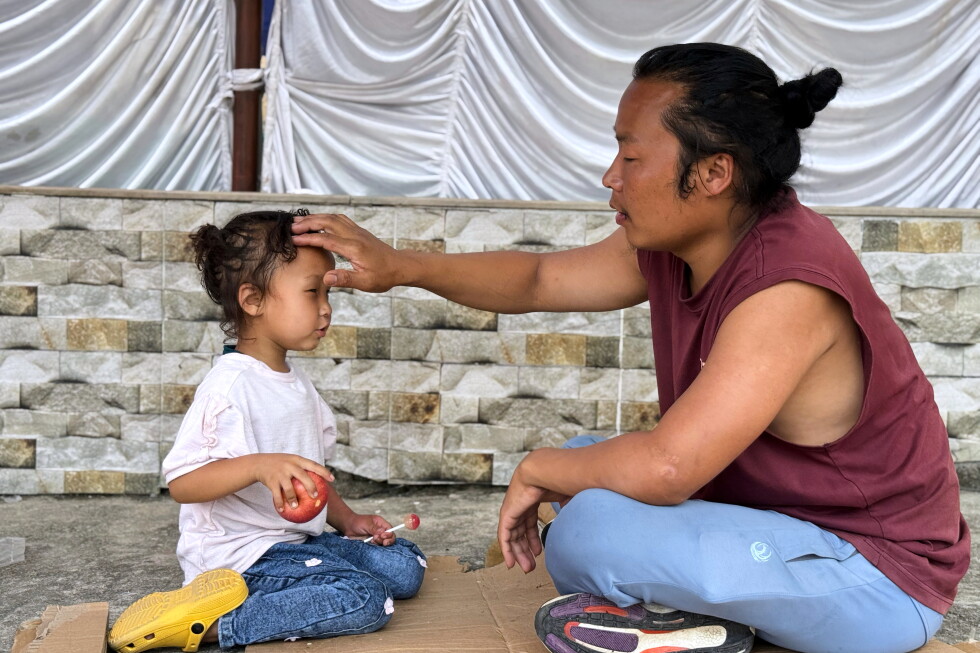
In a makeshift emergency shelter carved out of a Buddhist monastery in Kathmandu, Nepal’s capital, Tsering Gelbu Lama sits on the cold stone floor, brushing away unbidden tears. His 4-year-old daughter sits at his feet, unaware that her mother was swept to her death just days earlier when catastrophic floodwaters burst through mountain valleys along the Nepal-Tibet border. As he coaxes a spoonful of rice into the young girl’s mouth, his biggest fear reaches far beyond the loss of his wife and the home his family built on ancestral land: he has no idea how he will carry forward their centuries-old Indigenous cultural traditions to raise her in their faith and customs.
For Lama and hundreds of other flood survivors evacuated from remote Himalayan villages in Nepal’s northern Rasuwa district, the disaster has amplified a slow-burning crisis that was already eroding their community identities. Decades of outmigration of young people seeking education and work in Nepal’s cities have already weakened intergenerational transmission of local traditions. Now, the catastrophic floods have erased entire villages, swept away irreplaceable cultural heirlooms, destroyed restored religious sites, and killed dozens of community elders who carried oral knowledge of rituals, languages and customs — leaving displaced survivors questioning whether their unique way of life can survive at all.
“We’ve become homeless not only because we’ve lost our land — we’ve become homeless with our culture and tradition,” explained 36-year-old Tsering Sherpa, a Rasuwa native now staying at the Kathmandu monastery shelter, as he leaned against the stone steps of the building.
Nepal is one of the most ethnically diverse nations in South Asia, home to more than 120 distinct Indigenous and ethnic groups, many of which have preserved unique languages, ritual practices, and community festivals passed unchanged through hundreds of generations. Rasuwa district, tucked into the high Himalayan peaks along Nepal’s northern border with the Tibet Autonomous Region of China, is renowned for its tight-knit Indigenous Buddhist communities, whose unique cultural practices have even drawn international tourists to the region’s popular Tamang Heritage Trail, a trekking route that showcases local life and sacred traditions.
Survivors sheltering in Kathmandu still carry vivid memories of life before the floodwaters arrived. They describe villages nestled between steep forested hills teeming with bears, deer, and brightly colored butterflies, where rivers cut through lush green valleys. In shared photos and videos captured before the disaster, they show moments of daily cultural life: groups of women gathering to chop juniper for ritual incense, community members crafting new decorations for a local monastery that was being rebuilt, and men and women in vibrant handwoven traditional clothing dancing together during annual religious festivals.
“Now all of it is finished,” said 20-year-old Tenzin Dolma Ghale, a young survivor from Rasuwa.
When the floodwaters surged following heavy seasonal rains, residents described scrambling up steep hillsides to escape the rushing current, many finding temporary refuge in local monasteries that had only been rebuilt a year earlier — replacing structures that were completely destroyed in the devastating 2015 Gorkha earthquake that shook the Nepalese Himalayas. Most survivors had no time to grab belongings from their homes before evacuating; many were airlifted out by rescue helicopters with nothing more than the clothes on their backs. Others lost centuries-old family heirlooms that were meant to be passed down through generations, objects that carried both cultural and personal meaning for their communities.
The crisis of cultural preservation predates this year’s devastating floods, according to Alina Lama, a 26-year-old Rasuwa native who now volunteers at the Kathmandu shelter. For years, young people have left remote mountain villages for Nepal’s urban centers to access better education and job opportunities, drawn to the promise of more “modern” lives. This slow outmigration has already broken many intergenerational cultural ties: Alina Lama herself notes that she never learned many small, core details of her community’s traditions because she spent most of her young adulthood away from her village studying and working.
Now, the disaster has created an urgent new set of concerns, particularly for children who lost their parents in the floodwaters. “We don’t know who will teach them,” Alina Lama said.
International aid group Save the Children estimates that thousands of children across flood-affected regions are in need of urgent humanitarian assistance, though no official data has been released on how many children have been orphaned by the disaster.
For religious communities, the loss runs even deeper. With local Himalayan monasteries destroyed by floodwaters and many senior community monks — who carry specialized, localized knowledge of ritual practice — dead or displaced, key annual traditions are already at risk of disappearing. Tsering Sherpa points to the region’s important autumn Buddhist festivals, which for centuries have been held in local village monasteries, as an example of what the community stands to lose.
“We used to celebrate these festivals in our monasteries. Right now we don’t even have a monastery,” he said. “Culture and tradition are passed generation to generation by practice. If I can’t follow the tradition now, how can I pass it on to the next generation?”
This reporting on climate and environmental impacts on communities is supported by private philanthropic funding, with The Associated Press retaining full editorial control over all content.