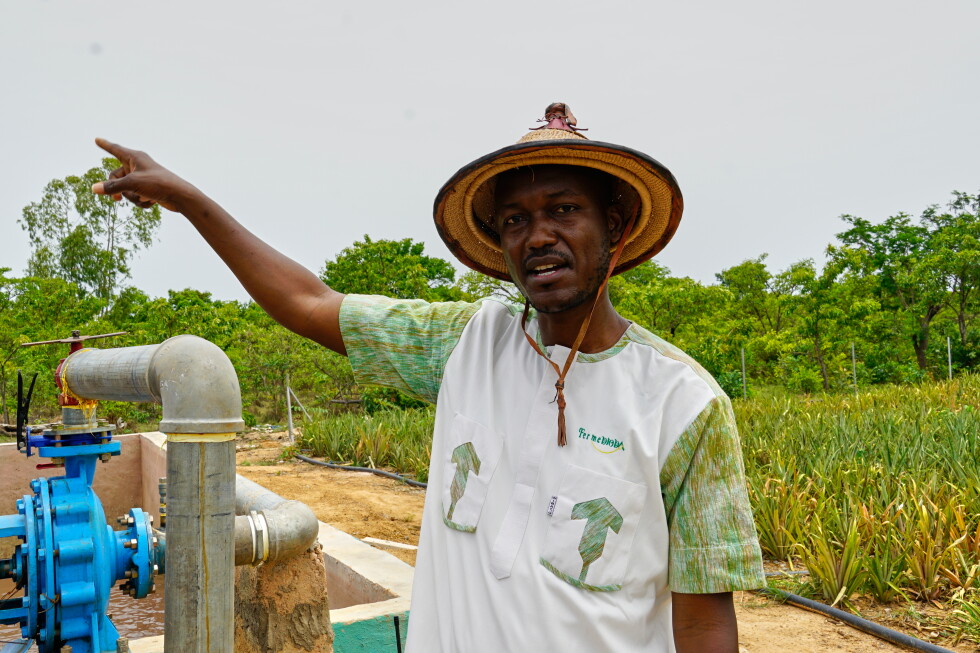
In the sun-scorched, sandy-stony plains outside Bobo-Dioulasso, western Burkina Faso, Oumarou Compaoré has defied long-held agricultural conventions to build one of the Sahel region’s first large-scale commercial pineapple operations – a project that has become a centerpiece of the landlocked West African nation’s growing push for food sovereignty amid climate volatility and economic instability.
For generations, conventional agricultural wisdom held that Burkina Faso’s dry, harsh Sahel climate could only support staple crops like cotton, maize and sorghum. Pineapples were widely seen as an exotic luxury import, grown exclusively by wealthier coastal neighboring countries and far out of reach for most local households compared to the ubiquitous mango that grows around many Burkinabe homes. But when border closures during the COVID-19 pandemic cut off supply chains and left fruit markets starved of stock, Compaoré – who had previously cultivated low-profit papayas – saw an opening. He launched his pineapple farm in 2018, branding himself the “Pioneer in pineapple production in the Sahel,” and the operation has since expanded to 50 hectares (124 acres) of productive farmland.
Compaoré’s unexpected success has captured the attention of Burkina Faso’s ruling military leadership, which has made expanding domestic agricultural production and cutting import dependence a core pillar of its national economic agenda under Captain Ibrahim Traoré, who took power in a 2022 coup. Traoré’s government has framed food production as a critical national sovereignty issue: it suspended rice imports in April 2024 to boost local output, inaugurated two domestic tomato paste factories that same year, and even launched a “buy local” campaign in major Ouagadougou supermarkets, where shelves dedicated to domestic goods – from shea butter and cassava flour to mango juice – bear the slogan “Let’s consume what we produce.”
These policy shifts come as Burkina Faso grapples with overlapping crises that have threatened food security for millions. Decades of reliance on imports have left the country vulnerable to global transport cost spikes and price shocks, while a 10-year long jihadi insurgency has seized control of large swathes of farmland, displaced hundreds of thousands of people, and disrupted market access. The United Nations estimates that 2.7 million Burkinabe face acute food insecurity during the annual lean season, when leftover harvest stocks run out and market prices hit their peak.
Against this backdrop, Compaoré’s pineapple initiative has inspired a growing wave of new farmers to enter the sector. While official national production data has not yet been published, regional agricultural director Adanabou Eric Pascal confirmed that total pineapple cultivation across the Houet administrative region – which includes Compaoré’s farm – had reached roughly 100 hectares (248 acres) as of November 2024. Kola Jean, an agricultural engineer who trains new growers at Compaoré’s farm, estimates more than 100 smallholder farmers have now launched their own pineapple operations.
One of those new entrants is Kaba Séré, a former nonprofit worker who switched to pineapple farming in 2023 after international aid cuts forced her out of her previous role. “We saw what Oumarou was doing and thought: It is possible, why not?” she said, after completing Compaoré’s cultivation training program. She has now expanded her operation to 60,000 seedlings, and says the profitable crop has allowed her to fully support her family. With pineapples still a relatively scarce commodity in local markets, growers report consistent demand, with many buyers purchasing fruit before it even reaches full maturity for harvest.
Still, the sector faces significant growing pains. Pineapples require up to two years to reach full harvest, and depend on consistent access to water and upfront investment in inputs like fertilizer, irrigation systems and reliable transport – costs many low-income smallholder farmers cannot cover. Compaoré relies on well water to irrigate part of his farm, but digging new wells is out of reach for most new producers. The Sahel’s increasingly harsh, hot and dry climate also creates growing challenges, though local agronomists have begun developing adaptation strategies, including evening irrigation with cool water to protect plants during extreme heat waves, according to Pascal Bazongo, a soil science professor at Burkina Faso’s University of Fada N’Gourma who advises Compaoré’s project.
Despite these hurdles, Compaoré remains optimistic about the future of domestic pineapple production. On recently acquired adjacent plots, 30 workers recently planted 60,000 new seedlings to expand his operation. He projects the new acreage will yield 60 to 75 metric tons of fruit, generating roughly $62,000 in revenue. Looking ahead, he says the potential for growth is far from exhausted: “We could even make the country self-sufficient in this fruit,” he said.