For nearly two and a half years, the full-scale Russian invasion of Ukraine has created a persistent, dangerous headache for one of its closest neighbors: Romania, an Eastern European member of both the European Union and NATO. Repeated incursions by stray drones originating from cross-border attacks on Ukraine have violated Romanian sovereignty, damaged property, and even injured civilians, forcing a long-controversial policy shift: Bucharest has formally approved shooting down unauthorized drones entering its airspace, and has already made good on this new strategy.
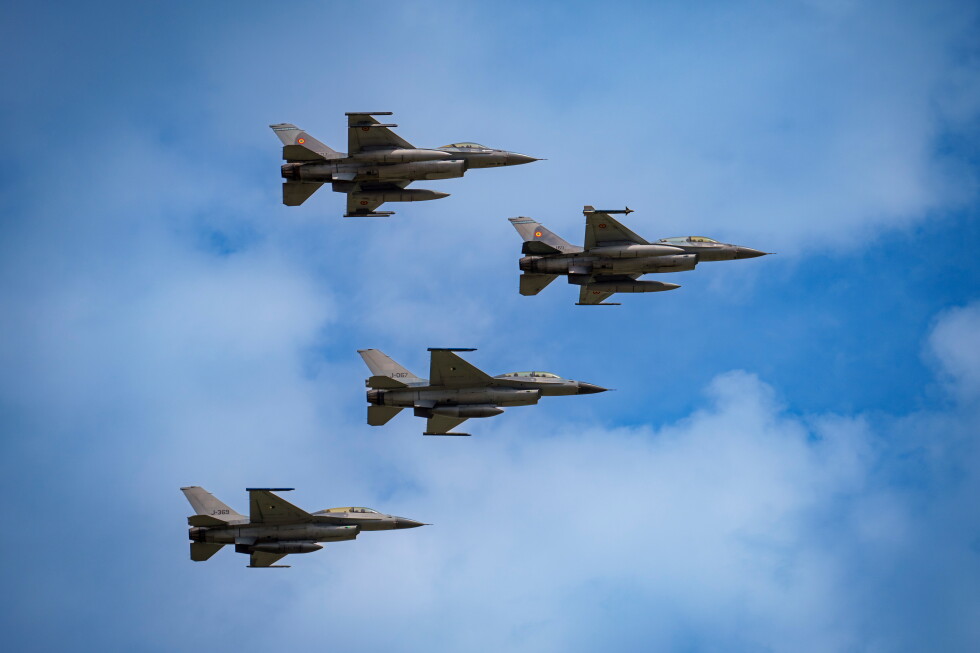
Starting last Friday, Romanian pilots flying F-16 fighter jets intercepted and shot down three unidentified drones in three consecutive days, as Russia ramped up missile and drone strikes on Ukrainian infrastructure near the shared border. After military forensics confirmed the downed aircraft were of Russian origin, Romanian officials took swift diplomatic action: on Monday, they summoned Russia’s ambassador to Bucharest to deliver a formal protest, and ordered one Russian diplomatic staff member expelled from the country, giving the individual five days to depart.
This marks a sharp break from Romania’s previous approach to drone incursions. For years after the full invasion began in February 2022, Romanian authorities responded to intrusions by scrambling jet fighters to intercept aircraft, collecting downed debris and fragments, constructing emergency fallout shelters along the border, and issuing repeated diplomatic reprimands to Moscow. Late last year, following a wave of incursions across NATO’s eastern flank, Romania and neighboring Poland jointly acquired the MEROPS counter-drone system, a short-range defensive tool designed to disable or destroy incoming stray unmanned aircraft. Even after passing legislation authorizing the military to shoot down incursive drones last year – a move that faced fierce opposition from nationalist domestic political parties – Bucharest held off on implementing the policy until recently.
Drones and drone fragments have crossed into the territory of multiple European Union nations since the war began, but the issue has been uniquely persistent for Romania. Official data from Romania’s Ministry of National Defense shows that at least 19 drones have violated Romanian airspace in 2024 alone, and a total of 50 confirmed incidents of drones or drone debris ending up on Romanian territory have been recorded since the war launched in February 2022. The most high-profile prior incident came in May 2024, when a stray drone crashed into an apartment block in the eastern Danube River port town of Galati, leaving a mother and her child injured.
Military analysts say that Galati incident acted as a critical psychological turning point for Romanian authorities. Speaking to reporters, Romanian military analyst Radu Tudor explained that the civilian injuries changed the government’s long-standing approach, adding, “This was somehow a kind of psychological trigger, in order to say: ‘OK, enough is enough.’” Tudor also noted that the policy shift likely reflects a broader change across NATO, rather than just a unilateral Romanian decision. “Until now, it probably was an Allied decision in NATO not to respond with firepower, because it was somehow a danger of escalation,” he said. “I think it’s not only a change of attitude of Romania, I think it’s a change of attitude in NATO.”
This is not the first time Romanian forces have shot down a stray drone in the region. Back in May, Romanian pilots, who rotate through deployments in Lithuania as part of NATO’s collective eastern flank defense capabilities, shot down a stray Ukrainian drone over Estonian airspace. That interception provided critical tactical experience that the Romanian military used to refine its procedures for downing incursive drones. “We recorded more than 100 attacks with drones near our border with Ukraine, and many of them resulted in debris or even drones that penetrated our airspace,” Cristian Popovici, head of public relations for the Romanian defense ministry and a former air defense officer, told the Associated Press. “Our pilots and our air force, we developed the tactics, procedures, and now we can face and we can eliminate this threat.” Popovici added that after the Estonian interception, the military applied the lessons learned, resulting in a 100 percent success rate for the three intercepts carried out last week.
Romanian President Nicusor Dan publicly praised the pilots following the interceptions, and firmly placed blame for the incursions on Moscow. “It is unacceptable and intolerable for the Russian Federation to continue violating Romanian airspace,” Dan said. To date, Romania has become the only NATO member on the eastern flank to shoot down four incursive drones: three on its own territory and one over Estonia. The tough stance from Bucharest aligns with a recent message from NATO Secretary-General Mark Rutte during the alliance’s summit in Ankara, Turkey earlier this month: “Don’t play with us.”
Moscow has rejected all accusations of responsibility for the incursions. In a statement posted to its official Facebook page, the Russian embassy in Bucharest denied the claims, saying Russia “has never directed and does not direct combat drones” to Romanian territory, and called the allegations “completely unfounded.” The embassy also warned that the unprovoked expulsion of a Russian diplomatic staff member “will not go unanswered.”
Despite its new hardline approach to stopping incursions, Romanian officials have emphasized that the country has no intention of being drawn directly into the ongoing Russia-Ukraine war. “We are in a peacetime, we are not involved in this fight,” Popovici said. “If Russia wants to escalate with NATO, it’s up to them. I’m not sure it’s a wise move now.”