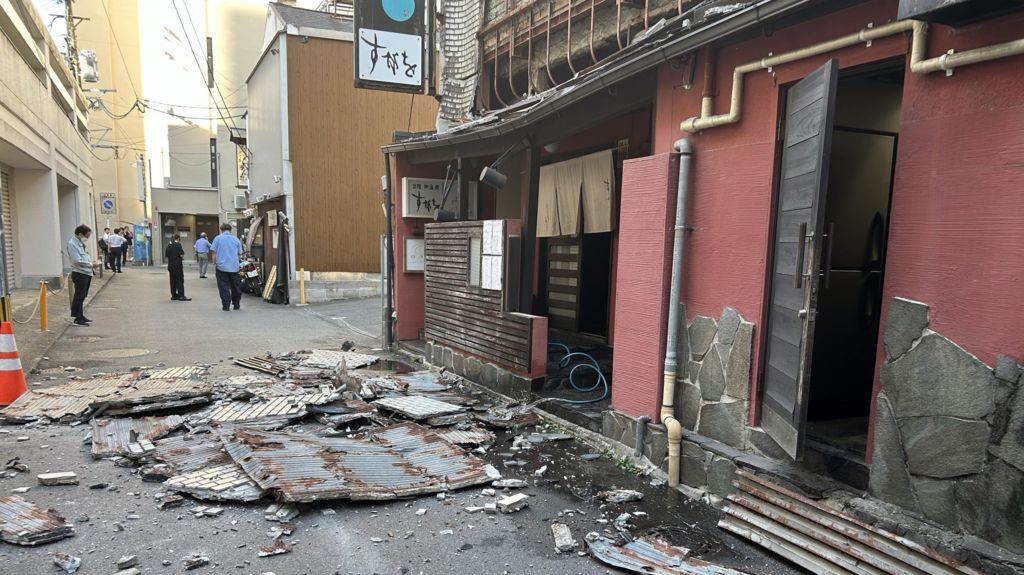
On a Tuesday afternoon local time, a powerful magnitude 7.1 earthquake jolted inland southwestern Japan’s Kumamoto City on Kyushu Island, triggering immediate emergency responses across the region. The seismic event hit at 16:27 local time (07:27 GMT), with a shallow epicenter just 10 kilometers below the Earth’s surface – a geological detail that has left national weather officials warning of potential strong aftershocks in the coming days.
Shortly after the quake struck, authorities issued a temporary tsunami advisory for coastal areas of the island, but the alert was fully lifted within an hour. Despite the quick end to the tsunami warning, damage has already been documented across the affected region: national public broadcaster NHK aired raw footage showing fractured road surfaces, damaged bridge infrastructure, and multiple active structure fires in populated areas.
As of the latest official updates, more than 150,000 residents have been ordered to relocate to designated emergency evacuation shelters. Dozens of people have been confirmed injured, with NHK reporting that 10 of those hurt are residents of a local elderly care facility, and at least 50 injured people are currently receiving inpatient care at regional hospitals. Prime Minister Sanae Takaichi confirmed that emergency teams are still conducting widespread damage assessments to tally the full scope of injuries and property destruction.
Critical public services have been disrupted across the hardest-hit zones: regional passenger rail services have suspended all operations, and power outages have cut electricity service to thousands of residential properties. Chief Cabinet Secretary Minoru Kihara announced that multiple first responder units have already been deployed to the region, including personnel from the Japan Self-Defense Force, national fire services, and the Japanese Coast Guard.
In a public statement, Kihara urged residents in high-severity shaking zones to remain vigilant. “We urge residents in areas where the shaking was particularly severe to pay close attention to evacuation information issued by local authorities via radio, television and the internet, and to act calmly,” he said.
Japan’s location along the geologically active Pacific Ring of Fire makes it one of the most earthquake-prone nations on the planet, with an average of 1,500 detectable seismic events recorded annually. This latest quake comes on the heels of recent seismic activity in the country: a magnitude 7.5 earthquake that struck northeastern Japan last December left 30 people injured, and the 2011 Great East Japan Earthquake – a magnitude 9 event off the country’s eastern coast – triggered a catastrophic tsunami that claimed more than 18,000 lives. Additional reporting for this story was provided by Chie Kobayashi in Tokyo.