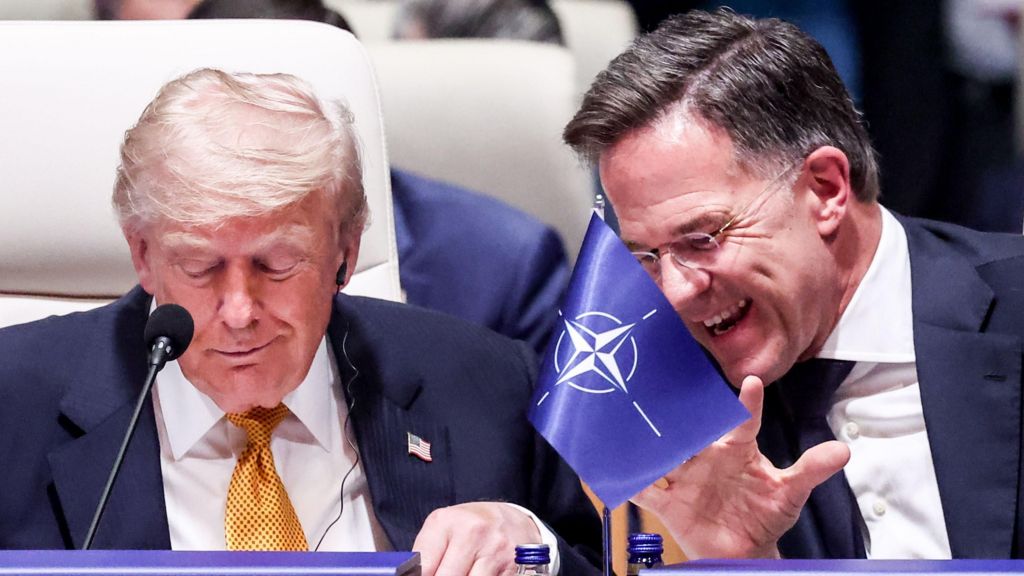
At NATO’s 2026 summit held in Ankara, alliance Secretary General Mark Rutte pushed back against growing public skepticism over the bloc’s unity, insisting in an exclusive interview with the BBC that the decades-old cornerstone of Western defense remains more robust and cohesive than ever.
Rutte’s upbeat assessment comes on the heels of a series of inflammatory and divisive comments from former U.S. President and current officeholder Donald Trump, who stirred controversy ahead of and during the summit. Most notably, Trump publicly expressed disappointment that NATO did not formally join his recent military campaign against Iran, despite the fact that the alliance was never consulted on the operation. Even so, multiple NATO member states including the United Kingdom granted U.S. forces access to their domestic military bases to launch strikes against Iranian missile infrastructure, enabling the large-scale operation to move forward.
Trump also reignited longstanding friction by repeating his unorthodox claim that the U.S. should take control of Greenland, and he publicly labeled Spain a “terrible partner” for the alliance. Still, the U.S. leader sought to soften tensions in his public remarks, noting that the Ankara summit had produced overall “unification” among leaders and claiming there was “tremendous love in that room.”
When asked to address the obvious disconnect between NATO leadership’s optimistic messaging and Trump’s polarizing public comments, Rutte — a seasoned former Dutch prime minister known for his diplomatic style — framed internal disagreements as a normal part of the alliance’s dynamic. “It’s a bit like in a family: you have families where you never quarrel, and then it bursts out completely,” he explained.
Despite past comments from Trump suggesting he would not rule out a full U.S. withdrawal from NATO, and his repeated claims that Washington has received poor returns on the trillions of dollars it has invested in the alliance, Rutte said he is 100% convinced of Trump’s commitment to NATO’s mission. He pointed directly to Trump’s recent Iran operation, codenamed Operation Epic Fury, as clear proof of the mutual benefits the U.S. gains from the alliance.
“[The operation] could not have taken place at this extent without using Europe as a power projection platform,” Rutte noted. He added that over 5,000 U.S. and coalition aircraft launched sorties from European bases over the six-week period between late February and mid-April, before a ceasefire with Iran took effect.
Beyond Middle East operations, Rutte highlighted NATO’s critical value for U.S. national security in the Arctic region. NATO’s Nordic members sit directly across from Russia’s large nuclear-armed submarine fleet based on the Arctic Kola Peninsula, giving the alliance an unrivaled early warning capability to protect the U.S. homeland. “You don’t want the Russian nuclear submarines to end up at the shores of the United States,” he said. “We prevent that as NATO collectively. So, for all these reasons, we are in this together, 32 countries and nations, because we need each other.”
Beyond addressing questions of unity and U.S. commitment, the core agenda of the 2026 Ankara summit focused on turning past pledges of increased defense spending into tangible action. The alliance’s top priority is scaling up European defense industrial capacity to counter the massive arsenal of drones, cruise missiles, and ballistic missiles fielded by Russia.
While some member states, including the United Kingdom, have not yet outlined a clear roadmap to reach the target of spending 3% of national GDP on defense by 2030, Rutte struck an optimistic note on progress made since NATO’s last summit, held in his home city of The Hague in 2025. He reported that European and Canadian members have already added a quarter of a trillion dollars in cumulative defense spending over the past two years, a figure he called “staggering.”
“Today we took stock… So we are delivering, and now we have to ramp up the defence industrial production even further, making progress and maintaining support for Ukraine,” he said.
When asked whether NATO would be prepared to fend off a potential Russian territorial incursion into a Baltic ally like Estonia by 2030, a scenario some analysts have warned about, Rutte expressed unshakable confidence. “Absolutely we’ll be ready. Now we’re ready, in 2030 we are ready, at any moment,” he said. “We are defensive. We will never attack another country, but every adversary knows that if they will try to attack us, we are ready. We will defend ourselves.”