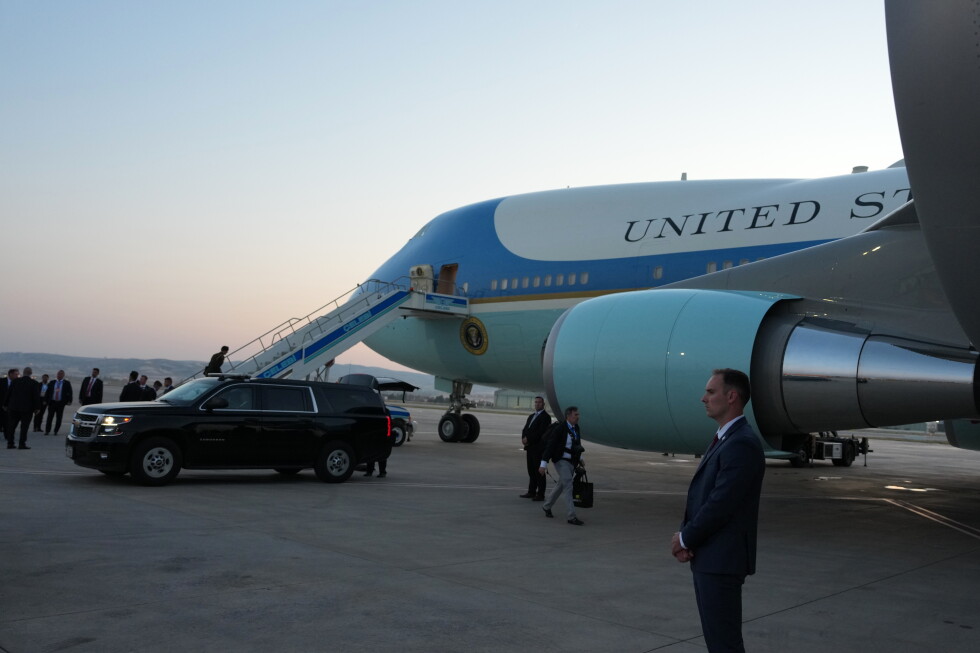
In an unanticipated shift that has sparked new debate over presidential travel security, former President Donald Trump departed a NATO summit in Turkey on a decades-old legacy Air Force One jet instead of the newly retrofitted Boeing 747-800 he had flown into the event on. The sudden change of aircraft unfolded against a backdrop of renewed armed escalation between the United States and Iran, just hours after U.S. forces launched large-scale retaliatory strikes against Iranian targets in response to recent attacks on regional commercial shipping.
Trump first broke news of the swap in a social media post, explaining that the gleaming new jet — gifted to the U.S. by Qatar and upgraded at a cost of $400 million — would make an unscheduled stop at Royal Air Force Mildenhall, a U.S. military facility in the United Kingdom, to allow service members to tour the aircraft. He said he would take the older Boeing VC-25A, a plane that has carried U.S. presidents for more than 35 years, back to Washington. When pressed by reporters on whether security concerns driven by rising Iran tensions prompted the switch, Trump declined to give a direct answer, only noting he was “No. 1 on the list for killing” for Iran, and framing the switch as a choice to fly the older jet “for old time’s sake.”
Independent observers and public records have long raised flags about gaps in the Qatari-gifted jet’s defensive capabilities. Photos published since the aircraft’s unveiling confirm it lacks some of the advanced missile detection and countermeasure systems that come standard on the older VC-25A fleet. The U.S. Air Force, which manages the presidential aircraft fleet, previously acknowledged that the Qatari jet — classified as an interim “bridge” aircraft meant to cover delays to the permanent Air Force One replacement program — had key complex engineering modifications intentionally excluded to speed up its entry into service. While the Air Force has repeatedly insisted no compromises were made to presidential security, it deferred all questions about the last-minute swap to the White House.
White House spokesperson Steven Cheung defended the new jet’s security protocols in an official statement, calling it a cutting-edge aircraft outfitted with top-tier safety systems to protect the president and his team. Cheung also acknowledged the administration’s use of tactical misdirection to counter threats, noting: “As the President has said recently, there are many enemies of America who have their sights on him, and we use every tool at our disposal — including distraction and misdirection — to address those threats.”
Further fueling security speculation, flight tracking data showed the transponder on the legacy jet carrying Trump was disabled shortly after takeoff from Turkey, a step typically reserved for travel to high-risk regions rather than scheduled summits hosted by NATO allies. All other world leaders’ aircraft departing the summit, including those from Germany and the United Kingdom, left with fully visible transponders. The new Qatari-gifted jet departed Turkey several hours ahead of Trump’s plane and landed without incident at RAF Mildenhall later Wednesday.
Geopolitical context adds weight to security concerns: Iran’s military arsenal includes drones and ballistic missiles with a range capable of reaching Turkey from Iran’s borders — a distance of roughly 800 miles. However, Washington-based think tank the Center for Strategic and International Studies confirms Iran does not currently possess weaponry with the range and accuracy to strike the United Kingdom, where the new jet was headed.
Jeremiah Gertler, senior aviation and defense analyst at industry consulting firm Teal Group, told the Associated Press that the gaps in defensive systems and a reduced number of communications antennas on the interim jet suggest it is only suited for domestic U.S. travel. The permanent replacement program for the aging Cold War-era VC-25A fleet — originally built to withstand nuclear blast effects and equipped with features including an onboard operating room and air-to-air refueling capabilities — has been plagued by delays, with the new permanent aircraft not expected to enter service until 2028. Trump’s flight to North Dakota last week marked the first time he had flown the new Qatari-gifted jet.