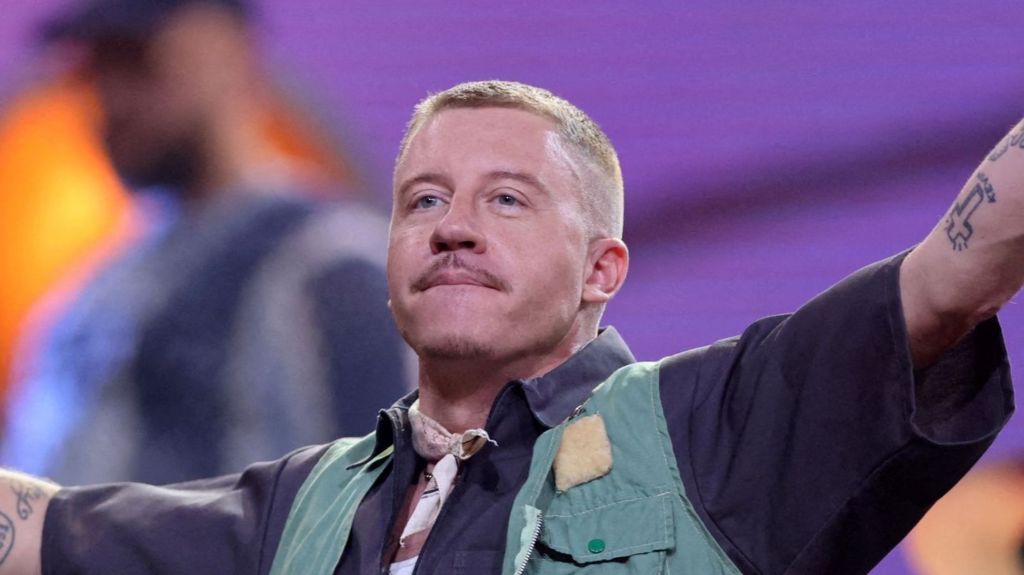
A major controversy has roiled the live music industry after prominent American rapper Macklemore, born Benjamin Haggerty, was removed from his opening act slot on Ed Sheeran’s North American *+–=÷× (Mathematics) Tour* (branded the Loop Tour by sources) following public pro-Palestinian remarks he made during two opening sets earlier this month. The fallout has pulled in other high-profile artists and reignited fierce global debates over artistic expression, political speech in entertainment venues, and the conflation of anti-Israel criticism with antisemitism.
Macklemore, a longstanding public advocate for Palestinian rights, first made his remarks during a September 4 stop at New Jersey’s MetLife Stadium, where he addressed the packed crowd alongside headliner Sheeran. “A big part of the reason why I wanted to do this tour in the first place is so that I could stand up in stadiums like this and say two words that are very, very dear to my heart: Free Palestine,” he told attendees. He followed the statement with a performance of his track *Hind’s Hall*, a song that condemns Israeli military operations in Gaza, paired with on-screen video footage of widespread destruction in the besieged enclave.
The performance immediately drew fierce backlash from pro-Israel advocacy groups. New York-based campaign organization StopAntisemitism accused the rapper of ambushing unsuspecting fans, arguing that attendees had purchased tickets to see Sheeran perform, not be subjected to what the group called “anti-Israel propaganda.” Undeterred, Macklemore doubled down on his remarks during the following night’s show at the same venue, directly addressing Jewish audience members: “Criticism of Israel, criticism of apartheid, being against genocide, is in no way a criticism of you,” he said, adding that he wanted to ensure Palestinians in Gaza and the occupied West Bank knew they had not been forgotten by the global public.
The dispute unfolds against the backdrop of the ongoing 11-month conflict between Israel and Hamas, which began after a Hamas-led cross-border attack on southern Israel on October 7, 2023 that killed approximately 1,200 people and took 251 hostages. Israel launched a large-scale military campaign in Gaza in response, and Gaza’s Hamas-run Ministry of Health, whose casualty figures are widely deemed reliable by the United Nations, reports that more than 73,780 Palestinians have been killed in the operation to date. Israel rejects accusations of genocide, stating its military actions are carried out in self-defense and in compliance with international law.
As pressure mounted, the Israeli-American Council launched a public petition urging Sheeran to remove Macklemore from the tour lineup, arguing that a commercial headlining concert was not an appropriate venue for political activism, and accusing the rapper of spreading “biased messaging and disputed claims.” In a lengthy, nearly 1,000-word statement posted to Instagram September 15, Macklemore confirmed he had been cut from the tour after a week of what he called “difficult conversations” with his long-time friend Sheeran that ended in “a place of fundamental disagreement.”
Tour promoter Messina Touring Group told *Rolling Stone* that the decision came after multiple venues on the tour stated they would not allow Macklemore to take the stage, a refusal that would have forced full tour cancellations and disrupted plans for hundreds of thousands of ticket holders. Macklemore, who noted he and Sheeran have been close friends for 13 years, said he empathizes with the difficult position the headliner was placed in, but criticized Sheeran for declining to take a public stance on the issue.
“Taking a side can cost you. Money, brand deals, sponsorships, festivals, private shows, relationships and access. I’ve lost all of those things. But there is no neutral position between the oppressor and the oppressed,” he wrote in his statement. Addressing repeated accusations of antisemitism leveled against him, Macklemore argued that bad-faith accusations of antisemitism have become a tool to silence criticism of Israeli policy. “When criticizing Israel, opposing Zionism or saying ‘Free Palestine’ gets conflated with hatred of Jewish people, it doesn’t protect Jewish people. It protects Israel from accountability,” he added. Despite his early removal, Macklemore framed the brief two-show run as a success: “If my words succeeded in turning the conversation back to Palestine, then it was the most successful tour I’ve ever been on.”
The controversy has since expanded to draw in another Grammy-winning artist: American singer Pink, who is Jewish, faced widespread online backlash after she reposted content criticizing Macklemore’s actions. Critics attacked Pink across a range of personal and professional issues, from her parenting choices to decades-old comments about fellow female pop stars Paris Hilton, Britney Spears, and Christina Aguilera. Pink later released a public statement clarifying her position, noting she does not speak on behalf of the Israeli government or any other state. She argued that Macklemore had no right to dismiss Jewish fans’ discomfort with his on-stage political messaging, which included graphic footage of war violence displayed to a crowd of casual concertgoers: “You don’t get to decide that for us,” she wrote. Pink also referenced a past controversy involving Macklemore, when in 2014 he apologized for wearing a costume featuring a large hooked nose and black beard, an outfit widely condemned as an antisemitic caricature. Sheeran has not yet issued any public comment on the situation, and it remains unclear which artist will replace Macklemore for the remaining dates of the tour.