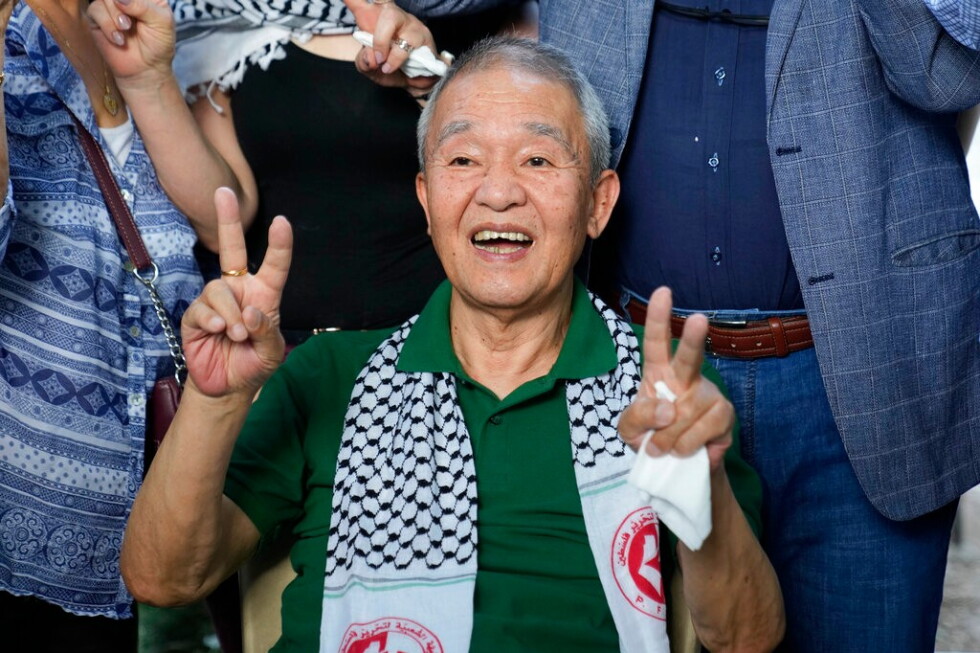
BEIRUT — Kozo Okamoto, the Japanese radical militant who participated in one of the deadliest attacks targeting Israeli civilians more than 50 years ago, has died at the age of 78 in the Lebanese capital Beirut, according to an official announcement from the Popular Front for the Liberation of Palestine (PFLP), the Palestinian faction that hosted and protected Okamoto for decades. The PFLP, the second-largest faction within the Palestine Liberation Organization (PLO), confirmed that Okamoto passed away on Thursday following a long undisclosed illness.
After his release from Israeli custody, Okamoto settled permanently in Lebanon, where he lived under the protection of Palestinian leftist groups and made only a handful of public appearances over nearly 40 years. Within PFLP circles, he was known by the alias Ahmad al-Yabani, meaning Ahmad the Japanese. In a formal statement released after his death, the PFLP praised Okamoto’s decades-long commitment to the Palestinian cause, framing his life as one defined by sacrifice for anti-Israel struggle. “His journey was marked by immense sacrifices spanning decades on the battlefields of struggle in support of the Palestinian cause,” the group said, adding that Okamoto “never compromised nor faltered but remained steadfast to his principles.”
Okamoto’s legacy is inextricably tied to the 1972 attack on Tel Aviv’s former international airport, a coordinated joint operation between the PFLP and the Japanese Red Army (JRA), a violent ultra-leftist guerrilla group founded in 1971. On May 30, 1972, Okamoto and two JRA comrades flew to Tel Aviv from a European departure point, retrieved their luggage packed with hidden rifles and grenades, and opened fire on crowds in the airport terminal. The assault left 26 people dead and dozens more injured. Okamoto’s two collaborators were killed during the response to the attack, while Okamoto was wounded and taken into Israeli custody.
Convicted of multiple counts of murder and sentenced to life in Israeli prison, Okamoto served only 12 years of his sentence before being released in 1985 during a large-scale prisoner exchange between Israel and Palestinian guerrilla factions. Following his release, he was granted political asylum in Lebanon, where he remained until his death. Over the course of his decades in Lebanon, Tokyo repeatedly demanded that Lebanese authorities extradite Okamoto to Japan to face justice, but Beirut consistently rejected these requests, as Okamoto had become a celebrated figure among many Lebanese and across the Arab world for his alignment with the Palestinian struggle against Israel.
Okamoto’s life in Lebanon was not without legal incident. In 1997, Lebanese security forces arrested Okamoto and four other Japanese citizens who had been living illegally in the country, sheltered by Palestinian and leftist Lebanese groups during the chaos of the 1975-1990 Lebanese Civil War. After a high-profile trial, the four other Japanese detainees were transferred to Japanese authorities in 2000, while Okamoto became the first person ever to receive formal political asylum status from the Lebanese government. During his 1997 trial, Okamoto famously testified that he identified as “an Arab resistance fighter.”
The most high-profile public appearance Okamoto made during his time in Lebanon came in May 2022, when he attended a commemoration event at a Beirut cemetery — the resting place of many prominent Palestinian militants — to mark the 50th anniversary of the 1972 airport attack.
Beyond the 1972 airport attack, the JRA claimed responsibility for multiple high-profile terrorist attacks across the globe during the 1970s, including the 1975 seizure of the U.S. Consulate in Kuala Lumpur, Malaysia. The PFLP, for its part, is a radical Palestinian faction that first gained global notoriety for the 1970 simultaneous hijacking of four Western civilian airliners, and later for the 1976 hijacking of an Air France flight traveling from Tel Aviv to Paris that was diverted to Entebbe, Uganda. Today, PFLP leader Ahmed Saadat remains one of the most prominent Palestinian figures held in Israeli custody; he was imprisoned for his alleged role in organizing the 2001 assassination of Israeli Tourism Minister Rehavam Zeevi, an ultranationalist politician who openly advocated for the mass expulsion of Palestinians from Israeli-controlled territory.