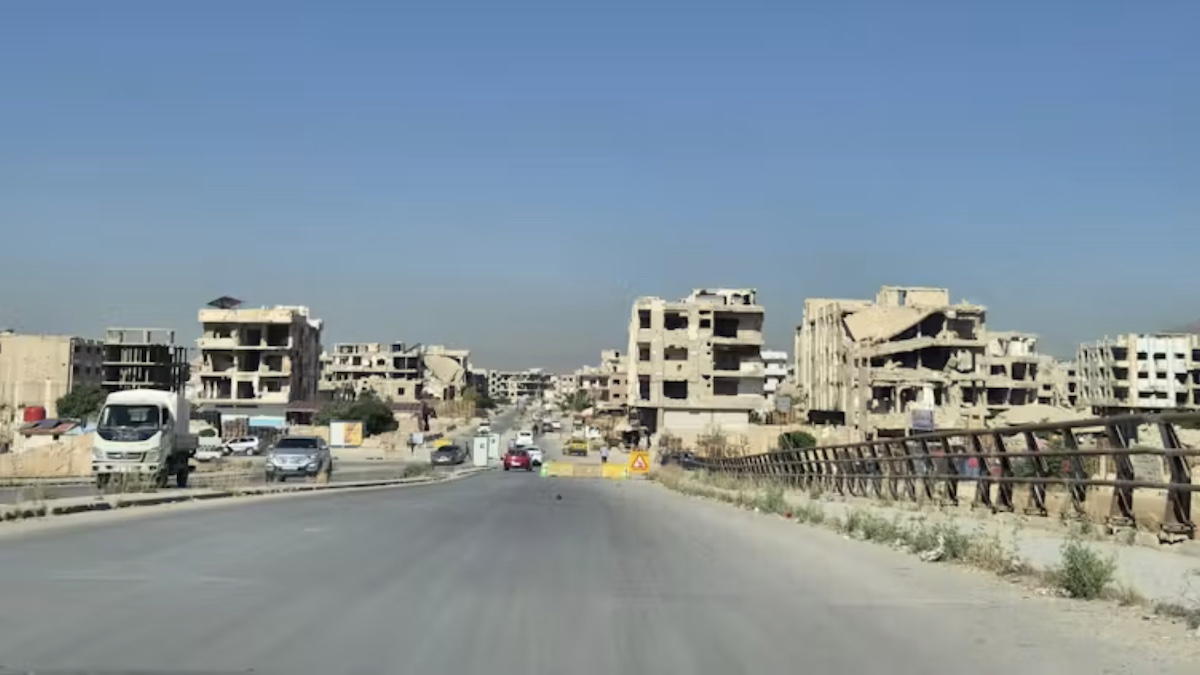
It began with an unplanned detour at a wedding in Hama, but what three peace and conflict researchers discovered during their week-long 2026 field trip across Syria would upend distant, secondhand narratives of a country still reeling from more than a decade of war. Between June 1 and 7, 2026, Bahadir Dincer, Bahar Baser, and Zeynep Sahin-Mencütek became the first independent researchers to travel freely across government-held areas of Syria following the collapse of the Assad regime, documenting the messy, uneven coexistence of destruction and recovery that rarely makes global headlines.
The team’s journey started on a warm June morning in Damascus, where they set out to visit four key regions: Rural Damascus, Aleppo, Raqqa, and Hama. Before leaving the capital, they took a short detour through the war-scarred districts of Jobar and Yarmouk. Jobar, once one of the capital’s fiercest frontlines between 2013 and 2018, remains almost entirely reduced to rubble. A young local activist who had recently returned home put it simply: “Even though Jobar has always been part of Damascus, it was forgotten during the war and remained forgotten afterwards.” While returning residents clear rubble and patch damaged structures on their own, most long-term Damascenes have never set foot in the district since the regime fell, leaving recovery fragmented and incomplete.
Yarmouk, once Syria’s largest Palestinian refugee camp, paints an equally stark picture. The researchers encountered an elderly couple sitting on plastic chairs outside one of the only partially repaired homes, surrounded by crumbling ruins. The scene encapsulated a core contradiction of post-war Syrian life: life has returned to devastated areas, but for most residents, that means learning to live alongside wreckage rather than rebuilding beyond it. Even in Eastern Ghouta, where entire neighborhoods still bear the marks of intense fighting, small signs of daily life emerge: a bread shop opens beside a collapsed apartment block, children play on potholed streets that once saw active combat, and families ride together on a single motorcycle through former frontlines. Recovery, it turns out, often moves far faster than formal reconstruction.
As the team traveled north along the M5 highway toward Aleppo, the road itself told a story of shifting fortunes. Abandoned factories and depopulated villages lined the route, constant reminders of the war’s enduring legacy, but new signs of normalcy appeared just as frequently: roadside fruit vendors, newly reopened roadside cafes, and even newly imported SUVs – a sight that would have been unthinkable on Syrian roads just a year earlier, their driver noted. Outside Hama, they stopped at a fully stocked roadside supermarket, where local hospitality offered a quiet reminder that cultural traditions and daily routines persist even amid chaos.
Arriving in Aleppo, a city the researchers had only studied through news reports and refugee testimonies for more than a decade, they encountered a city divided between restoration and ruin. Parts of the historic Old City’s famous souk have been restored, drawing visitors back to its narrow stone streets, but large swathes of the Old City and working-class districts like Shaar and Hanano remain piled with rubble. Local guide Amr explained that returning residents have cleared blocked streets themselves, without formal government support, just to access the remains of their homes. Yet as evening fell, the city came alive: cafes buzzed with conversation, crowded restaurants hosted family dinners, and pedestrians filled the streets to escape the summer heat. Aleppo is neither fully frozen in conflict nor fully rebuilt – it exists in the in-between, where destruction and daily joy coexist.
The next morning, the team set out on the long drive east to Raqqa, a route their driver Ahmed had not traveled in more than 15 years. For Ahmed, who grew up in Raqqa before displacement forced him to resettle in Damascus, the drive was as much a journey of personal rediscovery as it was research: a weathered roadside wall unlocked childhood memories of playing with his brothers, and a shuttered abandoned cement factory reminded him of the familiar landmarks that structured life before the war. When they crossed the Euphrates into Raqqa, rolling green fields replaced the arid plains west of the river, offering a brief moment of calm after a bumpy drive over cratered highway.
Raqqa carries a unique weight of trauma: after decades of neglect under the Assad regime, it became a hub of anti-regime protest, then the de facto capital of the Islamic State, then a region under separate Kurdish-led SDF administration until just months before the researchers’ visit. The cumulative effect of overlapping conflicts leaves the city and its residents visibly exhausted. Yet even here, small signs of connection and renewal emerge. During Friday prayers at a packed city mosque, the imam announced a national collection for flood-affected communities in Deir ez-Zor – a small act that carried enormous weight after years of fragmented governance and divided communities. Two local sisters who had recently returned to Raqqa shared their story of family separation: one had returned from Turkey to resume teaching, another from Jordan, while the rest of their large family remains scattered across Turkey, Germany, and other parts of Syria. “The others have scattered like leaves in the wind,” one sister said. “But we wait, hoping they will come home again.”
On the drive back to western Syria, the team encountered one of the most widely celebrated changes of the post-Assad era: freedom of movement. Where the road once was dotted with checkpoints that could delay travelers for hours, now convoys of commercial trucks move freely between regions, and even foreign researchers passed through checkpoints without delay. “Five months ago, I would have been stopped at ten checkpoints to get here,” a young 20-something shopkeeper who had recently returned from Turkey told the team. “Economically, life may have been easier then. But we had no freedom of movement. Now I can travel without anyone stopping me.” For Syrians across every region the team visited, this simple right to move unimpeded was described as a quiet revolution: “the road has become a road again,” multiple residents said.
For most Syrians, the post-Assad era is described as liberation – a shift that is felt not in abstract political speeches, but in small daily changes: working traffic lights, police officers managing intersections, the ability to speak openly without fear. This quiet hope is not just spoken, but acted on. In Aleppo, the team visited a former Baath Party youth center that has been transformed into a community education and support center for returnees, run by Syrians who gave up stable lives abroad to come home. “My country is trying to stand up again,” Esma, a teacher who returned from Turkey, told the team. “People here need us. If not now, when will we contribute?” In Raqqa, families gather for picnics along the banks of the Euphrates, young boys swim in the river, and local operators run sightseeing boat trips – ordinary activities that carry profound meaning, as people reclaim public spaces once defined by war.
Yet for every sign of hope, the researchers encountered constant reminders of the immense challenges that remain. More than 90% of Syrians live below the poverty line, 16.5 million require humanitarian aid, and the World Bank estimates total reconstruction costs will exceed $200 billion. As of mid-2025, the UN’s humanitarian response plan had received only 14% of its required funding, leaving basic infrastructure like water, electricity, and sanitation networks non-functional across large parts of the country. Nearly a quarter of all housing stock is damaged or destroyed, more than two million children remain out of school, and millions of acres of farmland are still littered with landmines and unexploded ordnance that kill civilians every week.
Experiences of recovery are deeply uneven too: wealthy Damascus neighborhoods like Abu Rummaneh boast crowded cafes and full restaurants, while just kilometers away, entire districts like Jobar remain abandoned. The return of displaced Syrians, many of whom settle in Damascus before returning to their hometowns, has put additional pressure on already strained housing, services, and food prices. The researchers heard firsthand from returnees navigating these barriers: a local research assistant who returned from Turkey cannot afford an apartment and lives in a room at the youth center where he works, and a university-educated taxi driver who returned from Idlib five years earlier relies on a constantly breaking old taxi for his only steady income. Returning home, it turns out, is only the first step toward rebuilding a life.
For policy debates in Europe that frame post-Assad Syria as ready for large-scale refugee returns, the researchers’ findings offer a sobering correction. The real question facing Syria today is not whether Syrians want to return – most do – but whether conditions exist for them to stay permanently. With widespread unemployment, severe housing shortages, and fragile public services, many returnees simply exchange one form of uncertainty for another. Rapid large-scale returns would overwhelm Syria’s already strained institutions and economy, leaving communities worse off. As one Damascus resident put it, “returnees will drown Syria” – not because they are unwelcome, but because the country is not yet able to absorb them.
The team’s journey ended where it began, with that wedding in Hama. As guests filled the church courtyard, traditional Ewiha wedding chants echoed through the building, punctuated by the joyful high-pitched ululation of zalghouta that has marked Arab celebrations for generations. On the surface, it was an ordinary wedding. But for the researchers, it was the most powerful reminder of what they had learned across 7 days of travel: Syrians are not just rebuilding buildings and infrastructure. They are rebuilding ordinary life, holding onto cultural traditions and social bonds even when the odds are stacked against them. Hope and hardship coexist, the team found – and so do recovery and ruin. This is the unspoken reality of Syria today.
This article is based on a two-year research project including more than 200 interviews with Syrian returnees, displaced people, officials, and humanitarian workers, republished with permission from The Conversation.