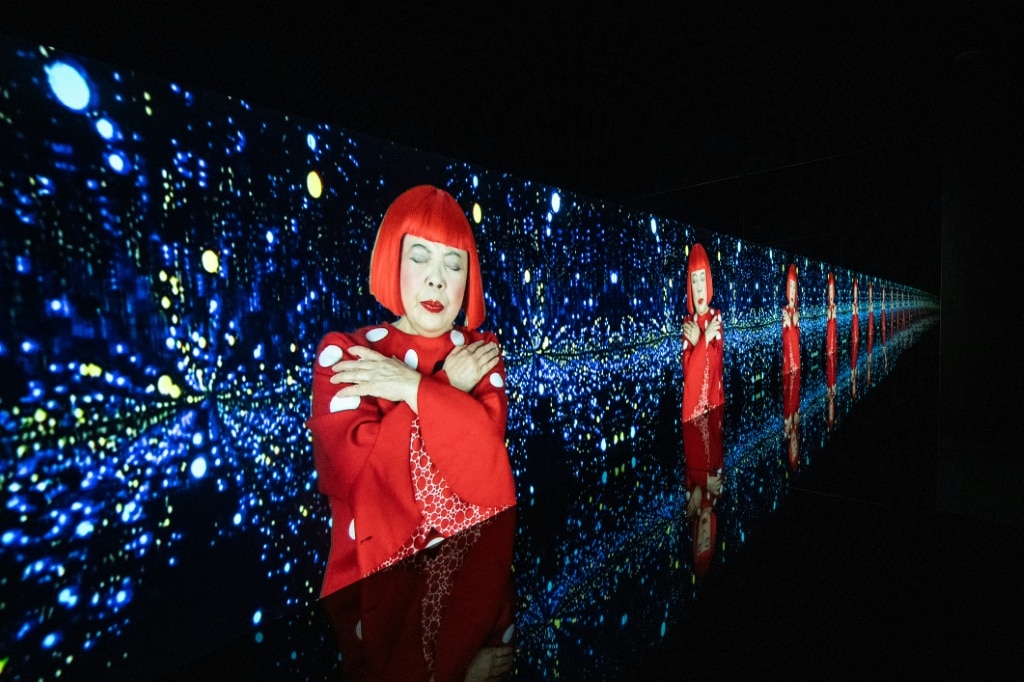
Yayoi Kusama, the globally revered Japanese avant-garde artist universally known as the ‘Polka Dot Queen’, has passed away at the age of 97, her official institution confirmed in a public statement on August 27, 2026. The pioneering creative, who died on August 14 at a Tokyo hospital, leaves behind a seven-decade legacy of boundary-pushing work that transformed contemporary art, shaped by her unique relationship with mental health and a distinct visual language defined by polka dots, net patterns and infinite, immersive motifs.
Born in 1929 into a wealthy Japanese family, Kusama began nurturing her iconic artistic style as young as 10, rooted in the vivid visions and hallucinations that shaped her childhood perspective. In her autobiography, she recalled an early transformative experience: after noticing a red floral pattern on a tablecloth, the pattern appeared to spread across every surface of the room, from ceilings to pillars, even covering her own body. This epiphany laid the foundation for the repetitive, proliferating motifs that would become her lifelong signature.
After completing art studies in her home country, Kusama relocated to the United States in the late 1950s, where she quickly carved out a space in New York City’s exploding 1960s avant-garde movement. As a Japanese woman working in a predominantly white, male creative scene, she faced systemic discrimination, but her large-scale bold canvases and provocative, experimental ‘happenings’—which combined body painting, public performance and her trademark polka dots—earned her rapid notoriety and a devoted cult following. Beyond fine art, Kusama expanded her practice into multiple domains: she launched a commercial fashion line, founded the conceptual ‘Church of Self-Obliteration’, and even officiated a same-sex wedding under her self-styled title as the ‘High Priestess of Polka Dots’, cementing her reputation as a radical cultural trailblazer.
Kusama returned to Japan in the 1970s, where she voluntarily admitted herself to a Tokyo psychiatric hospital to manage her long-standing mental health challenges. For the remaining decades of her life, she continued to create art daily from her base at the facility, rarely stepping away from her practice. Her official statement noted that she kept painting until her final days, never putting down her brush, and remained committed to exploring her core artistic themes of infinite love and the eternal soul throughout her entire life.
In the decades following her return to Japan, Kusama’s work grew into a global cultural phenomenon. Her iconic large-scale pumpkin sculptures—including the legendary installation on Japan’s Naoshima ‘art island’, her immersive ‘Infinity Rooms’ that play with perception and endless repetition, and other interactive installations drew record-breaking crowds at museums around the world, with major works selling for millions of dollars at auction. She developed a instantly recognizable public persona, often seen in public wearing her signature bright red wig and bold, polka-dotted clothing, turning her own image into an extension of her artistic brand.
Her artistic philosophy, which she termed ‘self-obliteration’, centered on the idea that repeating simple motifs allows the individual self to dissolve into a larger, interconnected whole, a concept deeply rooted in her lifelong experience of hallucinatory visions. News of her death triggered an outpouring of tributes from fans and admirers across the globe. One Japanese user on the social platform X wrote, ‘I’ve had the privilege of viewing her paintings and your works several times. Bold, delicate, beautiful. That world was one I had never known. And to me, she was also someone truly endearing. May you rest in peace.’