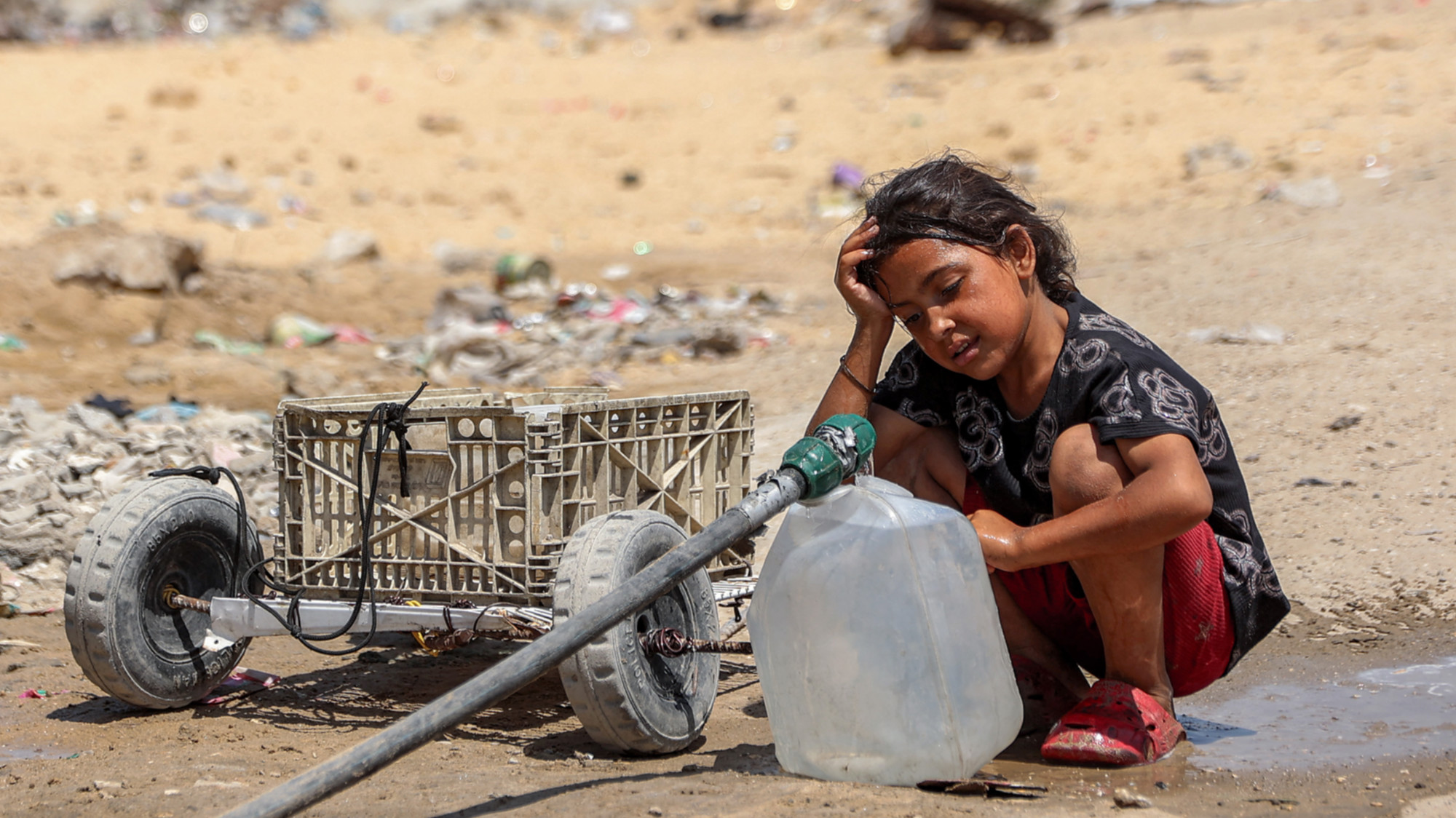
GAZA CITY — For hundreds of thousands of displaced Palestinians in Gaza, the shift from a brutal, unforgiving winter to the enclave’s Mediterranean summer has not brought relief. Instead, it has layered a new set of deadly hardships onto lives already upended by Israeli military action, displacement, and a collapsing humanitarian infrastructure.
When Middle East Eye first spoke to Rajaa Jendiya, a 47-year-old Palestinian widow and mother of three, in January, she described that winter as the harshest she had endured during her nearly two years of displacement. Today, with winter rains long gone, the flimsy tent that failed to shield her family from frigid cold has become a sweltering trap under the unrelenting Gaza summer sun.
“It is exactly like being locked inside a greenhouse,” Jendiya explained from the makeshift camp set up in a central Gaza City school, where she resettled after Israeli bombing destroyed her home in eastern Gaza’s Shujaiya neighborhood. “The tent traps all the sun’s rays and cranks up the heat. The temperature and humidity get so extreme that it feels like you’re suffocating — I have to leave just to catch my breath.”
Jendiya’s loss is one shared by countless families across Gaza: her husband was killed by Israeli forces in March 2024 during one of the so-called “flour massacres” that took place amid Israel’s siege and intentional starvation of northern Gaza. She is among 1.9 million displaced Gazans out of the enclave’s total 2.1 million population, according to UNICEF, the vast majority of whom rely on makeshift tents and overcrowded converted public buildings for shelter.
For these families, summer brings cascading crises that build on the instability they already face. Beyond the stifling heat, invasive disease-carrying insects have made rest nearly impossible, Jendiya says.
“All night long, mosquitoes keep us up, and as soon as the sun comes up, flies take over,” she said. “We cannot sleep at night or during the day, and the heat has brought new kinds of insects we have never seen before in our lives.”
Gaza’s geographic location along the Mediterranean Sea creates naturally hot, humid summers, with average temperatures ranging between 30°C and 32°C, and heatwaves regularly pushing readings above 35°C. For displaced Gazans living in overcrowded camps with little access to basic services, these conditions have sparked a public health emergency that disproportionately harms children.
Raw sewage often overflows around camp sites, and rotting garbage piles up in open areas, conditions that worsen dramatically as temperatures climb. Jendiya says she makes regular trips to local hospitals with her children, who have repeatedly contracted heat- and sanitation-linked illnesses, including widespread skin conditions that have spread across displacement camps. Health workers across Gaza have documented soaring rates of scabies, fungal infections, rashes, and lice, with children most severely affected.
Mona al-Mallahi, a 47-year-old displaced woman who pitched her tent on a narrow traffic island opposite Gaza’s al-Azhar University, echoes Jendiya’s account of unrelenting hardship. “There is no escape from the heat,” she told Middle East Eye. “During the day, we cannot stay inside the tent because it is unbearably hot, but outside there is no shade to protect us from the blazing sun. We spend every day searching for a way to breathe.”
Israel’s military offensive has destroyed more than 81 percent of all residential buildings across Gaza, flattening much of the Strip’s urban landscape and cutting down trees that once lined streets and public spaces. That has left tent-dwelling displaced residents fully exposed to the scorching summer sun, with no reprieve. Even after the October ceasefire came into effect, Israel continues to restrict the entry of emergency shelter materials and life-saving humanitarian relief, deepening the shelter crisis that leaves millions vulnerable.
Compounding the heat crisis is the near-total collapse of Gaza’s water infrastructure. More than 80 percent of the enclave’s water, sanitation, and hygiene systems have been damaged or destroyed, meaning running water for cooling and cleaning is a distant luxury for most displaced people.
“We are drenched in sweat from the moment we wake up until we go to sleep,” al-Mallahi said. “I would need to shower at least five times a day just to cope with the heat, but that is completely impossible. We barely have enough water for the most basic drinking and cooking needs, let alone to cool ourselves down.”
Most displaced residents collect bathing water from public taps at nearby schools or abandoned sites, while drinking water requires waiting in line for hours at charity-run water distribution trucks. The unrelenting sun has also left permanent visible marks on al-Mallahi, who lost her home in Gaza City’s Zeitoun neighborhood just days before the October ceasefire, and lost her son and grandchildren in an Israeli airstrike that hit the building where they took refuge.
“At noon, it feels like hell here. The heat burns our skin. Look at my face — I was not like this before. My skin was light and clear, but now it gets darker every day, and new spots are appearing from the constant sun and heat,” she said. “I used to hear about the suffering of people living in tents and pray God would help them, but I never imagined how much they endure until I lived this myself.”
Even for Gazans who still retain what is left of their homes, conditions offer little relief from the summer heat. Emad al-Sirsawi, a father of six who lives in a damaged apartment in Gaza City’s southwestern Tal al-Hawa neighborhood, says the only advantage of having a home is a ceiling to block direct sun — everything else remains just as desperate.
“We don’t have air conditioners or even fans. Even if some of us owned these before the war, we can’t use them because there is no public electricity, and we can’t afford the electricity sold by private generators,” he explained.
Since Israel launched its full military offensive on Gaza in October 2023, fuel shortages and the destruction of most of the enclave’s electricity infrastructure have left Gaza almost entirely without reliable power. Even after the ceasefire, Gaza’s electricity authority has not been able to restore even partial consistent power for residents. Private generator operators sell limited electricity at exorbitant prices, with one kilowatt-hour costing roughly 35 Israeli shekels ($11.5), meaning most residents can only use this costly power for essentials like lighting and charging mobile phones.
The lack of power also means refrigeration is out of reach for most families. “Whatever food we have spoils by the end of the day, so we lose large amounts of what little we have,” al-Sirsawi said. “We are forced to cook every day, but we do not have cooking gas, so we have to rely on firewood even in this extreme heat.”
Al-Sirsawi summed up the shared reality for all Gazans caught in the ongoing crisis: “No one can find comfort in Gaza, neither in summer nor in winter.”