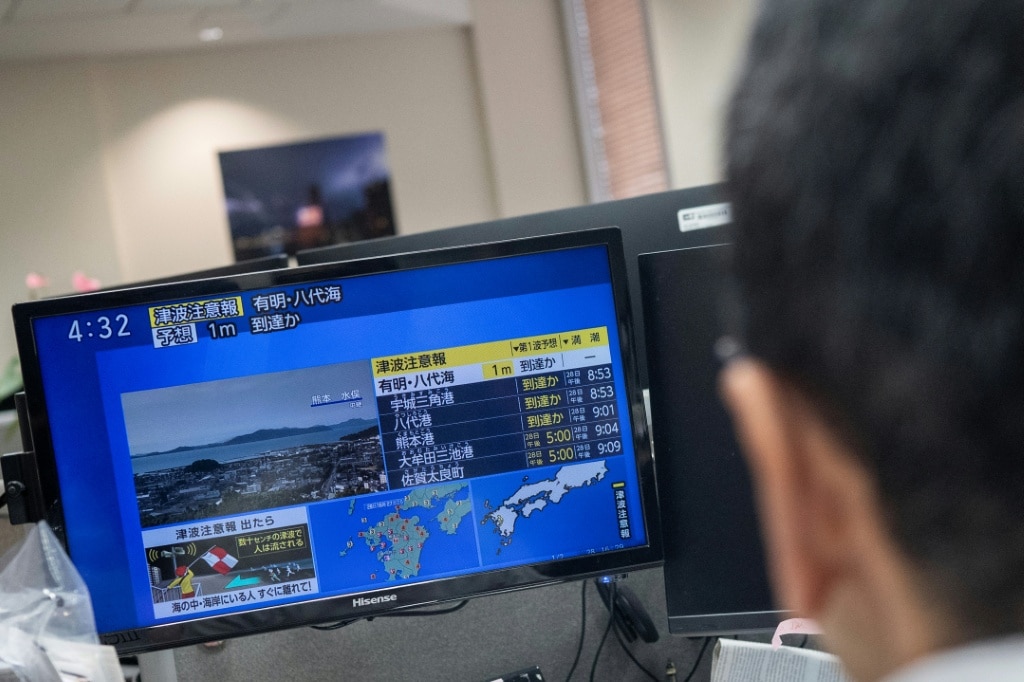
On Tuesday, a powerful 7.1-magnitude earthquake (measured at 6.8 by the U.S. Geological Survey) jolted southwestern Japan’s Kumamoto region on Kyushu Island, triggering widespread structural damage, multiple fires, and widespread disruption across the area. The tremor, which hit at 4:27 pm local time (0727 GMT), registered a maximum 7 on Japan’s intensity-based Shindo scale, and was followed within an hour by a 6.1-magnitude aftershock, with continued smaller jolts reported in the hours after the main quake.
Early rescue operations are focused on a collapsed shopping mall in the town of Kashima, where the structure’s second floor caved in during the tremor and sparked a subsequent blaze. Emergency responders initially confirmed that many people were trapped inside the building, with public broadcaster NHK reporting that between 20 and 30 mall employees remain unaccounted for as of Tuesday evening. While private broadcaster TBS has suggested a considerable number of fatalities may be inside the mall, national police have not yet confirmed any deaths at that site. One fatality has been confirmed from a separate residential building collapse elsewhere in the region, per Kyodo News, and more than 100 people have been reported injured across the affected area.
Additional missing persons have been reported at a factory in Yatsushiro city, where the top of a facility chimney crumbled during the quake. Footage captured by NHK shows widespread destruction across the region: multiple active wildfires, damaged highway bridges, a derailed cargo train, and dozens of residential properties left teetering on the edge of collapse. Unverified social media footage also shows partial damage to the outer walls of Kumamoto Castle, a historic landmark centuries old.
Witnesses described widespread panic as the quake struck. Chiharu Hara, a 35-year-old recruitment agent working in Kumamoto, told Agence France-Presse that the violent side-to-side shaking left her convinced her office would collapse. “Everyone panicked,” she said. A live on-air report from an NHK staffer based in the region half an hour after the main tremor noted that aftershocks continued to rock the area, making it nearly impossible to stand in the newsroom.
Emergency response efforts have been mobilized rapidly. Japanese Prime Minister Sanae Takaichi confirmed via social platform X that casualties, building collapses, road damage, and fires have all been verified, alongside widespread water and electricity outages. The country’s defense ministry has deployed 3,600 Self-Defense Force personnel to lead search and rescue operations, with 20 aircraft dispatched to conduct aerial damage assessments. A initial tsunami alert issued by the Japan Meteorological Agency was lifted just under two hours after the quake.
Local health facilities have been overwhelmed by the influx of injured patients. NHK reports that two area hospitals alone have admitted at least 50 injured people each, with patients arriving for treatment for burns, crush injuries, and fractures. Hospital staff told the broadcaster that the facilities themselves have sustained damage, including broken water lines and electrical failures. Around 10 additional injuries were reported at a local elderly nursing home. As of Tuesday evening, approximately 45,000 households and public facilities across Kumamoto remain without power, according to regional utility Kyushu Electric Power.
Officials have confirmed that there is no abnormal activity at the region’s nuclear power facilities, with three operating reactors continuing to function normally following the quake. Major transportation links were disrupted in the immediate aftermath: all high-speed shinkansen services through the region were suspended, and Kumamoto Airport was closed to air traffic for several hours before reopening Tuesday evening.
The earthquake hits a region already marked by seismic disaster memory: Kumamoto was the site of two devastating quakes in 2016, a 6.5-magnitude tremor followed two days later by a 7.3-magnitude event that killed 273 people and injured more than 2,800. Japan is one of the world’s most seismically active nations, positioned at the intersection of four major tectonic plates along the Pacific Ocean’s “Ring of Fire.” The country sees roughly 18 percent of the world’s earthquakes annually, with hundreds of minor jolts recorded each year. Major quakes remain a persistent national risk, most notably the 2011 9.0-magnitude undersea quake that triggered a deadly tsunami, killing over 18,500 people and causing the catastrophic meltdown of the Fukushima Daiichi Nuclear Power Plant.