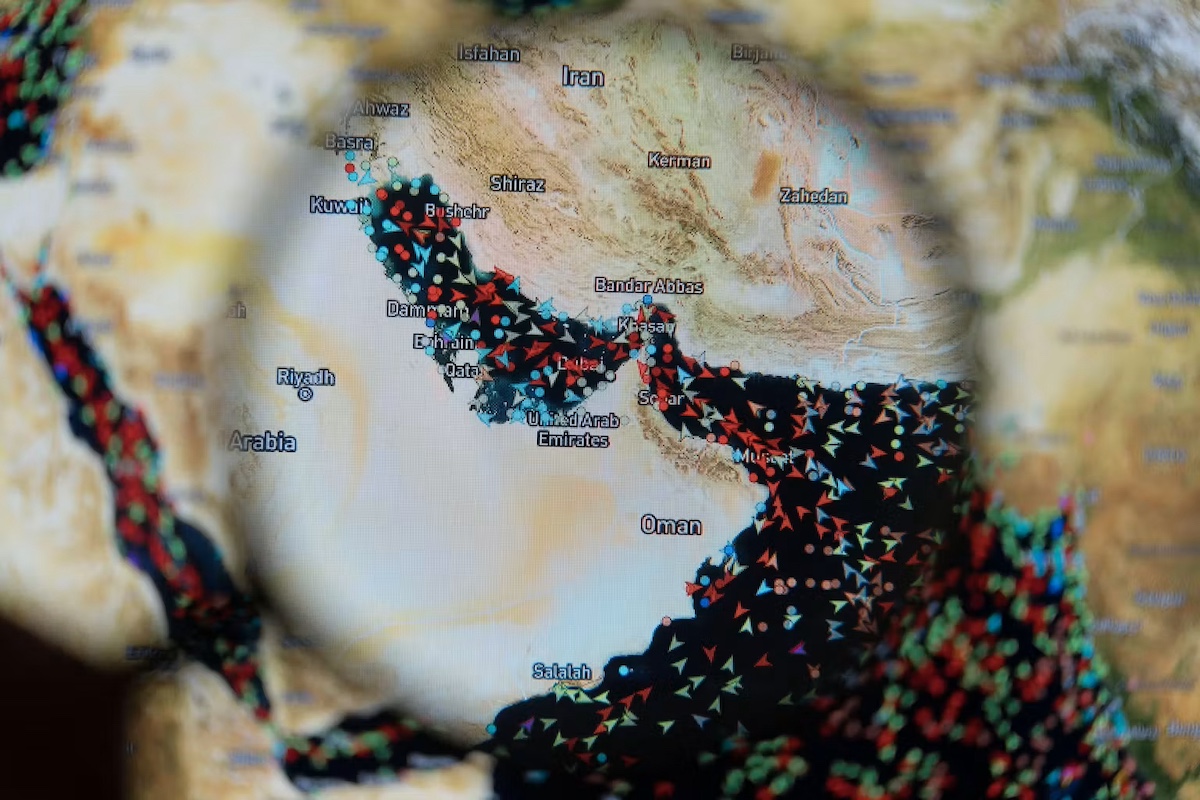
Tensions between the United States and Iran have settled into a dangerous stalemate in the Persian Gulf, with escalating tit-for-tat threats to maritime traffic that have now spread to a little-discussed but globally critical piece of infrastructure: the region’s network of undersea communications cables.
The long-running standoff has already reshaped activity in the Gulf: the U.S. Navy enforces a blockade blocking commercial vessels from entering or exiting Iranian ports, while Tehran has responded by threatening the freedom of navigation for all shipping passing through the Strait of Hormuz, the strategic chokepoint through which roughly a fifth of global oil supplies transit daily. Most recently, Iran has announced plans to establish a new restricted military zone extending from the Strait of Hormuz into the Gulf proper, though concrete details of the zone’s boundaries and rules remain undisclosed.
What has flown largely under the public radar, however, is the sprawling web of undersea fiber-optic cables crisscrossing the Gulf that connect the Middle East to the rest of the global digital economy. On August 16, the Wall Street Journal reported that Iranian authorities are actively considering targeted strikes against this critical undersea infrastructure (CUI). In the Gulf’s shallow waters, this threat is not a hypothetical risk—it is a credible danger that threatens Gulf economies and reverberates across the entire globe.
These largely unseen cables form the backbone of the world’s connected economy, carrying more than 95% of all international data traffic. Their function far outpaces basic consumer internet access and phone calls: they underpin trillions of dollars in daily global financial transactions, secure government communications, and support the data-heavy operations of the global technology sector. As demand for artificial intelligence has skyrocketed in recent years, tech giants including Google, Amazon, Meta and Microsoft have poured billions of dollars into expanding subsea cable networks to connect their sprawling global data center ecosystems, making these infrastructure assets more strategically important than ever.
For Gulf Cooperation Council states, this threat hits particularly close to home. Many of these nations have committed hundreds of billions of dollars to developing domestic AI sectors as part of sweeping plans to diversify their economies away from reliance on fossil fuel exports. Disruption to the Gulf’s undersea cables would not just interrupt internet service—it would directly undermine a core pillar of their long-term economic transformation goals.
Four major cable networks currently route traffic through the Persian Gulf and Strait of Hormuz, making the region an irreplaceable global digital chokepoint. These include the Fibre in Gulf system, which connects Bahrain, Iraq, Kuwait, Oman, Qatar, Saudi Arabia and the United Arab Emirates; the Falcon Network, which links 12 nations across the Middle East, South Asia and North Africa; the Asia-Africa-Europe1 (AEE1) network, which connects Southeast Asia to Europe via Gulf landing points in Oman, Qatar, Saudi Arabia and the UAE; and Gulf Bridge International, which connects eight regional states and extends onward to India and Europe. What was once purely a strategic chokepoint for oil and gas trade has now taken on new importance as a bottleneck for global digital connectivity.
Two unique geographic and operational factors make the Gulf’s CUI uniquely vulnerable to attack. First, the entire region has extremely shallow waters: the Persian Gulf has an average depth of just 50 meters, with a maximum depth of less than 100 meters. This means attacking the cables does not require the advanced deep-sea capabilities maintained by specialized state units like Russia’s Main Directorate of Deep Sea Research (GUGI), the Kremlin’s underwater sabotage and espionage force.
Off-the-shelf, commercially available technology common to the region’s massive oil and gas industry can easily be repurposed for offensive operations. Remotely operated vehicles (ROVs) capable of operating at thousands of meters below sea level are widespread in the offshore energy sector, and the number of similarly capable autonomous underwater vehicles (AUVs) operating in the region has grown dramatically in recent years. Iran has already publicly unveiled its own domestically built mine-clearing ROV, and defense analysts assume it holds additional unpublicized underwater capabilities. The shallow depth also means the entire cable network is well within the operating range of conventional military divers. Even less sophisticated tactics, such as a commercial ship “accidentally” dragging its anchor across a cable route—an incident that has already occurred in the Baltic Sea—could cause major outages.
The feasibility of an attack is not in question, and the threat has already had tangible consequences. Multiple planned new cable projects and expansion projects have been put on indefinite hold, after project owners and contractors concluded they cannot safely carry out installation work in the current high-risk environment. This disruption to infrastructure investment already highlights how geopolitical tension is reshaping the development of the global digital network.
John Aitken, a senior research fellow at RAND Europe and the author of the analysis, notes that Iran has almost certainly mapped the entire regional cable network and trained specialized teams to access the cables, which lie well within diver operating depths across most of the Gulf. Beyond publicly acknowledged ROVs for mine clearance, Iran’s mature offshore oil industry gives it access to a wide range of underwater assets that can be adapted for offensive operations.
The core open question remains: how far is Iran willing to go? A widespread attack on the regional cable network would cause massive disruptions to trade and digital communications across the Middle East, with immediate spillover effects for the global economy. If Tehran sought to avoid sweeping global condemnation, any attack would likely be limited and targeted. But given Iran’s increasing economic and diplomatic isolation, analysts say the regime may judge the risk acceptable to achieve its strategic goals.
This uncertainty around potential Iranian action has sparked new discussion about the need for updated deterrence frameworks for undersea infrastructure, a domain that has largely been overlooked in traditional security planning. Aitken argues the threat represents an extension of the Nixon administration’s “madman theory” of nuclear deterrence: a politically and economically isolated state may be willing to carry out extreme action in the CUI domain—action that rational observers would deem disproportionate to the stakes—to deter more conventional military attacks against its territory.
This development should not come as a surprise. Just as roads, bridges and railways became standard military targets in 20th century conflicts to disrupt an opponent’s war-fighting capacity, undersea cables are the critical infrastructure of the digital age, and they have now become a strategic target for nations in conflict.
While Iran’s exact intent to carry out attacks on the Gulf’s CUI remains unconfirmed, that very ambiguity is already reshaping investment and security planning across the region, with consequences that will be felt for global digital connectivity for years to come.