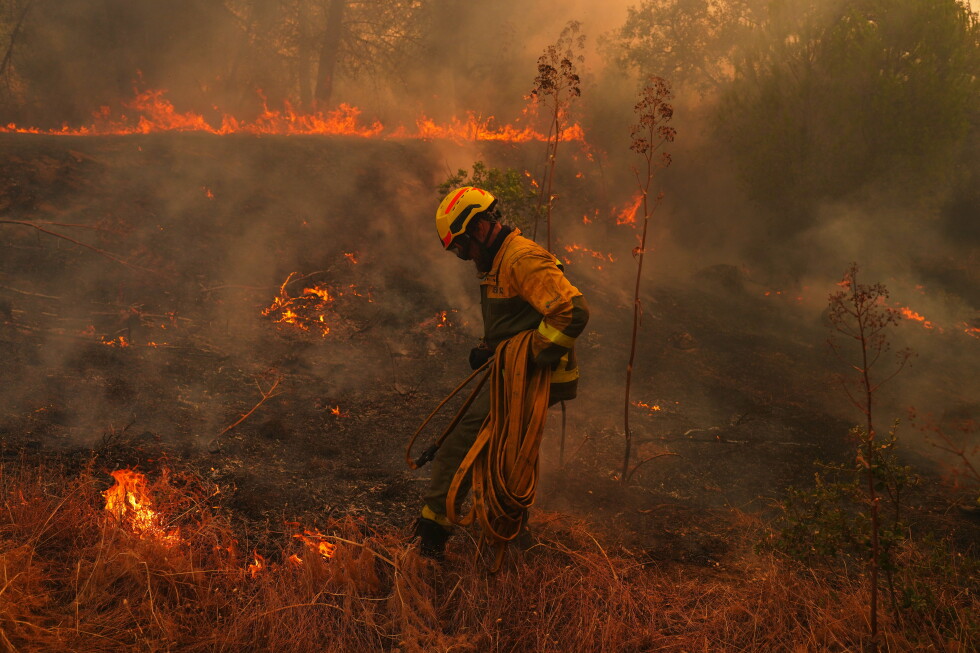
As out-of-control wildfires continue to scorch vast swathes of Spain and France this week, two independent scientific studies released Thursday deliver a clear, data-backed conclusion: human-caused climate change has directly amplified the extreme fire-conducive weather driving these catastrophic blazes, and has drastically raised wildfire risk across Southern Europe over the past eight years.
The first analysis, from international scientific collaborative World Weather Attribution (WWA), found that anthropogenic climate change made the record-breaking extreme inferno conditions in Spain 20 times more likely to occur, while doubling the odds of dangerous fire weather for the ongoing blazes in France. Looking at a longer 26-year warming trend, the report notes extreme fire risk probability has tripled in Spain and risen by 40% in France. WWA conducted its rapid assessment while fires were still actively spreading across the Iberian Peninsula and southwestern France, meaning the work has not yet completed formal peer review — the traditional gold standard for scientific publication. But WWA lead researcher Friederike Otto, a climate scientist at Imperial College London, emphasized the team uses widely accepted methodological approaches, and many of the group’s rapid analyses are later peer-reviewed and published in major academic journals.
Otto pointed to Spain’s unique combination of risk factors that turned dry heat into unprecedented fire danger: the country is currently experiencing its hottest summer on record, following an unusually wet January that spurred dense vegetation growth. A severe, prolonged drought then hit, drying out that excess plant life to create massive amounts of ready-to-burn wildfire fuel. Additional risk stems from widespread land abandonment in parts of Spain, which leaves overgrown, unmanaged vegetation to dry out and increase fire severity. In France, the Bordeaux region — one of the areas hardest hit by the current blazes — has large, dense pine forests that burn intensely once ignited, Otto added.
To quantify climate change’s impact, Otto’s team compared current fire weather severity — measured across four key factors: air temperature, drought levels, humidity, and wind speed — to historical regional data, and modeled what conditions would look like if the planet had not warmed by 1.4 degrees Celsius (2.5 degrees Fahrenheit) since the pre-industrial era.
A separate, pre-planned study published Thursday in the journal *Scientific Reports* adds broader long-term context to the current crisis. Lead author Raúl Cordero, a climate scientist at the University of Groningen in the Netherlands, found the average annual number of extreme fire-prone weather days across Southern Europe has more than doubled since the mid-20th century, jumping from roughly 10 days per year in earlier decades to around 25 days annually today. Not only are extreme fire days more frequent, Cordero’s analysis found they are also 50% more intense than the average recorded between 1981 and 2010.
Cordero’s research also highlights a troubling trend: from the 1980s through 2018, better fire suppression and land management practices led to steady reductions in the number of wildfires and total acreage burned across Southern Europe. But those hard-won gains have been completely wiped out by the rapid acceleration of climate-driven fire risk. “It doesn’t matter how many resources or how much money you have, you just cannot stop the propagation of a fire when the weather is so extreme,” Cordero explained. “The climate forcing is so extreme nowadays that it’s just amazing.”
Independent fire and climate scientists not involved in either study say the findings confirm long-held understanding of climate change’s wildfire impact. “This study makes sense and provides numbers to confirm what fire scientists already knew,” said Jacob Bendix, a fire researcher at Syracuse University. “We have always known that fires ignite more easily and spread more explosively under conditions of extreme heat and drought. And we’ve known for decades that extreme heat and drought are becoming more common due to anthropogenic climate change. So the general outline of these events, if not all the details, was tragically predictable.”
John Abatzaglou, a fire scientist at the University of California Merced, added that the research underscores that climate change is not a distant threat. “These findings make clear that climate change is not just a future problem, it’s already here,” he said.
Otto stressed that the solution to worsening wildfire risk requires urgent action to cut fossil fuel use. “We need to stop burning fossil fuels,” she said. “Because as long as we keep burning fossil fuels, temperatures will increase globally. And that will mean that these fire weather conditions will get worse and worse and worse. And there are hard limits to what we can adapt to.”