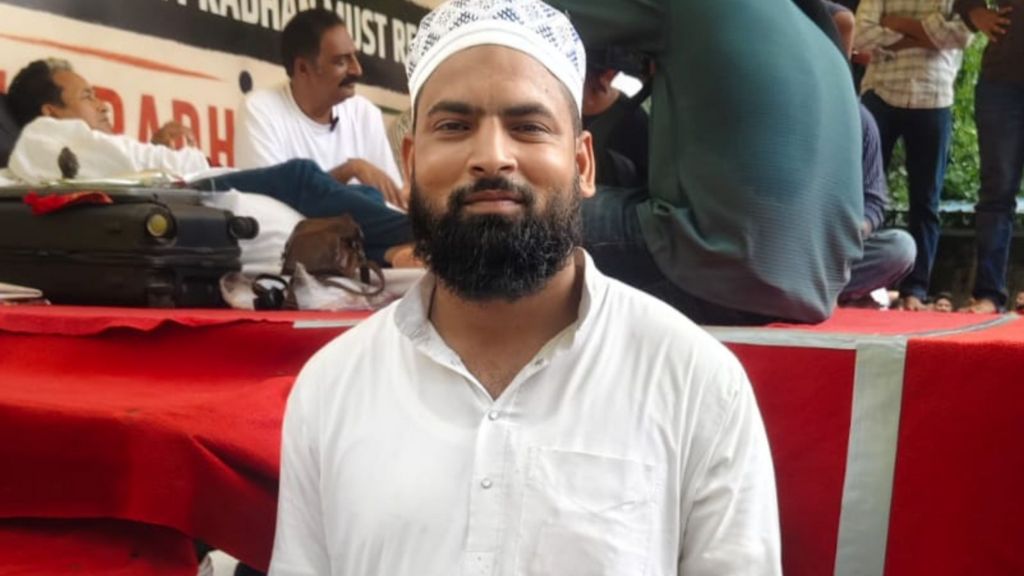
Raised by illiterate farmworking parents in northern India who revered knowledge above all else, 24-year-old law student Mohammad Junaid grew up ingrained with one core belief: education is the only irreversible gift that can rewrite a person’s destiny. What he never anticipated, however, was that this same belief would lead him to the center of one of India’s largest recent student-led protests, and ultimately to the steps of the Supreme Court to challenge alleged police mistreatment.
When the Cockroach Janta Party (CJP) issued a call in June for students to gather at Delhi’s iconic Jantar Mantar to demand accountability for widespread irregularities in a critical national medical entrance examination, Junaid packed only a small bag, planning to attend for just 24 hours. He ended up staying six weeks, evolving from a casual participant to one of the protest movement’s most visible and indispensable volunteers. Drawing on organizational experience he gained during the 2020 Indian farmers’ protests, Junaid stepped in to bring structure to the grassroots campaign when the first wave of demonstrators decided to camp indefinitely at the protest site with almost no basic supplies.
From sourcing drinking water and arranging meals to securing blankets and shelter for exhausted participants, Junaid became the go-to coordinator for all incoming donations and logistics. As local communities stepped up to support the movement—farmers bringing fresh vegetables, local gurdwaras supplying daily cooked meals, and ordinary citizens dropping off medicine, water and fruit—volunteers and organizers alike automatically directed all resources to him. The work was grueling, with Junaid averaging only a few hours of sleep a night, but it was the stories of affected families that cemented his commitment. He met parents who had taken crippling loans to pay for exam coaching, and one couple who distributed food to protesters on what would have been their daughter’s birthday; she had died by suicide after the exam paper was leaked, a tragedy that left Junaid certain the fight was bigger than any individual. The experience transformed his life trajectory: where he once never imagined himself as an activist, he now says he will spend his life fighting for equitable, transparent education.
Tensions escalated on 20 July, when thousands of protesters defied a police ban to march toward India’s parliament. Security forces responded with tear gas, baton charges, and mass detentions. Junaid spent hours tending to injured demonstrators, locating missing students, and helping frightened participants return to the protest camp. The violence of that day, he says, broke something inside him, and confirmed he could not step away from the movement. Five days later, after India’s education minister stepped down, CJP leaders declared victory and called off the protest, with most volunteers preparing to return home. Junaid’s path took a different turn.
Alleging that he was unlawfully detained by police just hours before the protest officially wrapped up, Junaid has filed a petition with India’s Supreme Court. In his claim, Junaid says he was taken into custody after leaving a hospital where he had sought treatment for a stray dog bite. He was held overnight for extensive questioning about his protest role, and alleges he was blindfolded while being transported to the police station. The petition further claims authorities targeted his family: his father was picked up for questioning from the family’s small Ghaziabad farm on 23 July, and police searched the family home the following day, damaging furniture and demanding identification and bank details for all extended family members. Ghaziabad Police have only confirmed that they questioned Junaid’s father, and have denied any misconduct. Delhi Police has not responded to requests for comment on Junaid’s allegations.
Junaid’s case has drawn sharp condemnation from opposition politicians and civil liberties organizations, with CJP leaders accusing authorities of a targeted crackdown on protest volunteers. His petition is one of multiple claims of unlawful detention amid broader allegations of a widespread police crackdown on demonstrators across Delhi and other Indian states. The Supreme Court has already ordered authorities to refrain from taking coercive action against protesters with no prior criminal record while the main case is heard, and CJP has threatened to resume mass protests if all pending cases against demonstrators are not withdrawn. Junaid’s petition has not yet been scheduled for a hearing.
In the aftermath of his detention, a video of Junaid breaking down during an interview went viral on Indian social media, alongside clips of supporters celebrating the protest’s initial victory. Junaid says the experience has left him questioning whether his Muslim identity played a role in his targeting—something he has no concrete evidence to prove, but that has lingered in his mind. Throughout the protest, he says, religious identity was never a topic of conversation: participants saw each other only as students and activists fighting for a shared cause. The question of religious profiling comes amid longstanding criticism from rights groups and opposition parties that Prime Minister Narendra Modi’s government has overseen growing marginalization of India’s Muslim community, the country’s largest religious minority. Modi’s administration has repeatedly rejected these accusations.
When Junaid returned home after his release, his parents—who spent decades working their small plot of land to give their son an education—urged him to step away from the movement, afraid that his activism would bring more trouble. But for Junaid, the confrontation with authorities has only strengthened his resolve. He describes the experience as a small sacrifice for the larger fight for fair education and accountability, and says if protesters return to the streets, he will be right there with them.