On the sun-scorched outskirts of Abu Khasaf village in Iraq’s Maysan governorate, a weathered, roofless concrete structure sits on Halima Flaih’s family plot, a quiet testament to both lost community joy and unyielding resistance. Two decades prior, Flaih, her husband, and their daughters hand-molded every concrete block, raised the walls, and plastered the interior to build a small gathering space where local Ma’adan (Marsh Arab) families would mark weddings, feasts, and community milestones. Today, the cracked, parched earth beneath the structure tells a grim broader story: the nearby UNESCO World Heritage-listed Hawizeh Marshes, a 7,000-year-old transboundary wetland straddling Iraq and Iran, is on the brink of total desiccation, driven by overlapping pressures of climate change, upstream dam construction, and state policies that critics explicitly prioritize oil extraction over the ecosystem’s survival.
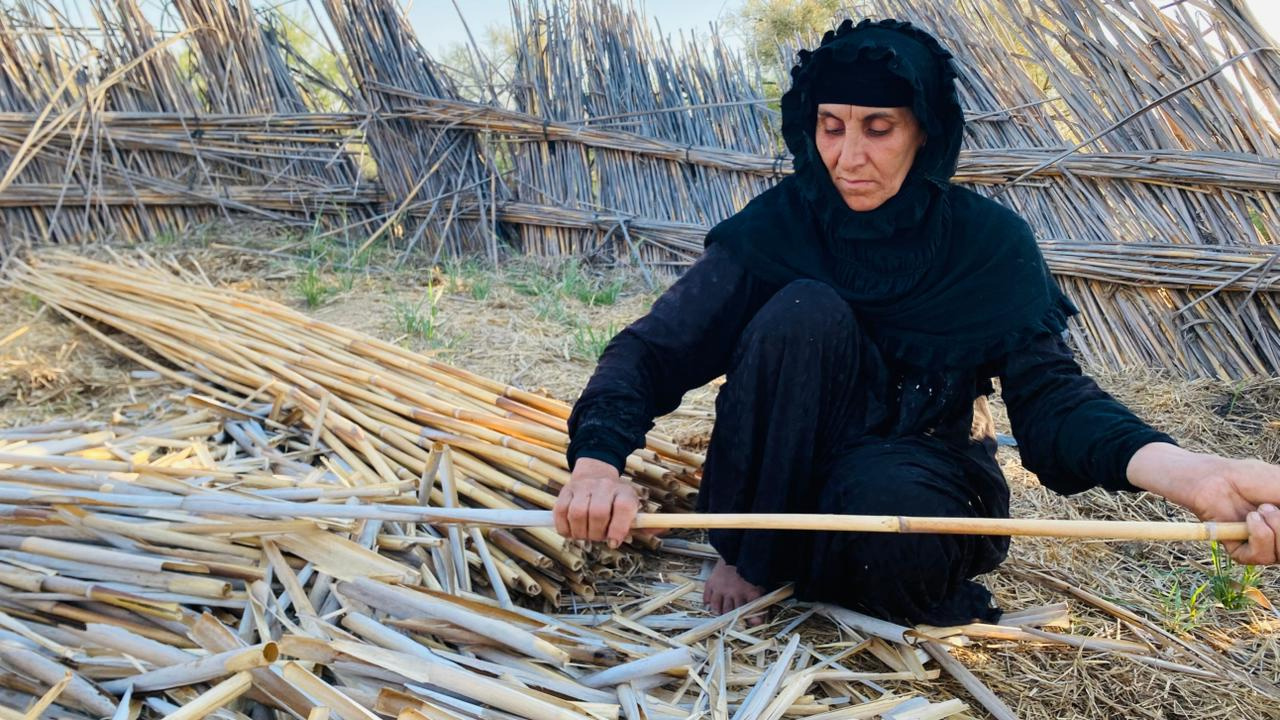
Refusing to join the tens of thousands of displaced Marsh Arab families who have fled to overcrowded urban peripheries in recent years, Flaih and her family have embarked on a radical act of cultural preservation: converting the abandoned hand-built space into a tiny community micro-museum dedicated to safeguarding Ma’adan ancestral heritage. The planned collection will feature hand-woven reed bariya mats, traditional cotton fishing nets, and carved oars for the narrow mashoof canoes that once served as the community’s primary mode of transport. Far more than a static artifact display, the micro-museum is framed as a living archive to ensure future generations never forget the Ma’adan’s millennia-long symbiotic relationship with the wetlands, even if the water never returns to the parched landscape.
Once recognized by UNESCO as a global cradle of civilisation and critical biodiversity sanctuary, the Hawizeh Marshes have seen their ecological outlook plummet from “significant concern” in 2020 to “critical” – the IUCN’s highest threat rating – by 2025. Local research from the London School of Economics Middle East Centre confirms that a 2022 state-constructed earthen berm, officially marketed as a cross-border anti-smuggling measure, effectively cut off most natural water inflows to the wetlands, triggering a cascade of ecological collapse that displaced hundreds of families from four surrounding villages. Investigations from independent media outlets and civil society groups including Save the Tigris have further revealed that state-issued oil and gas concessions, including the 20-year HWZ 1 field awarded to Chinese firm Geo-Jade Petroleum in 2023, overlap 300 square kilometres of the UNESCO-protected core zone. Field operations for the concession began before a legally required environmental impact assessment was completed, and the full report has never been released to the public. Multiple official letters obtained by Middle East Eye confirm that Iraq’s state-run Oil Exploration Company requested permits to build 10-metre-wide access pathways and drill power points directly inside the protected zone, requests that the Water Resources Ministry later acknowledged fell within the UNESCO core boundary.
Iraqi government officials have repeatedly denied any causal link between oil development and marsh desiccation, claiming inter-ministerial monitoring teams enforce full compliance with environmental protections, and that emergency water tanker deployments meet local community needs. But on-the-ground realities starkly contradict these official statements. Local residents report government water tankers rarely make even token visits to remote villages, forcing families to pay up to $45 a day for private water deliveries to meet drinking needs and keep their dwindling herds of water buffalo alive. More than 140,000 people across central and southern Iraq have been displaced by environmental degradation since 2018, per International Organization for Migration 2024 data, with one fifth of Iraq’s total climate-displaced population hailing from Maysan governorate alone. Displaced families like Abu Qasim and Um Qasim, who lost their entire buffalo herd to drought in 2022, now eke out a marginal existence in overcrowded semi-urban settlements on the outskirts of Amarah city, facing social stigma from urban residents and losing access to the ancestral livelihoods – weaving reed mats, producing traditional clotted qaymar cream, and subsistence fishing – that defined Ma’adan life for generations.
Independent environmental experts warn that unregulated oil access roads and pipeline construction inside the marsh core risk permanently shattering the wetland’s fragile hydrological balance, creating stagnant dead zones and fragmenting critical fish spawning and wildlife habitats. Slow-decomposing oil contaminants trapped in the waterlogged anaerobic marsh soil could poison local groundwater for decades, making natural ecological recovery effectively impossible. Iraq’s status as the world’s 11th most polluted country in 2025, per IQAir data, is further exacerbated by massive gas flaring from southern oil fields that generates annual emissions equivalent to 22 million metric tonnes of CO2. UNESCO has issued formal warnings that the Hawizeh Marshes could be added to the List of World Heritage in Danger as early as 2027, calling on Iraqi authorities to implement an immediate permanent ban on all extractive activities inside the protected site. For Flaih and her remaining family, every day they stay on their parched land is a deliberate act of resistance. Her 23-year-old son Mustafa commutes two hours round-trip to a low-wage power plant job in Amarah to cover the family’s exorbitant water costs, while her husband Hashem has lost more than half of his 20-head buffalo herd to thirst and disease. Even as their traditional livelihoods fade, the family remains determined to complete their small micro-museum, ensuring the Ma’adan’s ancient, water-centered way of life is never erased from collective memory.