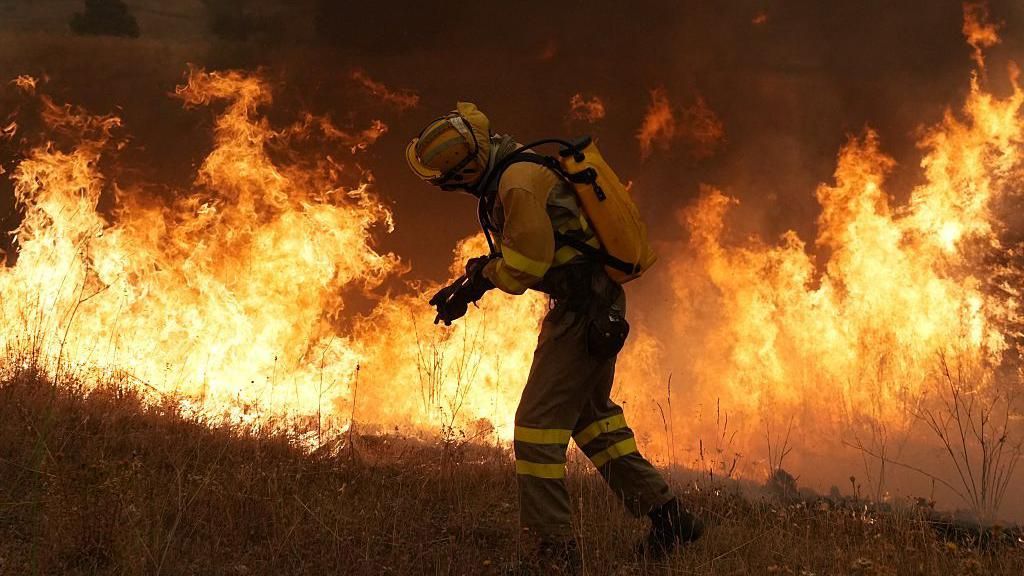
As southern Europe grapples with devastating, record-breaking wildfires that have forced Spain to declare a national state of emergency, a groundbreaking wildfire research project based in Australia is highlighting how merging millennia-old Indigenous ecological knowledge with cutting-edge modern technology can reshape global wildfire risk management.
Marta Yebra, a Spain-born bushfire expert based in Canberra, leads the Bushfire Research Centre of Excellence, an institution established after Australia’s catastrophic 2019-2020 Black Summer fires that burned an area roughly the size of the United Kingdom. Yebra has spent years developing advanced wildfire detection and prevention strategies for Australia, one of the most fire-prone regions on Earth, and now believes her country’s hard-won experience holds critical lessons for Europe as it faces its worst wildfire season in decades.
At the core of Yebra’s work is an innovative collaboration that combines two vastly different sources of expertise: high-resolution satellite data that measures landscape fuel moisture content, and the generations-old environmental knowledge of Australia’s Indigenous communities. While satellites can identify areas with high concentrations of dry, flammable vegetation such as dead leaves, grass, shrubs, and bark, that raw data lacks on-the-ground context that makes it actionable. That gap is filled by Indigenous land managers like Adrian Webster, who learned to read the Australian landscape – what his community calls “country” – from his elders.
Webster uses traditional observations, from plant color and scent to canopy shade, to verify and contextualize satellite data. He also assesses subsurface conditions to build a complete picture of fire risk, from underground moisture levels all the way up to the top of forest canopies. “She had all this amazing data, but there was no translation to what it meant on the ground, so it was kind of useless,” Webster explained of Yebra’s satellite information. “But through an Indigenous perspective, it was not useless. It was a map that could guide you through the country and, if you understood it, take you directly into a place that is ready to burn.” Yebra noted that Webster’s on-the-ground assessments showed remarkable alignment with satellite readings, proving that combining Indigenous ecological expertise and Western science creates a far more accurate picture of fire risk than either approach can deliver alone. Her team is now seeking additional funding to expand the project and co-design fire management plans directly with Indigenous communities.
This merging of ancient wisdom and modern science extends beyond risk detection to proactive fire management, centered on the traditional Indigenous practice of cultural burning. For more than 60,000 years, Indigenous Australians have used small, controlled “cool burns” to reduce accumulated flammable fuel across the landscape, creating patchy vegetation that prevents large, catastrophic blazes from developing. Unlike modern prescribed burns, which are large-scale hazard reduction operations conducted during cooler months, cultural burning is tied to a deep spiritual connection to the land, and its principles are increasingly being adopted around the world.
Pointing to the massive fuel buildup that has amplified Spain’s current wildfire crisis, Yebra noted that this proactive, risk-focused approach is largely absent from European landscape management. “It is difficult to watch what is happening in Spain, but it is not surprising,” she said. “Particularly as climate change is increasing the frequency of extreme fire weather across southern Europe.” Australia’s decades of experience living with high-intensity wildfires have driven a key shift in strategy: moving from only reacting to blazes after they start to proactively identifying and reducing risk long before ignition occurs. That shift, Yebra argues, could drastically improve wildfire outcomes across southern Europe.
Webster echoes that message, emphasizing that the core lesson from Indigenous fire management is proactive action. “The longer you leave it, the more fuel there is to burn, so the fire is naturally going to be bigger and harder to extinguish,” he said. “Indigenous people always knew that, so we burnt continuously all the time. That way there was no fuel for big fires.”
Modern Australian firefighting has expanded on these traditional practices with additional tactics that are gaining traction globally. Backburning – the practice of intentionally setting controlled fires ahead of an advancing main blaze to strip it of fuel – has long been a standard tactic in Australia, but it was rarely used in Canada until recent years. When Australian firefighter Damian Hatfield deployed to Alberta to help tackle Canada’s 2023 record wildfire season, backburning was not widely implemented; when he returned in 2024, the tactic had become a core part of Canadian firefighting operations. Technology has also transformed response efforts: NSW Rural Fire Service’s Trent Curtin notes that drones now provide fast, detailed situational awareness to ground crews, deliver critical equipment, support backburning operations, and assess post-fire damage long before larger aircraft can be deployed.
As Australia braces for what forecasters warn could be an extremely severe 2026 summer fire season, amplified by a predicted super El Niño that will bring more extreme heat and drought, fire leaders are emphasizing the need for global cooperation. Country Fire Authority Chief Officer Jason Heffernan, based in Victoria where the 2009 Black Saturday bushfires – Australia’s deadliest on record – remain a searing memory, notes that fire seasons are growing longer and more intense across the globe, even in regions that rarely faced major wildfires in the past.
“No fire service can do this on their own and the key is to have formal and trusted networks,” Heffernan said, pointing to the growing need for cross-border resource sharing. That cooperation is already in action: just this week, France made its first-ever request for Australian firefighting support, with two dozen crew and several aircraft set to deploy to help tackle the country’s own record-breaking wildfires amid a prolonged heatwave. Australia already regularly exchanges firefighting resources with the United States and Canada, and Heffernan expects requests from Europe to grow as the global wildfire threat intensifies and the global fire community becomes more interconnected. For Webster, this global collaboration rooted in traditional knowledge is about more than just fighting fires: it’s about “allowing our mother – the planet Earth – a voice again.”