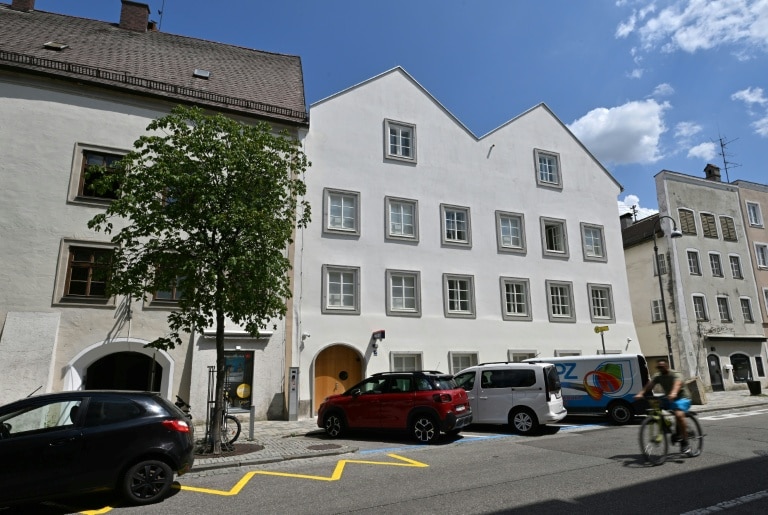
On Wednesday, Austria will formally inaugurate a new police station inside the building where Nazi dictator Adolf Hitler was born, a long-planned intervention aimed at halting the site’s use as a gathering place for rising far-right extremist groups. This conversion brings an end to decades of contentious, sensitive debate over the future of the property, located in the border town of Braunau-am-Inn. The project comes as Austria faces ongoing international criticism for failing to fully confront its culpability for atrocities committed during the Holocaust.
After a major 20-million-euro ($23 million) refurbishment that finished three years behind its original schedule, the unassuming 17th-century town center building where Hitler was born on April 20, 1889, is barely recognizable to returning visitors. Its iconic rough-cast yellow exterior, located just a short distance from Austria’s border with Germany, has been completely whitewashed by the lead Austrian architecture firm Marte. A official police insignia now hangs above the main entrance, while the pavement outside retains a permanent memorial stone inscribed with the words: “For Peace, Freedom and Democracy. Never Again Fascism. Millions of Dead Warn.”
The legacy of Nazism in Austria remains a deeply fraught issue. Following Hitler’s 1938 annexation of the country, 65,000 Austrian Jews were murdered in the Holocaust, and an additional 130,000 were forced into exile. Today, the far-right Freedom Party of Austria (FPOe), which was originally founded by former Nazi officials, holds the position of the most popular political party in the country, with polling aggregator Europe Elects recording its support at roughly 37 percent among Austrian voters.
For nearly a century, the building was owned by the same private family from 1912 onward. Starting in 1972, the Austrian state leased the property and operated it as a community center for people with disabilities, a group targeted for mass extermination by the Third Reich. Despite repeated calls for change driven by the steady stream of neo-Nazi visitors making pilgrimages to the site, the last private owner Gerlinde Pommer blocked all proposed alterations and fought the state’s attempt to seize the property through legal channels until her legal challenge concluded.
It was not until 2019, three years after the Austrian legislature passed a special law to enable state seizure of the decaying building, that the country’s Supreme Court gave final approval for the 810,000-euro purchase of the 800 square-meter property. When evaluating possible uses for the site after acquisition, outright demolition was ruled out by leading historians, who argued that Austria must maintain a visible reminder of the country’s Nazi past, rather than erase it. Historians pushed for Austria to confront its role in the Nazi regime’s murder of more than six million Jews, along with Roma, LGBTQ+ people, political dissidents and communists.
Officials rejected converting the building into a dedicated Holocaust memorial out of concern that it would still act as a draw for extremist sympathizers. After months of deliberation, an expert commission ultimately settled on the plan to repurpose it as a permanent police station. The Austrian government has stated that the constant police presence at the site will send an unambiguous message that any glorification of Nazism is unacceptable in the country, and will permanently neutralize the property as a far-right gathering spot.
However, the plan has drawn sharp criticism from Holocaust remembrance groups. Robert Eiter, spokesperson for the Mauthausen Committee Austria, an organization founded by survivors of the Mauthausen concentration camp, called the approach absurd. “Humanity will not forget where the worst mass murderer in history was born,” Eiter told Agence France-Presse. “And this renovation will not prevent a single neo-Nazi from making the pilgrimage to Braunau.”