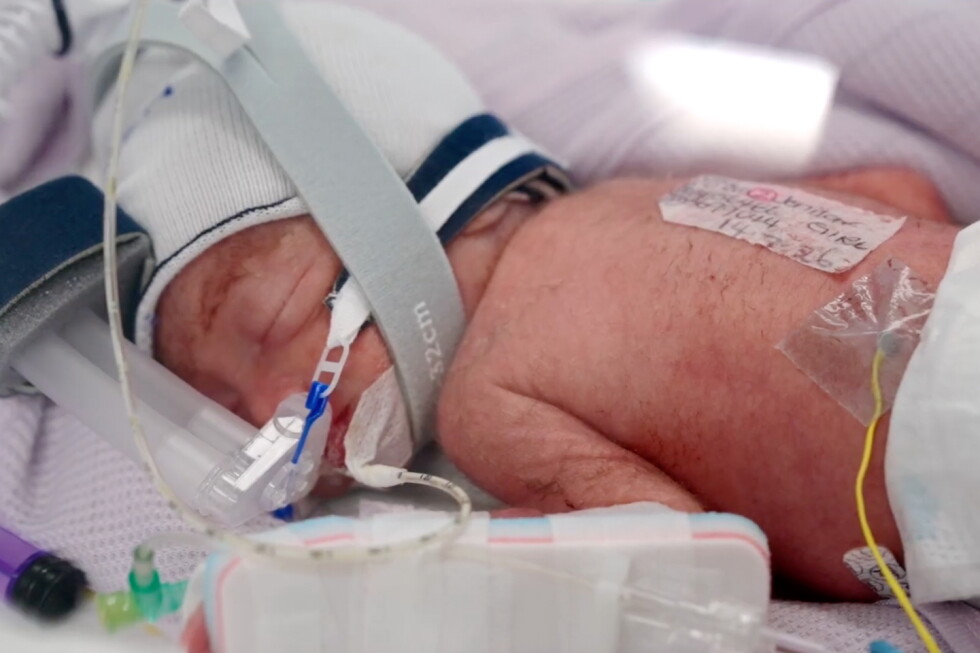
In an unprecedented medical event for Australia, 34-year-old Jenitar Sau Na’amoana has safely given birth to four identical quadruplet girls, a natural conception that experts call a one-in-15-million statistical anomaly.
Na’amoana, who already shares four children with her husband Jorthan, never planned an expanded family — the couple was stunned when prenatal tests confirmed she carried four identical fetuses, all developed from a single fertilized egg that spontaneously split into four embryos. The delivery took place last week at Royal Brisbane and Women’s Hospital (RBWH) in Queensland, marking the first recorded case of naturally conceived identical quadruplets in Australian history.
Maternal-fetal medicine specialist Dr. Alexa Bendall, who led Na’amoana’s care team, called the case medically extraordinary. While the general odds of spontaneous quadruplet conception hover at roughly 1 in 700,000 worldwide, the subset of identical quadruplets from one fertilized egg is far rarer, with odds estimated at 1 in 15 million. The vast majority of higher-order multiple pregnancies today result from fertility assistance treatments, making this all-natural conception even more unusual.
Multiple pregnancies carry inherently elevated health risks for both birthing parent and fetuses, particularly when multiple fetuses share a single placenta — a common trait in identical multiple births. According to Johns Hopkins Medicine, people carrying multiple fetuses face far higher risks of preterm delivery, miscarriage, and congenital abnormalities than those carrying single fetuses. To mitigate these risks, RBWH assembled a large specialized care team that began closely monitoring Na’amoana starting at just 10 weeks gestation. By 25 weeks, she was admitted as an inpatient to receive around-the-clock observation to track the development of the four fetuses. On July 14, Na’amoana delivered the four girls via planned cesarean section at 28 weeks and four days gestation.
In a post-delivery statement, Dr. Bendall emphasized just how positive the outcome has been for the family. “The fact that we’ve got four beautiful, healthy babies born at 28 weeks and four days is incredible,” she said. While Na’amoana experienced some mild blood loss during delivery, Bendall noted the amount was well within expected ranges for a quadruplet birth, and the mother is now recovering well.
All four infants are currently being cared for in RBWH’s neonatal intensive care unit, where they are progressing steadily. In a touching gesture to the care team, the couple named their daughters Emily, Harriet, Catherine, and Alexa — with the youngest named in honor of Dr. Bendall. The specialist called the tribute deeply moving, saying she feels privileged to have supported the family through their unprecedented journey.
“From an academic perspective, it’s really interesting,” Bendall said of the case. “But also from a human perspective, to be able to be part of the family’s journey and come out with four beautiful babies and a healthy mum is very precious.”
This reporting from the Associated Press Health and Science Department was supported by funding from the Howard Hughes Medical Institute’s Department of Science Education and the Robert Wood Johnson Foundation, with the AP retaining full editorial control over all content.