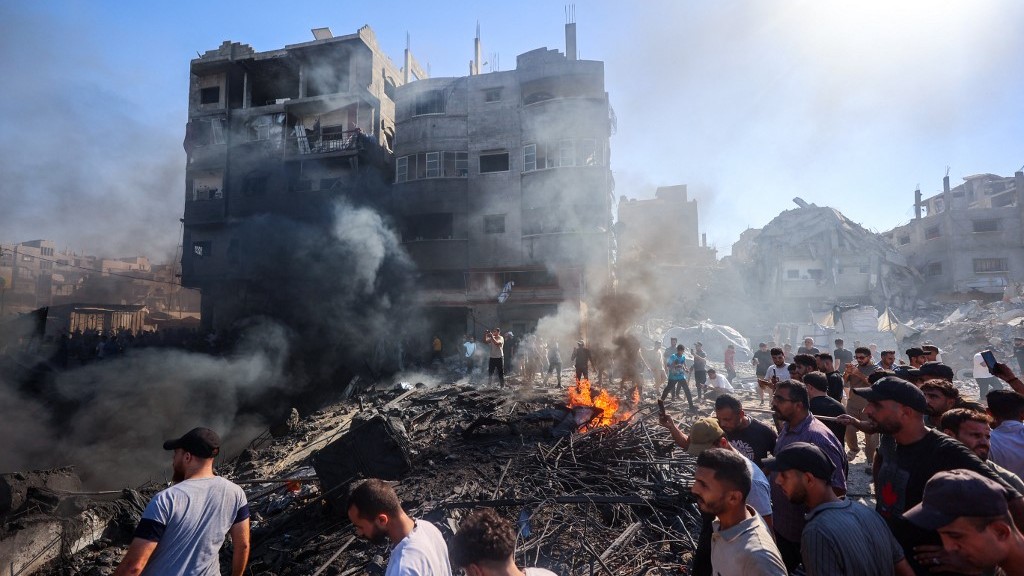
An explosive investigation published by leading Israeli newspaper Haaretz has uncovered a rapidly expanding Israeli program that deploys mercenaries, local criminal gangs, and convicted drug dealers as proxy forces to commit war crimes in the Gaza Strip on behalf of the Israeli state and its military.
Drawing on firsthand testimony from active-duty Israeli soldiers, verified United Nations documentation, and high-resolution satellite imagery, the probe details how increasingly heavily armed collaborator militias have systematically displaced Palestinian communities from their homes and launched offensive operations across multiple areas of the besieged enclave. According to the investigation, Israeli military and intelligence agencies have trained and equipped at least five separate militia groups to date, with evidence pointing to the possible formation of a sixth. All of these groups operate out of heavily fortified bases located in Israeli-occupied sections of Gaza.
One unnamed Israeli soldier, speaking on condition of anonymity to Haaretz, described the explicit division of labor between Israeli regular forces and the proxy militias: “The state, army and Shin Bet intelligence service send armed and trained militias to commit war crimes, and I’m the one who has to protect them during their operations so they don’t get hurt.”
The investigation comes against a backdrop of already heightened international scrutiny of Israeli conduct in Gaza. Israel is currently facing a formal genocide case brought before the International Court of Justice, and the International Criminal Court has already issued public arrest warrants for Israeli Prime Minister Benjamin Netanyahu and former Defense Minister Yoav Gallant on charges of war crimes and crimes against humanity committed in the enclave.
Haaretz’s findings also reveal alarming connections between the Israeli-backed militias and extremist groups. At least one armed faction supported and supplied by Israel had confirmed links to the Islamic State, according to the investigation. That group was led by Yasser Abu Shabab, who was killed by Hamas forces in December 2025. News of his death was widely celebrated across Palestinian communities, and even his own family publicly disowned him as a traitor for collaborating with Israeli authorities. Despite his death, Haaretz notes that the broader militia project he represented has continued to grow in scope and power, particularly in the period following the October 2025 ceasefire agreement.
Another high-profile militia leader, Shawqi Abu Nasira, has openly acknowledged his cooperation with Israel in a widely circulated online video. “I made the decision to liberate the land from Hamas,” he stated. “If people say that makes me a collaborator, then I’m a collaborator.” The vast majority of Palestinians across all political factions, regardless of their stance on Hamas leadership, uniformly view collaboration with Israel as an act of treason against the Palestinian people.
The investigation also documents how Israel has built dedicated military infrastructure for these proxy groups amid the widespread destruction of Gaza’s built environment. Near one major militia base in the Gaza neighborhood of Shujaiya, Israeli forces completely flattened a large historic Palestinian cemetery to clear space for an expanded training compound for the militias.
Testimony from soldiers confirms that the operational integration between the Israeli military and the proxy gangs has grown increasingly close. Fighters from the militias are allowed to move freely through Israeli army outposts across occupied areas of Gaza, and the investigation notes that the gunmen regularly stage public shows of force, film the events, and upload the footage to social media platforms like Facebook for propaganda and new recruitment drives. Israel provides all small arms and heavy weapons for the militias, and also backs their ground operations with artillery support and drone surveillance and strikes.
Beyond frontline combat roles, the proxy mercenaries serve a second core strategic purpose aligned with Israeli government policy: targeting Palestinian civilians struggling to survive under ongoing Israeli occupation and blockade. The gangs drive Palestinian families from their residential areas, loot personal and private property, and burn homes to the ground. This activity aligns with repeated public statements from senior Israeli ministers who have openly called for making life unlivable in Gaza as part of a broader campaign to ethnically cleanse the enclave and clear space for new Jewish Israeli settlements.
One Israeli soldier described a typical raid carried out by the mercenaries: They arrived in unmarked pickup trucks, then “they just ran and shot at people. They entered every structure, looted everything they could get their hands on, came out with piles of stuff – and then burned down the house.”
While claims that Israel has deployed local criminal gangs to advance its ethnic cleansing strategy in Gaza have circulated for more than a year, the new firsthand testimony from Israeli soldiers provides definitive confirmation that these groups now operate as a formal “operational arm” of both the Israeli military and the Shin Bet domestic intelligence service.
A striking contradiction sits at the heart of Israeli policy in Gaza: While the Israeli government continues to arm and expand these local criminal gangs, it simultaneously demands that Hamas disarm and rejects all proposals for the formation of an independent Palestinian security force to govern Gaza after a permanent ceasefire. This arrangement allows Israel to deploy the militias to target anyone it labels a Hamas affiliate, while also turning the groups loose on ordinary Palestinian civilians.
Hamas officials speaking to Haaretz confirmed that the group will not agree to surrender its defensive weapons as long as Israeli-backed armed militias remain active in Gaza, noting that the collaborator groups have explicitly targeted Hamas members and supporters. The group would be left vulnerable to sustained attack if it disarmed while these proxies remain fully armed and supported by Israel, the sources added.
Haaretz’s investigation concludes with a stark warning that Israel’s current proxy strategy is creating the conditions for mass atrocities on a scale not seen in decades, drawing a direct parallel to the 1982 Sabra and Shatila massacre. During that event, Lebanese Phalangist forces allied with Israel slaughtered up to 3,500 Palestinian and Lebanese civilians while Israeli troops surrounded the Beirut refugee camps, secured the perimeter, and oversaw the 48-hour killing spree.