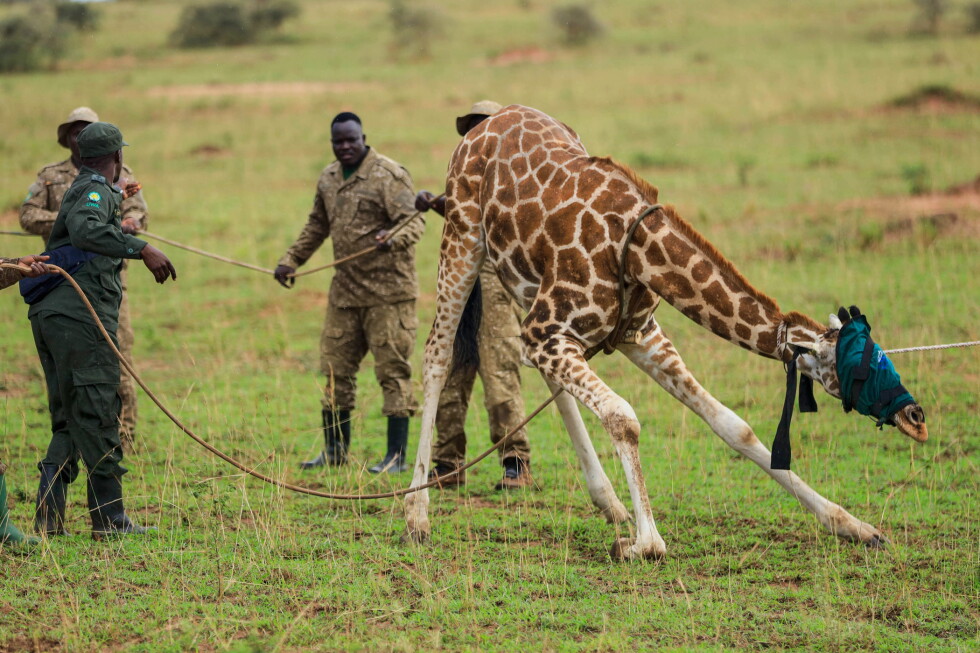
On a crisp, cold morning at Murchison Falls National Park, Uganda’s largest protected wilderness, a team of park rangers gathered to begin a high-stakes conservation mission: relocating a dozen of the country’s critically endangered Nubian giraffes to a safer habitat 65 miles away. As the rangers traded lighthearted jokes and sang to lift their spirits ahead of the complex translocation operation, the weight of the task ahead hung over the group—this project is widely viewed as a critical safeguard for a species increasingly squeezed by human industrial activity.
Starting on Tuesday, conservation teams began moving 12 Nubian giraffes, Earth’s tallest terrestrial mammal, from Murchison Falls National Park to the rejuvenated Ajai Wildlife Reserve, a journey of 106 kilometers. The multi-day operation is designed to establish a separate, self-sustaining population of the vulnerable species, boost regional biodiversity, and unlock new ecotourism opportunities for local communities.
The urgent need for this translocation stems from a growing threat to Murchison Falls’ ecosystem: the Ugandan government’s push to develop the region’s extensive oil reserves. An estimated 40 percent of Uganda’s total known oil deposits lie within and around the boundaries of Murchison Falls National Park, and large-scale drilling operations have expanded rapidly in recent months, despite years of fierce opposition from global and local environmental advocates. Heavy industrial machinery now traverses protected wilderness areas as the country moves toward its goal of producing first commercial oil from the region. By June 2023, French energy giant TotalEnergies had officially launched drilling operations in the Tilenga project area, which sits entirely within Murchison Falls National Park.
Patrick Atimnedi, assistant commissioner for veterinary services at the Uganda Wildlife Authority, who led Tuesday’s translocation work, explained that establishing a satellite population of giraffes in a separate protected area will mitigate the risk of population collapse if oil drilling causes irreversible damage to the species’ current habitat. Beyond oil and gas development, Atimnedi noted that multiple interconnected pressures have been steadily shrinking the available habitat for Nubian giraffes in Uganda, including unregulated tourism expansion, climate change-driven ecological shifts, the spread of woody brush into savanna landscapes, and invasive plant species.
Nubian giraffes can reach heights of up to 6 meters and weigh as much as 2,000 kilograms, making them particularly vulnerable to habitat fragmentation and loss. “This is shrinking the habitat of wildlife here, but especially giraffes,” Atimnedi said. “So having a seed population somewhere about 100 kilometers away from here within the same conservation area, the same zone, is the right conservation decision to make.”
After a final safety and strategy briefing from Atimnedi, the operation got underway, with conservation staff guiding three giraffes into specialized waiting trucks. Tree branches were secured inside the vehicles to give the animals access to food during the journey, helping keep them calm throughout the transport. At the Ajai Wildlife Reserve, a team of 12 rangers was already on standby to receive the newly arrived giraffes. Once offloaded, the animals wasted no time exploring their new 166-square-kilometer home.
Ajai Wildlife Reserve has a complicated conservation history: once home to a thriving, diverse array of African wildlife, the reserve’s entire animal population was wiped out in the early 1980s amid widespread poaching and prolonged political insecurity across northern Uganda. Today, the reserve is the site of an ambitious long-term ecological restoration project, and the Nubian giraffe translocation is the latest milestone in that effort. Beyond giraffes, conservationists have already successfully reintroduced southern white rhinos, Cape buffalo, plains zebras, and hundreds of Uganda kobs to the restored landscape.
Wilson Katamigwa, senior warden at Ajai Wildlife Reserve, reported that the reintroduced species already in the reserve are thriving: “The animals are now doing very well and are multiplying. Many are now pregnant. They are spreading all over the reserve, both inside the electric fence and outside the electric fence.”
Conservation officials are optimistic that the 86-year-old reserve, first established in 1937, will provide a stable long-term home for the new giraffe population, helping grow Uganda’s overall Nubian giraffe numbers despite mounting threats from human activity and climate change. To protect the new population, part of the reserve has been enclosed with predator-proof fencing, and the number of anti-poaching rangers has been increased substantially. Local communities, which receive a cut of all tourism revenues generated by the reserve, have also participated in extensive conservation education programs to build buy-in for the project.
“They are ready to conserve with us, and we are having a good working relationship with the district leadership,” Katamigwa said. Once the full translocation of 12 giraffes is complete, community members will be invited to the reserve to see the giraffes, which have been absent from the region for more than 40 years. “The big dream is that we want to see the economy of this place growing bigger and bigger and for the Madi Okollo district to be included in the money economy using tourism,” Katamigwa added.
As the first giraffes stepped off the transport trucks onto the reserve’s grasslands, local resident Moses Ayoti could not contain his excitement at the return of the species to the region, and at the environmental and economic benefits the giraffes will bring to his community. “The community is aware, the vigilance is high, and I am sure they are going to take care of the animals because they belong to the local community, too,” Ayoti said.