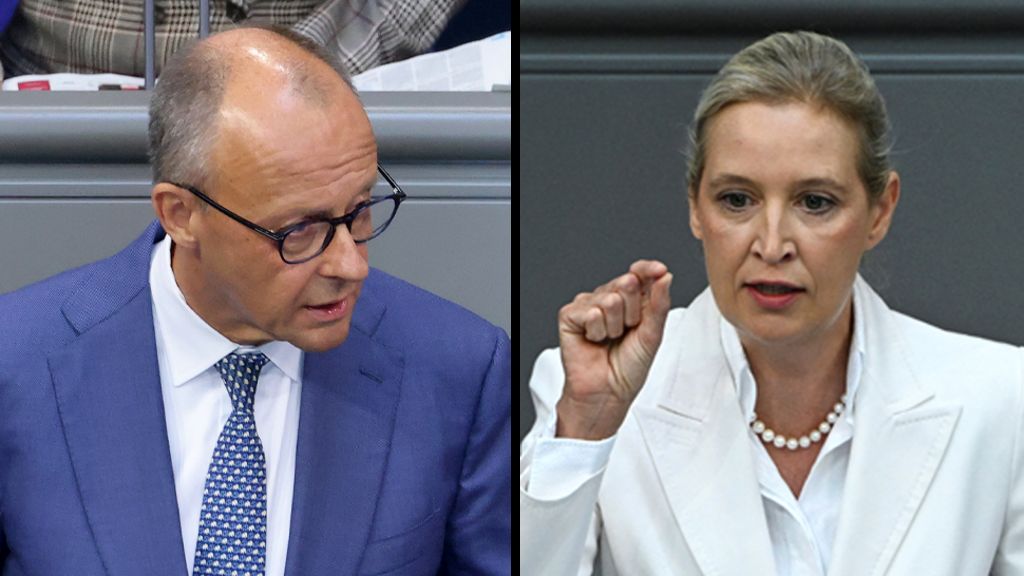
The political landscape of Germany shifted dramatically this week, following a landmark electoral upset that has reignited fierce ideological battles in the country’s federal parliament. Just days after the far-right Alternative for Germany (AfD) secured a sweeping victory in the eastern state of Saxony-Anhalt — capturing nearly 44% of the popular vote, while Chancellor Friedrich Merz’s Christian Democratic Union (CDU) saw its support cut in half to just 17.2% — Merz and AfD leader Alice Weidel faced off in their first high-stakes parliamentary debate since the election result.
In a charged address to the Bundestag, Merz launched a scathing attack on the AfD, labeling the party a fundamental “destructive force” for German democracy and society. His sharpest criticism targeted the AfD’s flagship “remigration” policy, a hardline agenda that prioritizes mass deportations of irregular migrants and has been repeatedly flagged by Germany’s domestic intelligence service, which already classifies the Saxony-Anhalt AfD branch as a confirmed right-wing extremist movement. Merz argued that the policy would strip Germany of one-sixth of its skilled labor force, many of whom have migrant backgrounds. He called the proposal “nothing other than ethnic cleansing in the skilled trades, based on skin color and national origin.”
Weidel, who opened the debate, struck back at Merz’s three-party coalition government with center-left Social Democrats, framing the Saxony-Anhalt result as a clear public rejection of the administration’s agenda. She told assembled MPs that voters had delivered a definitive verdict: Merz’s government was a complete failure, and its time in power had run its course. She blamed mass, unregulated migration for rising public insecurity, citing repeated incidents of knife violence in public spaces including trains and transit stations. Weidel also accused the coalition of driving Germany’s national finances toward bankruptcy, noting that the CDU had been “pulverized” at the polls in the eastern state.
The debate quickly descended into chaos, with repeated heckling from AfD MPs that grew so disruptive that Bundestag President Julia Klöckner was forced to intervene, threatening to expel unruly members from the chamber. “We are not on a football pitch,” she warned.
Beyond the acrimonious verbal exchange, the election result has upended decades of political convention in post-World War II Germany. No far-right party has held executive power in any of Germany’s 16 federal states since 1945, and the AfD fell three seats short of an outright parliamentary majority in Saxony-Anhalt, leaving the path to forming a state government unclear. The party has already begun exploring coalition options, opening talks that could see it govern with the left-wing populist BSW, while local AfD officials have even floated the possibility of working with Merz’s CDU — if the mainstream party abandons its longstanding “firewall” policy that bans any formal cooperation with the far-right.
Merz rejected that prospect outright, dismissing the AfD’s claims of a mandate and accusing the party of breaking its pre-election promise to only govern if it won an outright majority. He also criticized the AfD for its pro-Russia stance, arguing that the party’s foreign policy positions actively harm German national interests, and warned that its remigration agenda would cripple core public and private services: if the policy was implemented, Merz said, not a single care home, hospital, or restaurant would be able to function normally. While he acknowledged that targeted deportations of undocumented migrants are a necessary policy, Merz stressed that the government maintains a critical distinction between people who contribute to German prosperity and those without legal permanent residency.
Internationally, the AfD’s historic gains have already drawn high-profile praise from former U.S. President Donald Trump, who hailed the outcome as a victory for global populism. Trump linked the result to widespread public anger over what he called “absolutely horrible immigration rules and regulations” in Germany. Merz, for his part, acknowledged that the result represents a “seismic” shift that has permanently altered the country’s political terrain.