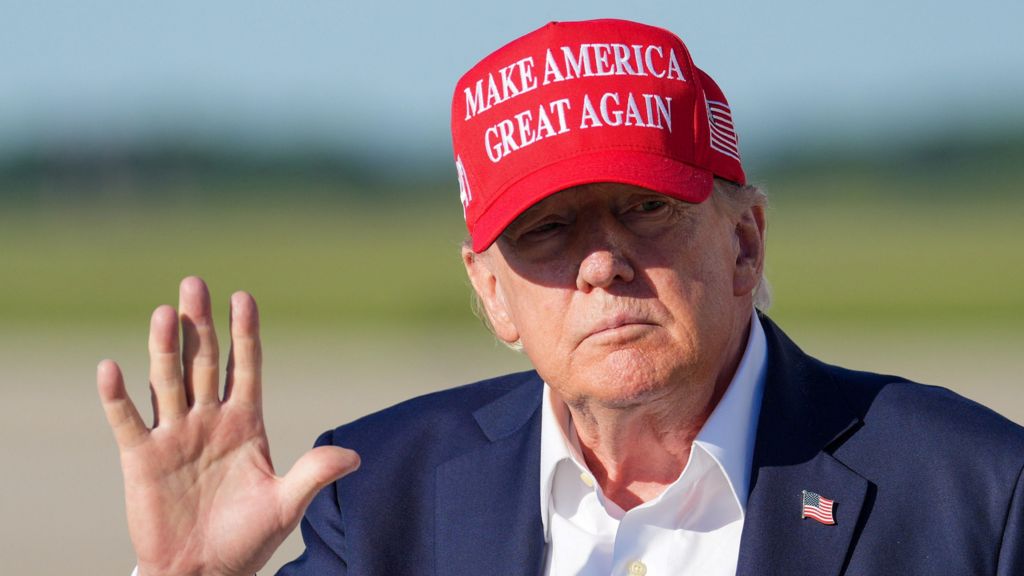
Ahead of U.S. President Donald Trump’s planned visit to Ireland this coming weekend, Ireland’s largest opposition party Sinn Féin has confirmed it will participate in widespread public demonstrations against the trip, citing Washington’s ongoing facilitation of Israeli military actions in Palestine that the party leadership describes as genocide. The visit, which will see Trump hold formal meetings with Ireland’s head of state and top elected official before heading to a private golf resort, has sparked significant public and political backlash across the country, which holds one of the most pro-Palestinian policy stances in the European Union.
During Sinn Féin’s annual pre-parliamentary term policy think-in in Dublin this week, party president Mary Lou McDonald told reporters that public outrage over the crisis in Gaza and the Israeli-occupied West Bank has made protests against the visit not just inevitable, but entirely justified. “I’m not surprised that there will be protests at this visit,” McDonald stated. “I think that is quite correct given the scale of the breaches of international law, given the genocide in Palestine, events in Gaza and on the West Bank, we are seeing settler violence at a rate that is literally unspeakable.”
McDonald emphasized that the United States bears direct responsibility for the ongoing crisis, saying “The United States, and I say this with deep, deep regret and some anger, facilitates that, facilitates Israel in its onslaught against the Palestinian people. So quite correctly there will be a protest against some of that. I would be deeply shocked if there weren’t and, yes, Sinn Féin will be there.”
Beyond joining the street demonstrations, McDonald has publicly pressured Irish President Catherine Connolly and Taoiseach Micheál Martin to openly raise the Palestinian crisis during their scheduled meetings with Trump. Connolly, who was a vocal critic of U.S. policy prior to her election to the presidency last year, will hold a short introductory meeting with Trump at the Áras an Uachtaráin, the official presidential residence. McDonald said she expects Connolly to use even that brief encounter to address the issue of U.S. military and political support for Israel’s campaign in Gaza. “I would imagine and I would hope that given the opportunity, that she would raise the matter particularly in regards to Palestine and the United States ongoing facilitation and arming of Israel,” McDonald said, adding that she made the call aware of the limited time available for the meeting.
For Martin, who is set to hold a full bilateral meeting with the U.S. president, McDonald said the taoiseach has a clear obligation to reflect the widespread public opposition to Israeli actions in Ireland. “The taoiseach will have every opportunity again to set out the views and the position of the Irish State and the Irish people and I believe he must do so very, very clearly and very firmly,” she added.
Trump’s itinerary for the weekend confirms he will first meet with Connolly and Martin in Dublin before traveling to his private golf resort in Doonbeg, County Clare, where he will attend the Amgen Irish Open golf tournament. Opposition politicians across Ireland have argued that the Irish government should not extend a warm welcome to Trump, amid widespread public anger over his administration’s unwavering support for Israel.
The call for Irish leaders to address the Israeli-Palestinian conflict comes just days after the United Kingdom announced new sanctions against illegal Israeli settlements in the occupied West Bank. UK Foreign Secretary Ed Miliband framed the move as the start of a new approach to the conflict that backs up criticism of injustice with concrete action, accusing the Israeli government of ignoring settler-driven ethnic cleansing of Palestinian communities. Israel’s Foreign Minister Gideon Saar responded by calling Miliband’s accusation an outrageous lie, and announced retaliatory measures including the closure of the UK’s consulate in East Jerusalem.
This week marks the annual pre-session think-in period for all major Irish political parties, held ahead of the new term of the Dáil, Ireland’s national parliament. The closed-door gatherings bring together parliamentary party members, TDs (the Irish equivalent of members of parliament) and senators to map out policy priorities and legislative strategies for the coming year.