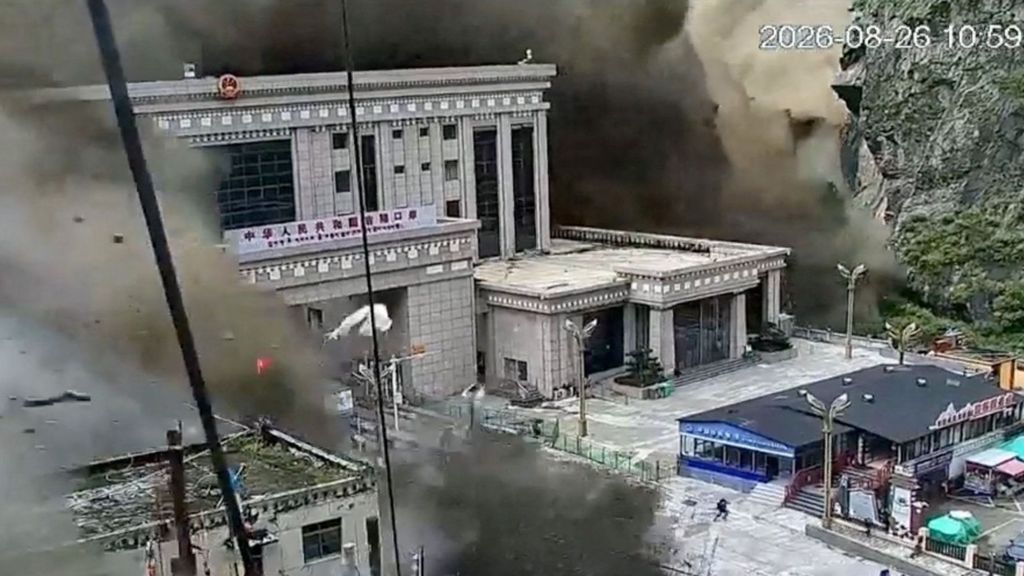
Dramatic surveillance footage capturing a catastrophic flash flood tearing through Gyirong Port, a key border crossing between Nepal and Tibet Autonomous Region of China, has circulated widely across global social media and international news outlets—yet it remains almost entirely inaccessible to audiences inside China, according to a new Reuters report.
The torrential flood, which struck earlier this week, has already claimed hundreds of lives, with hundreds more still unaccounted for as of Friday. But inside China’s strictly censored online ecosystem, searches for information about the disaster and related user-generated content are heavily restricted. As of Thursday, China’s national state-run flagship news bulletin had only aired a single still image of the event, with minimal additional context.
While Beijing has launched a large-scale search and rescue operation deploying hundreds of emergency responders, and President Xi Jinping personally chaired an emergency coordination meeting to direct response efforts, the stark contrast between global access to on-the-ground footage and the controlled information environment inside China has thrown the country’s online censorship framework into sharp relief.
China’s administration of Tibet has long been marked by strict information controls. Beijing asserts full sovereignty over the region, which it annexed in the 1950s, and has repeatedly cracked down on anti-government protests, while facing widespread international accusations of severe human rights violations against the Tibetan Buddhist population. Chinese authorities have designated the exiled Tibetan spiritual leader the Dalai Lama as a separatist, and the region’s name itself is a heavily monitored term for Chinese online censors. These long-standing sensitivities have shaped the government’s response to the disaster, observers say.
State media has published incremental updates confirming the rising death toll, ongoing rescue work, and risks posed by a newly formed barrier lake at risk of catastrophic overflow. But beyond official statements highlighting rescue operations, little additional information has been released. No firsthand survivor accounts from the affected areas in Tibet have been made public, and no user-posted footage of the disaster or its aftermath has been allowed to remain online. Anxious families of missing people inside the region have also not spoken publicly, and contacting residents in the area remains extraordinarily difficult even in non-disaster times. One veteran foreign correspondent with experience covering North Korea noted that reaching interview subjects in Pyongyang is often easier than connecting to people in Lhasa, Tibet’s capital.
The information gap was thrown into stark relief Thursday evening, when China’s main state broadcaster led its flagship evening news segment not with the Himalayan flood disaster, but with the launch of a new collection of President Xi Jinping’s political writings. Foreign journalists are barred from traveling to Tibet without prior official approval, leaving international reporters with a narrow window to gather information before content is scrubbed from online platforms and local voices are silenced. Most external reporting has therefore had to rely exclusively on official state media dispatches, which have focused heavily on the dramatic efforts of rescue teams scaling cliffs and crossing raging rivers to reach hard-hit communities, with no details on the number of people saved or the full extent of damage.
Analysts emphasize that Beijing is not indifferent to the disaster: Premier Li Qiang, China’s second-highest ranking leader, was rapidly dispatched to the region to oversee debris removal and response efforts, an unusually quick visit for a top official following a major crisis. Instead, the muted, controlled public narrative is rooted in the Chinese Communist Party’s overriding priority of maintaining social stability, the report notes.
Party leadership fears that a large-scale, unregulated public discussion of the disaster could stoke public discontent over the response or perceived lack of pre-disaster mitigation, observers say. There are also additional concerns that the tragedy could become a organizing point for dissent, particularly in a region where Buddhist religious identity remains a core part of community life. While large-scale public protests have not occurred in Tibet for years, Tibetan exile groups have repeatedly raised alarms over expanding Beijing control, including new education policies that critics say erode the influence of monasteries and Buddhist cultural practice.
Within hours of the flood striking, local party authorities issued an internal notice calling on grassroots party members to lead relief efforts, provide psychological support to affected residents, and prioritize maintaining social order and public confidence in disaster zones. The notice explicitly states that members who perform well will receive rewards, while those who fail to meet expectations will face disciplinary action. Rights activists report that Tibetan residents can face detention or arrest for speaking to foreign journalists or posting online content that deviates from the official government narrative, a restriction that has left ethnic Tibetans living outside the region unable to confirm the safety of family members trapped in the disaster zone.
The International Campaign for Tibet, an advocacy group, has acknowledged the critical work of on-the-ground first responders, but has accused Beijing of systematically removing user-generated videos and firsthand accounts of the disaster from domestic social platforms. The organization has called on Chinese authorities to release full, verifiable information about the scale of casualties and damage.
Beijing has long rejected accusations of human rights violations in Tibet, pointing to massive infrastructure and economic investments that have grown the region’s tourism sector and integrated it more closely with China’s national economy. Even so, most Chinese citizens residing outside Tibet currently have little access to accurate, detailed information about the flood disaster unfolding in the Himalayan border region.