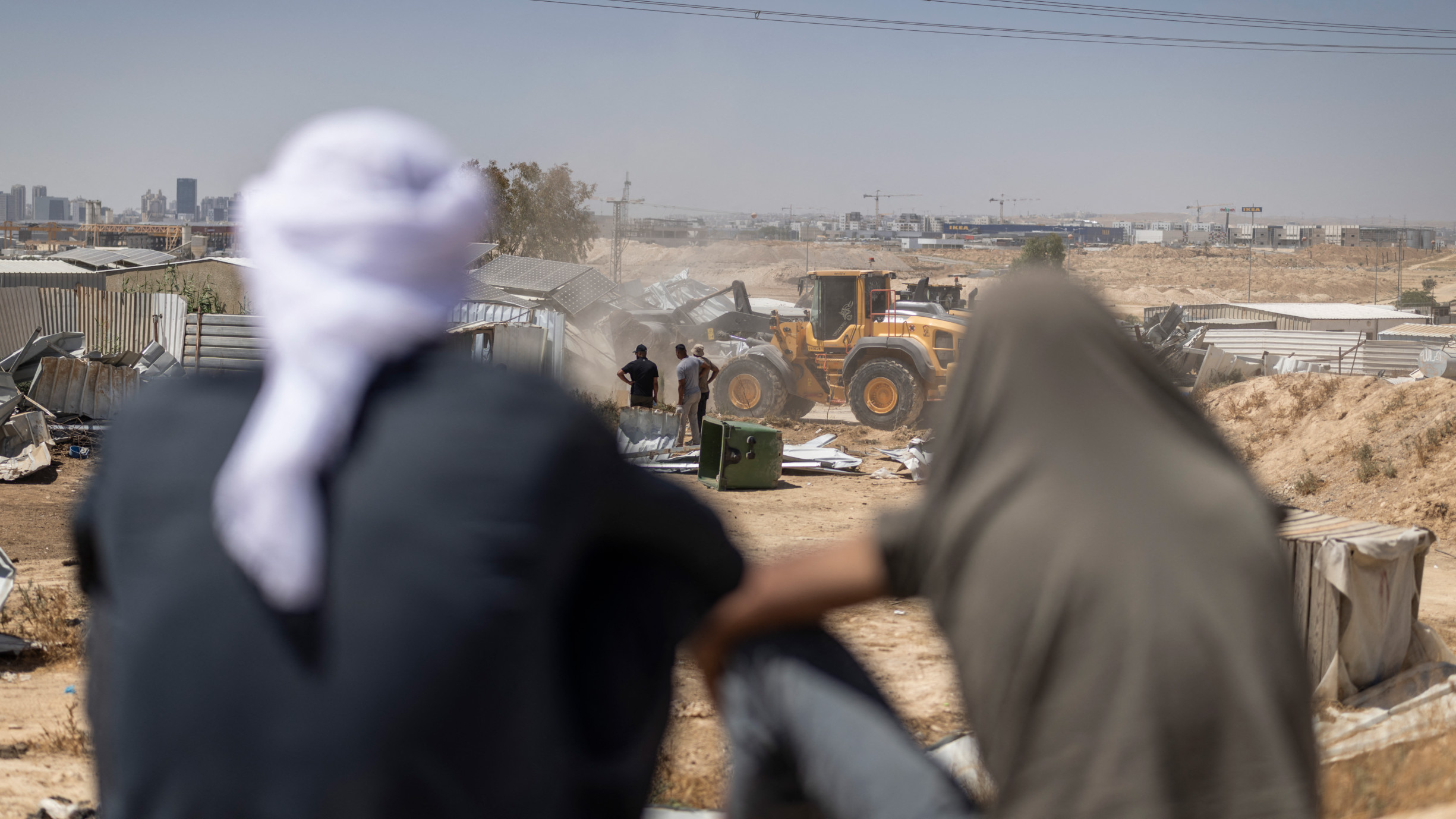
Israel’s far-right Finance Minister Bezalel Smotrich, leader of the Religious Zionism party, has announced a sweeping new policy plan to advance the judaisation of Israel’s northern Galilee and southern Negev (called Naqab in Arabic), announcing he will replicate the aggressive settlement expansion policies he has implemented in the occupied West Bank across these two regions.
Smotrich first unveiled the plan in a post on the social platform X on Thursday, framing the initiative as a continuation of what he calls a “revolution” in West Bank settlement policy. Over the past four years, Smotrich has overwritten planning protocols, seized large swathes of Palestinian territory in the occupied West Bank, and authorized dozens of new illegal settlements and outposts – actions that have been widely condemned by the international community as de facto annexation of Palestinian land.
Under the new framework, Smotrich says he will scale this same model up dramatically across the Negev and Galilee, two regions that are already home to the vast majority of Israel’s Palestinian citizen population. The plan’s core targets are clear: to bring 1 million additional Jewish residents to the two regions, build 40 entirely new communities, establish dozens of new agricultural farms, expand existing Jewish localities, and create hundreds of thousands of new housing units designated exclusively for Jewish settlers.
The far-right minister also explicitly pledged to scrap existing planning provisions for Arab communities, claiming these schemes have “seized land reserves” and pose a threat to Jewish settlement in the regions. “After the revolution in Judea and Samaria,” Smotrich stated, referring to the West Bank by its religious Jewish name, “it’s now the turn of the Negev and Galilee. Yes, we are judaising.”
Looking ahead to Israel’s upcoming national elections, Smotrich announced that his party will demand full control over two of Israel’s most powerful national land planning agencies if it joins the next governing coalition. He made clear that bureaucratic procedures and opposing voices will be pushed aside to speed up the establishment of new agricultural settlements: “We are going to trample over procedures and people in order to allow the farms to be established.” The plan also calls for purging what Smotrich labels “anti-Zionist and post-Zionist elements” from the country’s land institutions, and cancelling existing policies that he claims “are strangling the Jewish communities” in the regions.
Smotrich’s plan is structured around three core pillars: land, population, and security. It explicitly argues that “a land that we do not hold, Arabs will hold,” framing the policy as a zero-sum effort that advances Jewish settlement at the direct expense of existing Palestinian communities. On security, the plan calls for a harsh crackdown on criminal networks in Palestinian communities, with the stated goal of “dismantling the armed Arab autonomy.”
This push for judaisation comes against a backdrop of surging violent crime in Palestinian communities inside Israel that has followed current Prime Minister Benjamin Netanyahu’s government taking power in 2022. As of this year, 161 Palestinian residents of Israel have already been killed in crime-related violence, marking a dramatic escalation that Palestinian leaders attribute to systemic government neglect of Arab community safety. Most recently, a young Palestinian man was shot and killed in a crime-linked incident in Jaffa on the same night Smotrich announced his new plan.
While Smotrich’s plan marks a dramatic escalation of settlement efforts, the push to judaise the Negev and Galilee is not a new development in Israeli policy. Successive Israeli governments have pursued the same goal for decades, most notably in 1976, when the Yitzhak Rabin administration’s Galilee judaisation plan sparked mass protests among Palestinian communities in northern Israel. The Israeli military’s violent crackdown on those protests left six Palestinian demonstrators dead on March 30 1976, a date that has been commemorated annually by Palestinians around the world as Land Day ever since.
Judaisation of these regions has already been a central policy priority for Netanyahu’s current far-right government, with Smotrich’s party colleague Orit Strook – who serves as Israel’s Settlement Minister – leading ongoing efforts in this area. Earlier this month, Strook claimed that one of her greatest policy achievements had been “halting the Islamic conquest of the Galilee,” and under her leadership, the Settlement Ministry has allocated millions of shekels in public funding to incentivize Jewish relocation to the Negev and Galilee.
According to 2023 official Israeli data, roughly 740,000 Palestinian residents live in the Galilee, where they make up around half of the total population. In the Negev, official counts put the Palestinian population at around 200,000, but independent estimates put the actual figure closer to 300,000, as the Israeli government refuses to recognize dozens of unregistered Bedouin villages in the region, meaning their residents are excluded from official population counts. Overall, Palestinians make up roughly 30 percent of the Negev’s total population.
Palestinian political leaders inside Israel have harshly condemned the plan, framing it as a explicitly racist effort to enforce apartheid-style demographic engineering. Yousef Jabareen, head of the left-wing Hadash party and leader of the newly formed Palestinian Joint List, called the initiative “racist minister Smotrich’s plan to judaise the Negev and Galilee is essentially an apartheid plan.” He added, “Arab citizens will not accept the status of second-class or third-class citizens,” and vowed that Palestinian political factions would work to defeat the plan through electoral and political action in the upcoming elections.