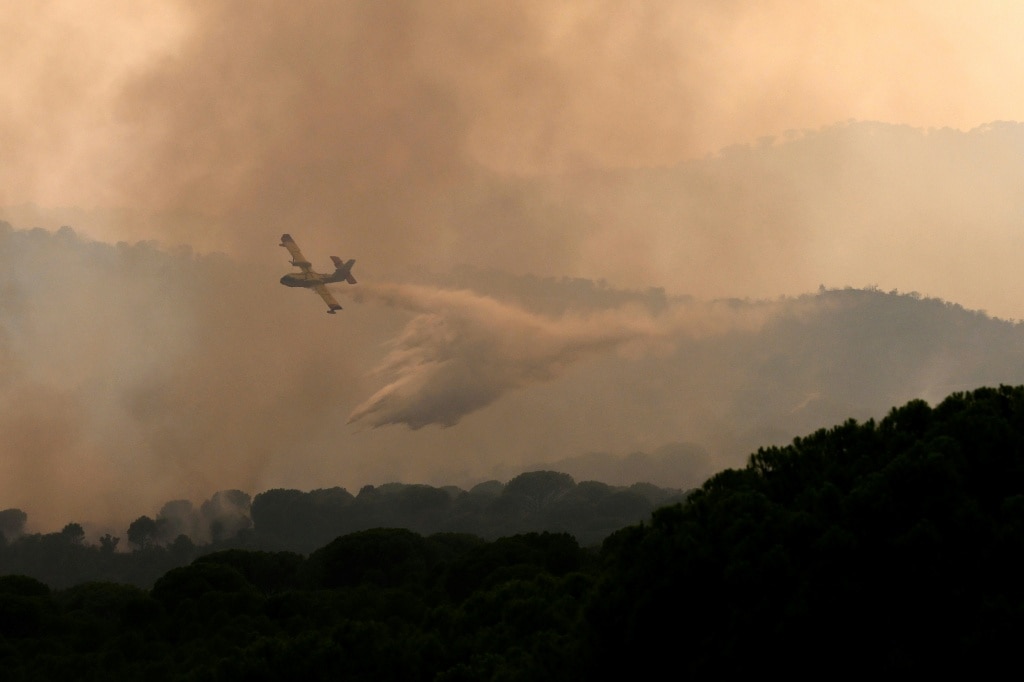
As Western Europe braces for a second blistering heatwave this week, firefighters across France and Spain are working around the clock to corral the most destructive wildfires the region has seen in decades, leveraging a narrow window of slightly cooler conditions before soaring temperatures return to fan the flames.
The fast-spreading infernos have already carved a devastating path through thousands of hectares of forest, reducing hundreds of residential structures to ash and forcing mass evacuations that have displaced tens of thousands of residents. With meteorologists forecasting a return of oven-like heat — starting Tuesday in France and Wednesday in Spain — emergency crews are locked in a race against time to get existing blazes under control before extreme conditions return.
On France’s Cap Ferret peninsula, where civilian volunteers have helped carve a massive 50-meter-wide, 25-kilometer-long firebreak to contain the blaze near Bordeaux, regional fire commander Eric Pitault said crews were holding the line against the inferno, though he acknowledged that teams were growing exhausted after six straight days of battle. Since the blaze ignited, it has scorched more than 42,000 hectares (103,000 acres) of land, forced 220,000 people to flee their homes, and destroyed 240 dwellings. While overnight flare-ups were reported in the northern part of the peninsula, French authorities confirmed these outbreaks have been contained, and the total burned area has not expanded.
In Spain, the toll is even greater: wildfires burning primarily west of Madrid have already consumed 77,000 hectares (190,000 acres) — an area nearly as large as New York City — and forced 60,000 residents to evacuate. Outside the Madrid-region town of Aldea del Fresno, displaced locals waited in lines of cars at roadblocks on Monday, hoping for permission to return to their homes to check on properties and rescue stranded pets. But Spanish civil security forces blocked re-entry, citing extreme risks from toxic wildfire smoke. Galia Borisova, a 55-year-old domestic worker waiting to reach her animals in nearby Picadas, said authorities had warned even masks could not filter the thick smoke, a risk she could see firsthand from her position at the roadblock.
The ongoing crisis is the latest manifestation of a broader trend of extreme weather that has gripped Europe throughout 2024, with consecutive back-to-back heatwaves and a widespread continental drought that scientists directly link to human-caused climate change. Years of rising global temperatures have created the ideal conditions for catastrophic wildfires: the preceding wet, mild winter and spring allowed vegetation to grow thick and lush, but months of extreme heat have dried that vegetation out, turning vast swathes of the European countryside into a massive tinderbox ready to ignite at the smallest spark.
Leaders of both nations have acknowledged the new reality of climate change that is driving these repeated disasters. Spanish Prime Minister Pedro Sanchez described the ongoing wildfire crisis as “the most painful expression of a climate emergency,” while French President Emmanuel Macron warned the public that “the coming weeks will be tough and we have to hold out.”
The crisis is already stretching European emergency resources thin, and EU crisis management commissioner Hadja Lahbib warned that the danger is not limited to France and Spain. Extreme fire risk is also building across central and eastern Europe, with conditions expected to worsen in Hungary, Slovakia, the Czech Republic, and Portugal in the coming days. “Extreme conditions are looming for Hungary, Slovakia and the Czech Republic, in addition to France, the Iberian Peninsula… where the situation is expected to worsen, including in Portugal starting today,” Lahbib said.
Spain’s national meteorological agency AEMET has confirmed the new heatwave will last through at least the end of this week, with forecasts calling for temperatures as high as 42°C (107.6°F) in the country’s northeast and 39°C (102.2°F) in central regions. For its part, MeteoFrance is forecasting high temperatures of up to 40°C (104°F) across the country starting Tuesday, paired with dry, gusty winds that will only increase fire risk. Spanish Interior Minister Fernando Grande-Marlanka said Sunday that the next 48 hours would be “absolutely decisive” for containing the large wildfires burning outside Madrid before the new heatwave hits.