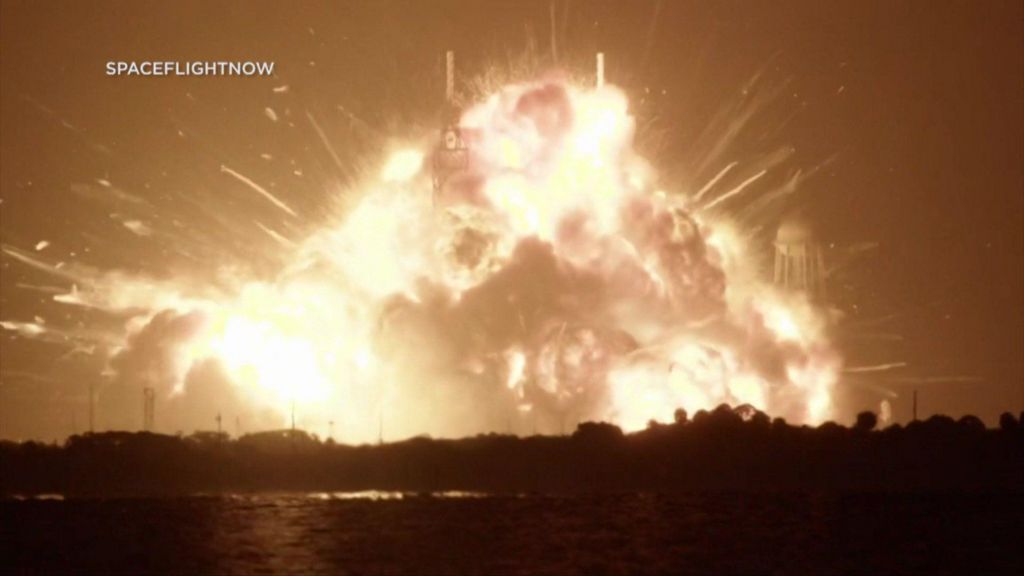
A dramatic engine test explosion at Florida’s Kennedy Space Center has sent shockwaves through the commercial space industry, casting significant uncertainty over both Blue Origin’s operational roadmap and NASA’s ambitious timeline to return astronauts to the Moon and establish a permanent lunar base. The incident, which unfolded at approximately 21:00 local time on May 29, 2026, occurred during a routine engine evaluation of the 98-meter New Glenn heavy-lift rocket, destroying the vehicle and causing severe damage to its dedicated launch infrastructure.
Thankfully, no casualties were reported in the blast, a outcome that Blue Origin founder Jeff Bezos confirmed in a post on social platform X. “All personnel are accounted for and safe,” Bezos wrote. “Very rough day, but we’ll rebuild whatever needs rebuilding and get back to flying. It’s worth it.” But the damage to Space Launch Complex 36 (LC-36), the only facility purpose-built to launch New Glenn, is extensive. Video footage captured after the explosion shows one of the pad’s critical lightning protection towers collapsed, and industry analysts broadly agree that repairs and recertification will take months, not weeks. Until that work is complete, Blue Origin has no capability to launch its largest rocket.
The setback extends far beyond Blue Origin’s internal development program, with cascading impacts on two high-profile projects: Amazon’s Leo broadband satellite constellation (formerly Project Kuiper) and NASA’s multi-billion-dollar lunar exploration initiative. For Amazon, the timing could not be worse. The rocket that exploded was scheduled to carry 48 Leo satellites to orbit as early as June 4, marking the first orbital launch of the constellation on Blue Origin’s own rocket. Currently, just over 300 Leo satellites are in orbit, all launched by third-party providers including SpaceX, United Launch Alliance, and Arianespace. That leaves the constellation, which was designed to compete with Elon Musk Musk’s SpaceX-led Starlink service, far behind its regulatory deployment schedule.
Under the terms of its license from the U.S. Federal Communications Commission, Amazon is required to have half of its planned 3,236-satellite constellation in orbit by July 30, 2026. As of late May, the company was already more than 1,300 satellites short of that target, with launch vehicle availability widely cited as a key cause of delays. With New Glenn grounded for months, Amazon will now be forced to rely even more heavily on rival providers, most notably SpaceX, to keep its deployment on track, and industry observers expect the company will almost certainly need to request another extension to its FCC license timeline. Musk offered a muted response to the explosion, posting only, “Most unfortunate. Rockets are hard” on X.
The most high-stakes ramifications of the blast center on NASA’s Artemis program and lunar base initiative. Just days before the explosion, NASA Administrator Jared Isaacman unveiled the first three missions of the agency’s plan to build a permanent outpost at the Moon’s south pole, framing the program as the start of a sustained human presence on the lunar surface. The first of these missions, Moon Base 1, is scheduled to launch no earlier than autumn 2026 aboard Blue Origin’s robotic Blue Moon Mark 1 “Endurance” lander, which was intended to fly to the Moon on top of a New Glenn rocket. The mission is tasked with delivering two NASA science payloads to the Shackleton Connecting Ridge and demonstrating precision landing capabilities that are critical for the safety of future crewed landings. That timeline is now in serious doubt.
Additionally, earlier this week NASA awarded Blue Origin a contract worth up to $468 million to deliver two commercial lunar terrain vehicles, built by Astrolab and Lunar Outpost, to the lunar south pole by 2028. These rovers are required to be in position before astronauts arrive, and the contract specifies that they will launch on New Glenn rockets. NASA’s broader Artemis III mission, scheduled for 2027, is planned as a low-Earth orbit test of two commercial crewed lunar landers developed by Blue Origin and SpaceX. Prior to the explosion, Blue Origin was widely regarded as further along in development than SpaceX, whose Starship lander has yet to complete a successful in-space propellant transfer test – a critical requirement for the mission. Now, the balance of the program has shifted unexpectedly.
NASA’s official target for the first crewed lunar landing in more than 50 years remains 2028, a timeline that was already facing scrutiny before the explosion. Compounding the pressure on NASA, China is moving forward with its own plan to land taikonauts on the Moon by 2030, leaving the U.S. space agency with little flexibility to absorb extended delays. In his response to the incident, Isaacman acknowledged the inherent challenges of space development. “Spaceflight is unforgiving, and developing new heavy-lift launch capability is extraordinarily difficult,” he wrote on X. But industry analysts agree that Isaacman’s goal of accelerating the frequency of NASA lunar missions is now at serious risk of being derailed by last night’s setback.