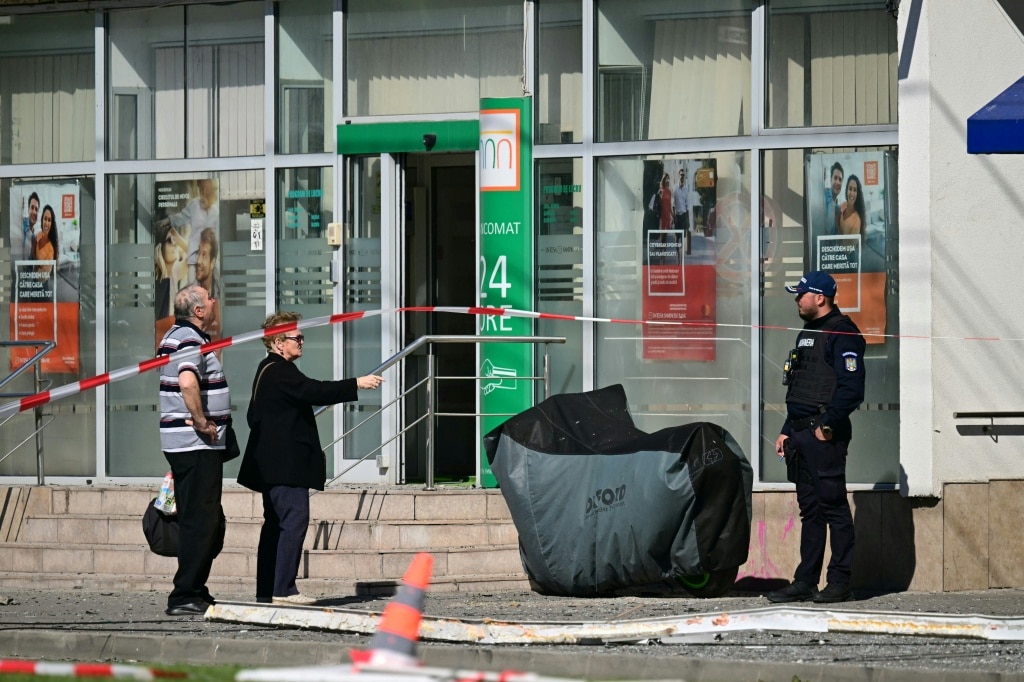
In an unprecedented incident that has sent shockwaves across the transatlantic alliance, a drone crashed into a residential apartment building in the Romanian city of Galati early Friday morning, leaving two people injured and triggering fierce condemnation from both NATO and the European Union. The strike, the first time a residential structure outside Ukraine has been hit since Russia launched its full-scale invasion in 2022, marks what Romanian officials call a dangerous and irresponsible escalation by Moscow.
According to official statements from Romania’s Ministry of National Defence, the incident unfolded overnight between May 28 and 29, amid a renewed wave of Russian drone attacks targeting civilian and critical infrastructure sites in Ukraine near the shared river border with Romania. “One of these drones entered Romanian airspace, was tracked by radar as far as the southern part of the city of Galati, and crashed onto the roof of an apartment building, with the impact triggering a fire,” the ministry confirmed. Local emergency services reported that a 14-year-old boy and a 53-year-old woman were hospitalized with injuries from the crash and subsequent blaze.
While dozens of unauthorized drone incursions have been detected across Romanian airspace since the start of the Russian offensive, this event marks the first time a drone has struck a residential building in the NATO member state. Immediately after the intrusion was detected, two Romanian F-16 fighter jets were scrambled to respond, but military officials confirmed there was no opportunity to safely shoot down the unmanned aircraft before impact. General Gheorghe Maxim of Romania’s Joint Forces Command told reporters that only four minutes passed between detection and crash, leaving an extraordinarily narrow window for intervention. Romanian President Nicusor Dan echoed this assessment, noting that the decision to hold fire was made to avoid putting civilian lives at greater risk from a mid-air intercept.
In the wake of the incident, Romanian officials have moved quickly to escalate their response. Bucharest summoned the Russian ambassador to Romania for an urgent meeting, and President Dan convened an emergency meeting of the country’s national defence council to address what officials described as “the most serious incident to have affected our national territory” since the 2022 invasion. The Romanian defence ministry reiterated its condemnation of the strike, confirming that the country has formally requested accelerated deliveries of dedicated anti-drone defence capabilities from allied partners.
The incident has drawn widespread condemnation from European and transatlantic leaders. European Commission President Ursula von der Leyen said Russia’s “war of aggression” had “crossed yet another line”, and pledged to step up deterrence efforts along the European Union’s eastern flank. Senior officials from Germany, France, the United Kingdom and the United States all issued statements denouncing the strike, with US Ambassador to NATO Matthew Whitaker calling the incident a “reckless incursion” and reaffirming that Washington stands in full solidarity with its NATO ally. Maia Sandu, President of Moldova — a country sandwiched between Romania and Ukraine that has also faced repeated drone incursions and fallen debris on its territory — warned that Russia represents “a danger to all” in the region.
NATO has echoed this condemnation, with alliance Secretary General Mark Rutte vowing “absolute solidarity” with Romania after a call with President Dan. “Russia’s reckless behaviour is a danger to us all,” Rutte wrote on social media. “I affirmed that NATO stands ready to defend every inch of Allied territory.” Supreme Allied Commander General Alexus Grynkewich, the top US military commander for the alliance, held a call with his Romanian counterpart to coordinate next steps, with NATO confirming that the two sides agreed to maintain close consultation throughout the ongoing investigation and consideration of additional defensive measures.
The incident comes as NATO member states bordering Ukraine and Russia — including Romania, Latvia, Estonia and Poland — face growing risk of cross-border drone incursions from the ongoing war. Just days earlier, Latvia formed a new government two weeks after the previous administration collapsed over a political dispute rooted in stray Ukrainian drone incursions that exposed gaps in the Baltic state’s air defences.
As of Friday afternoon, multiple alliance sources confirmed there is still no indication whether Romania will request emergency consultations under NATO’s Article Four, the provision that allows member states to request discussions when they believe their territorial integrity, political independence or security is under threat. A request for Article Four consultations would still fall well short of triggering the alliance’s Article Five mutual defence clause, which has only been invoked once in NATO’s 75-year history, following the September 11, 2001 terrorist attacks on the United States. Since the start of Russia’s full-scale invasion of Ukraine, Article Four consultations have been called three times: immediately after the 2022 invasion, by Poland following a Russian drone incursion, and by Estonia after a Russian fighter jet violated its airspace.