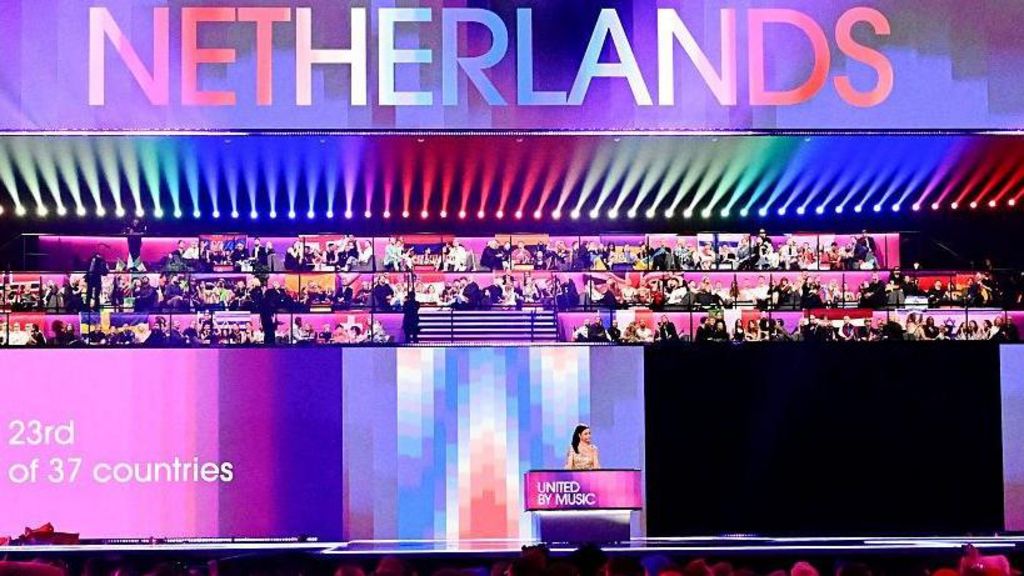
One of Europe’s most high-profile annual entertainment events is facing fresh internal turmoil after Dutch public broadcaster Avrotros announced its full withdrawal from the 2027 Eurovision Song Contest, citing irreversible damage to the competition’s long-held claim of political neutrality amid ongoing international armed conflicts. The decision, formally announced in an official statement released Monday, marks a deepening of rifts that have divided the Eurovision community since 2024, as tensions over Israel’s participation in the contest continue to escalate.
Avrotros leadership made clear that the recent rule adjustments adopted by the contest’s governing body, the European Broadcasting Union (EBU), do not go far enough to repair the competition’s compromised neutral standing. Earlier in August, the EBU passed a landmark amendment to its competition rules: any nation actively involved in a large-scale armed conflict that wins the contest will be barred from hosting the following year’s event. The rule change also expands disqualification for hosting to nations grappling with sensitive geopolitical situations that threaten the security, safety or regional stability of a potential host. While the amendment was widely interpreted as a response to calls for stricter standards around Israel’s participation, it also applies to Ukraine, which has been engaged in a full-scale defensive war against Russian invasion since 2022.
For Avrotros, however, these incremental changes failed to address core concerns around the contest’s shifting identity. In its statement, the broadcaster noted that two ongoing crises—the severe humanitarian catastrophe unfolding in Gaza and growing global restrictions on press freedom—have deepened divisions within the Eurovision ecosystem in recent years. The rule updates, Avrotros argued, do not provide sufficient confidence that the competition’s founding independent and neutral character has been restored.
The exit of Avrotros does not automatically mean the Netherlands will be absent from the 2027 contest. Unlike the United Kingdom’s single national public broadcasting system, the Netherlands has a decentralized network of multiple public broadcasters overseen by umbrella organization NPO. Another Dutch public outlet could step in to take on participation, and the EBU has already confirmed it will open dialogue with NPO to explore this path. Avrotros also emphasized that its withdrawal is limited to the 2027 contest, and does not rule out future Dutch participation in 2028 and beyond.
This development follows a series of boycotts that have rocked the contest over the past year. Last November, after the EBU rejected a motion to suspend Israel from the 2026 contest held in Vienna, Austria, five national broadcasters announced boycotts—including major Eurovision participant nations Spain, Ireland and the Netherlands. Despite the protests, Israeli entrant Noam Bettan finished second in the 2026 competition, marking the second consecutive year Israel has claimed the runner-up position. This back-to-back strong performance has amplified private concerns among participating broadcasters over the security risks of hosting the contest in Israel if the country claims its first victory since 1998, a fear that directly prompted the EBU’s new rule barring conflict-zone nations from hosting.
Taco Zimmerman, director general of Avrotros, framed the painful withdrawal as a matter of alignment with core organizational values. “The Eurovision Song Contest was originally created to bring people and countries together, but it is now a platform for division,” Zimmerman said in a statement. “It is undeniable that international conflicts are increasingly affecting the contest, undermining its neutral character. As a public broadcaster, we remain committed to our values. They guide us in everything we do, even when that means stepping away from an event that is very close to our hearts. That is painful as we would have very much liked to be part of the contest again next year.”
In response, EBU contest director Martin Green expressed regret over Avrotros’s decision but reaffirmed respect for the broadcaster’s stance. “We will now continue our dialogue with NPO, the umbrella organization for Dutch public service media, regarding the opportunities for another broadcaster to participate,” Green said in a statement. “We very much hope that audiences and artists in the Netherlands can continue to be represented in the Eurovision Song Contest.” Green pushed back against claims the contest has become a platform for division, reaffirming its founding mission: “The Eurovision Song Contest has always been a place to bring people together, celebrate diverse communities, and show that a better world is possible even in the most difficult times.”
The rule amendment, which was approved by the contest’s governing body following feedback from participating broadcasters after the 2026 Vienna contest, addresses a long-unresolved gap in Eurovision rules that many feared would leave the organization in crisis if a conflict-zone nation won. Ukraine’s 2022 victory, just months after Russia’s full-scale invasion, was broadly celebrated as a symbolic show of global solidarity, with the United Kingdom stepping in to host the 2023 contest on Ukraine’s behalf. But growing polarization around the Israeli-Palestinian conflict has created far deeper divisions within the Eurovision community, with no clear consensus on how to balance political values with the contest’s founding mission of cross-border connection.