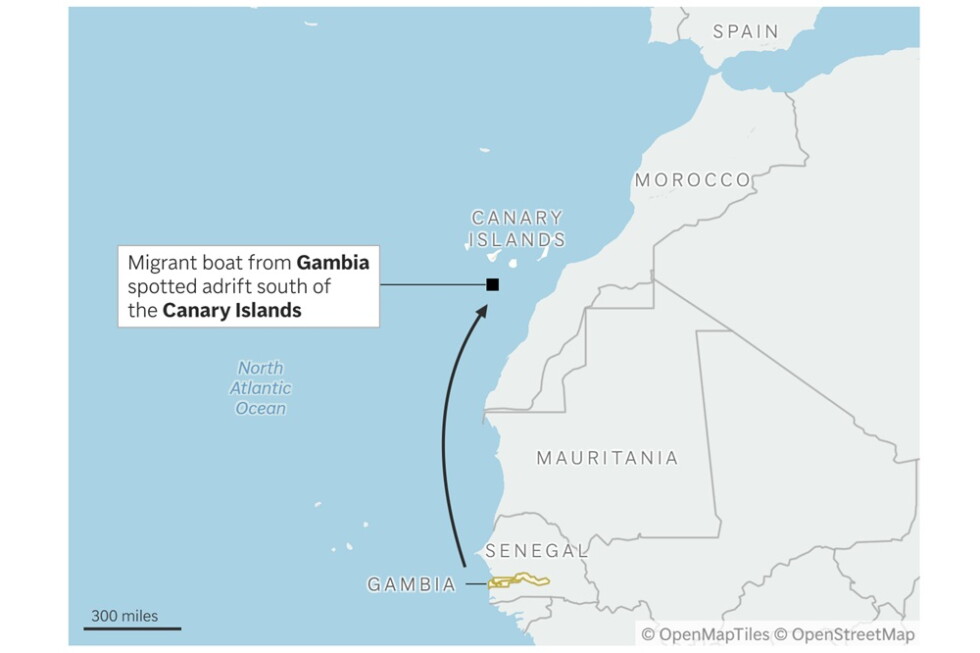
A devastating maritime disaster off the coast of Spain’s Canary Islands has left at least five migrants dead and dozens more missing, with activists reporting an even higher death toll following the vessel’s catastrophic breakdown in the Atlantic Ocean. Only 44 people from the overcrowded boat were pulled to safety by Spanish rescue crews this week.
Spain’s Maritime Rescue Service confirmed Thursday that a surveillance plane first detected the unstable, drifting vessel around 120 kilometers south of Gran Canaria on Wednesday afternoon. Responding quickly to the distress call, rescue teams immediately airlifted three of the most severely injured survivors to a Gran Canaria hospital by helicopter, while the remaining 41 passengers were transported to shore by rescue vessel. The group disembarked early Thursday at Arguineguín port, where local Red Cross teams stood by to provide urgent medical care and support.
José Antonio Rodríguez Verona, a Canary Islands-based Red Cross spokesperson, told reporters that all 44 survivors are men, including several underage passengers, who originated from Mali and Senegal. In an interview with the Associated Press, Rodríguez Verona explained that the survivors arrived in a fragile state: many were severely disoriented and dehydrated, with a large number collapsing or vomiting immediately after setting foot on land after weeks adrift at sea.
Due to the survivors’ poor physical and mental condition, it took responders time to piece together the details of the fatal voyage. Survivors told aid workers they departed from Gambia nearly a month earlier, and had been stranded adrift for far longer than anyone anticipated. When their food and fresh water supplies ran out, desperate passengers were forced to drink seawater to survive, a choice that left many gravely ill.
The survivors also shared chilling accounts of the scale of the disaster: they told the Red Cross that more than 100 people, including multiple women and one infant, were originally on board the small vessel. As passengers died of dehydration and illness over the course of the journey, surviving passengers threw the bodies overboard, until they eventually became too weak to continue the practice.
Spain’s Maritime Rescue Service stated in an official emailed statement that rough sea conditions, including 2.5-meter-high waves and strong gusting winds, prevented crews from recovering the remains of five deceased passengers found still on the boat when rescuers arrived.
In a separate update, Helena Maleno, founder of migrant rights organization Walking Borders — a group that tracks fatalities and missing persons along migration routes leading to Spain — has put the total death toll from this voyage at 83, including three women and the infant. Maleno confirmed via a post on the social platform X that the boat departed Gambia 27 days before the rescue. Maleno’s organization regularly receives distress messages from relatives of missing migrants and coordinates rescue requests with Spanish authorities. The Associated Press has reached out to Maleno and Walking Borders for additional context, but has not yet received a response.
This disaster highlights the ongoing deadly risk of the West African Atlantic migration route to the Canary Islands, which remains one of the most dangerous migration crossings into Europe. While the number of migrant arrivals to the Spanish archipelago has dropped sharply over the past year, tens of thousands of migrants have died or gone missing on the route in recent years. In multiple extreme cases, overcrowded migrant boats have become lost and drifted all the way across the Atlantic Ocean as far as the Americas before being found.