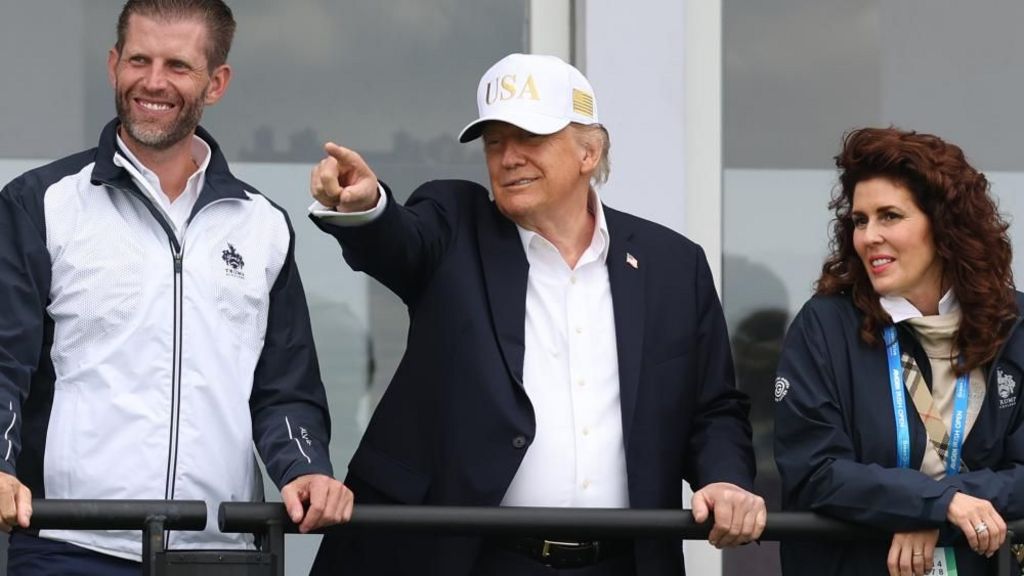
Former U.S. President Donald Trump is wrapping up a two-day official visit to the Republic of Ireland, a trip that has blended leisure golf diplomacy with provocative political comments that have drawn international attention and widespread public pushback.
On the second full day of his trip, Saturday, Trump took up residence at his own Trump International Golf Links in Doonbeg, County Clare, where he is in attendance for the 2026 Irish Open, watching the tournament’s opening rounds of play. The event is a natural fit for Trump, a lifelong avid golfer who has longstanding ties to the Co Clare resort and personal connections to top golfing talent competing in the tournament: defending champion Rory McIlroy, a Northern Irish golf star, previously played a round with Trump in early 2025, and Trump has publicly lauded McIlroy’s back-to-back Masters championship wins in recent years. Trump is scheduled to stay through Sunday to watch the tournament’s final round of play before departing for the U.S. from Shannon Airport Sunday evening.
The most politically charged moment of the trip came a day earlier, during formal meetings in Dublin with Ireland’s top leadership, including Irish President Catherine Connolly and Taoiseach (Irish Prime Minister) Micheál Martin. Speaking to reporters after his closed-door talks with Martin at Dublin’s Farmleigh House in Phoenix Park, Trump shared his unprompted stance on the long-running issue of Irish unification. “I would love to see a united Ireland,” Trump told reporters, adding that he believes unification will “happen eventually.” He called a united Ireland a “fantastic thing” and a “great thing,” arguing “how can it be bad?” While he acknowledged the United Kingdom would have a significant say in any border poll on unification, he praised Martin, saying the Taoiseach was “the right man over here to get it moving.”
Trump’s comments quickly drew a response from Downing Street, the official residence of UK Prime Minister Andy Burnham. A Number 10 spokesperson pointed reporters back to comments Burnham made earlier that week in the House of Commons, where the prime minister reaffirmed his government’s unwavering commitment to the Good Friday Agreement, the 1998 peace deal that ended decades of sectarian conflict in Northern Ireland. Burnham clarified Wednesday that any decision on holding a border poll on Irish unification rests solely with the Northern Ireland Secretary, and can only be considered when a clear public consensus in favor of unification emerges across Northern Ireland. A spokesperson for Martin later noted that Trump’s stance should not come as a surprise to any observers, saying the former U.S. president has “consistently held the view that he sees unity in Ireland as the optimal outcome.”
Even as Trump held formal meetings and teed off at his Irish golf resort, thousands of Irish citizens gathered to demonstrate their opposition to the visit. More than 10,000 marchers took to the streets of Dublin to protest Trump’s arrival, organizing the demonstration to start moments after Trump departed the capital for his Co Clare resort. Event organizers said the protest was intended to deliver a clear, public message rejecting both Trump and his broader policy agenda.