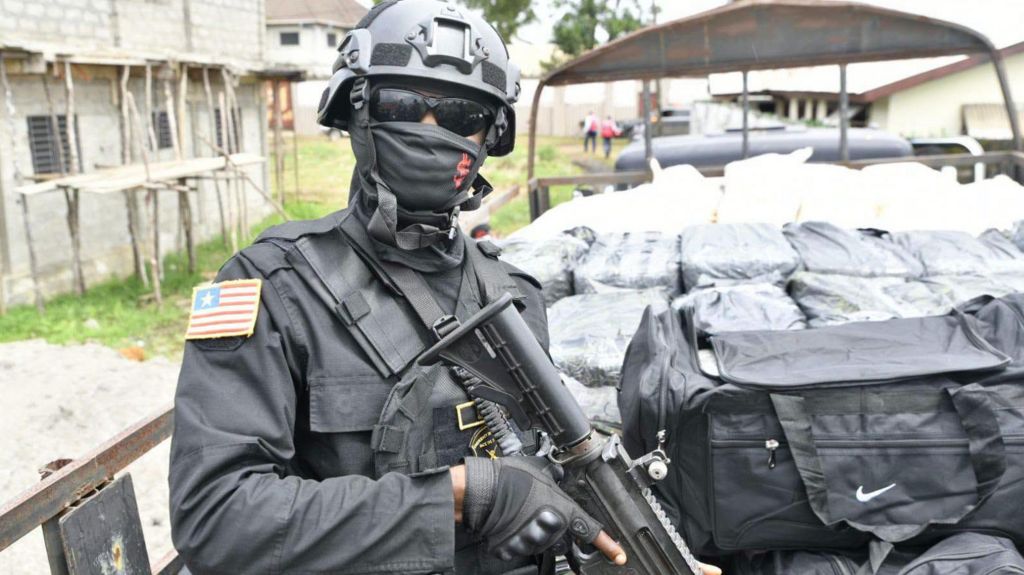
Law enforcement agencies in Liberia have carried out the largest drug seizure in the nation’s history, confiscating a massive shipment of high-grade cocaine estimated to be worth more than $370 million near the capital, Monrovia. The operation targeted a suspected illicit storage facility in Duazon, a small town located roughly 20 kilometers east of Monrovia, and resulted in the arrest of multiple suspects, investigators confirmed this week.
Visual evidence released by the Liberia National Police via social media shows dozens of sealed suitcases and cardboard boxes stowed inside a freight truck, all of which held the contraband confirmed as cocaine through forensic testing, according to Police Chief Gregory Coleman. In an interview with the BBC, Coleman explained that Tuesday’s seizure marked the culmination of 18 months of coordinated surveillance targeting transnational drug trafficking networks that have reestablished a foothold in Liberia since 2018.
Among those taken into custody are two foreign nationals and several Liberian citizens. One foreign suspect was found carrying two passports – one Spanish and one Colombian – while the second holds a Serbian citizenship, Coleman confirmed. As of the latest update, no formal criminal charges have been filed against any of the detainees, and investigators are still working to trace the origin of the shipment and identify its final destination. Coleman noted that the two foreign suspects were arrested shortly after entering Liberia, as law enforcement was already actively tracing the supply chain of the network.
Liberian Vice-President Jeremiah Koung has publicly commended security forces for their successful operation, emphasizing in a statement that any individual found guilty of involvement in the trafficking ring will face full legal accountability, regardless of their position or status. This historic bust comes just one month after a smaller but still significant cocaine seizure at Roberts International Airport, where security officers intercepted six mislabeled cargo boxes falsely declared as holding food seasoning and textiles. Inside, investigators found nearly 200 compressed blocks of cocaine bound for international export.
That airport seizure sparked widespread political controversy, with public critics accusing authorities of delaying investigations to allow key suspects to flee the country. In response, President Joseph Boakai ordered a joint probe involving both national police and the Liberia Drug Enforcement Agency (LDEA). To date, several suspects have been formally charged, and international arrest warrants have been issued for other network members who remain at large.
The bust underscores the growing challenge of transnational drug trafficking across West Africa, a region long identified by international law enforcement groups as a major transit hub for cocaine moving from South American production centers to consumer markets in Europe. Criminal organizations exploit the region’s porous border controls and uneven law enforcement capacity to move large shipments, and data from the Global Initiative Against Transnational Organised Crime shows that at least 30 percent of all cocaine bound for Europe now transits through West Africa. Beyond transshipment, the group also reports that local consumption of cocaine, including the cheaper crack cocaine variant, has risen steadily across the region in recent years.
Total cocaine seizures across West Africa have climbed consistently since 2019, hitting roughly 30 tonnes in 2025 alone, according to the Global Initiative. The United Nations has repeatedly warned that the expanding influence of drug cartels in the region, who are running increasingly sophisticated smuggling operations, poses a major threat to regional stability and security.
Liberia has already seen multiple high-profile drug seizures in recent years, including a 520-kilogram cocaine shipment intercepted at Monrovia’s seaport in 2022. Since taking office in 2024, President Boakai has made cracking down on drug trafficking a core policy priority, reshuffling the leadership of the LDEA multiple times amid growing public and international pressure to address the issue.