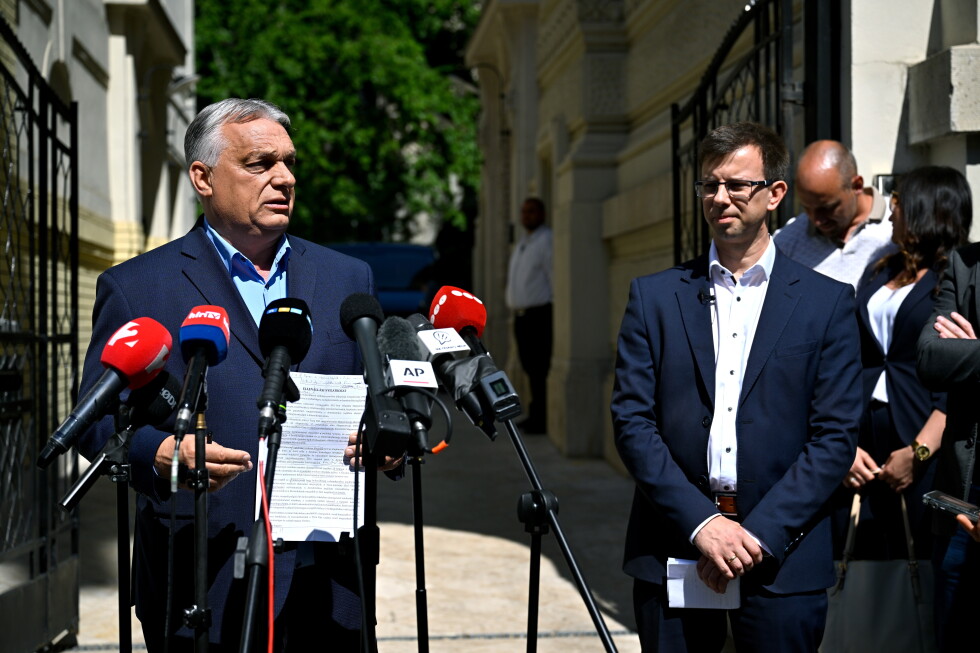
BUDAPEST, Hungary — In a striking public move Wednesday, former Hungarian prime minister Viktor Orbán announced that his far-right Fidesz party will spearhead a peaceful national resistance campaign against the newly installed center-right administration he accuses of exercising tyrannical power. The announcement comes three months after Orbán’s 16-year unbroken grip on national governance came to an abrupt end, following a landslide April election loss to Prime Minister Péter Magyar and his pro-European Tisza party, a defeat that has left Fidesz grappling with plummeting support and internal upheaval.
Speaking outside Fidesz’s Budapest headquarters, Orbán centered his attack on a recent constitutional amendment passed last week by Tisza’s parliamentary supermajority. The amendment, which removed the Orbán-aligned sitting president of Hungary and introduced a 12-year cumulative term limit for members of parliament, has, in Orbán’s view, dismantled the country’s rule of law and eliminated the system of checks and balances that underpinned Hungarian democracy.
Orbán went further, arguing that the retroactively applied term limit pushes Hungary back to the authoritarian conditions of the late 1980s, the final years of the country’s Soviet-backed Communist dictatorship, when free democracy and independent rule of law did not exist. He added that the new regulation would bar roughly half of Fidesz’s sitting parliamentary caucus members from running in the 2030 national election, cementing what he labeled an undemocratic power grab. “This new political system is not a democracy, it is tyranny,” Orbán declared.
Since taking office in May, Magyar’s administration has moved rapidly to roll back the institutional changes Orbán put in place during his tenure, framing the effort as a crackdown on what the prime minister calls Orbán’s corrupt “mafia state.” The new government has removed hundreds of political appointees installed by Fidesz, ousted leaders of state institutions that Magyar’s allies say enabled Orbán’s autocratic shift, suspended Hungarian public broadcasting’s news division — which Magyar argues operated as a state-funded propaganda factory for Fidesz — and shut down the controversial Sovereignty Protection Office, a body widely criticized by Orbán’s opponents as a tool to intimidate government critics and suppress independent media.
Fidesz has pushed back against these moves, framing them as unconstitutional attacks on democratic opposition and warning that Magyar’s government is building its own authoritarian system. Tisza, by contrast, argues that the administration is acting on the overwhelming electoral mandate it won in April to deliver on campaign pledges to root out systemic corruption and restore the rule of law eroded during Orbán’s 16-year tenure.
Wednesday’s announcement formalized Fidesz’s opposition: Orbán said the party considers all officials appointed by Tisza to replace Fidesz-era appointees illegitimate, and publicly released the party’s pre-planned “Declaration of Resistance” against the new administration. The declaration, published by Fidesz late Tuesday, states that “from this day forward, our mission is to restore the democratic rule of law” and asserts that “every citizen has the right to stand against tyrannical rule.” Orbán emphasized that the movement will rely exclusively on peaceful tactics, both within the parliamentary system and through public action outside the legislature, to oppose what he calls arbitrary state power. The declaration provides few concrete details on what the resistance will entail, beyond noting that the party will offer support to people it describes as “victims of the authoritarian regime” and document alleged violations of Hungarian law.
Polling data from recent weeks illustrates the dramatic slide Fidesz has experienced since its election defeat. A June survey conducted by independent pollster Medián and published by Hungarian news site HVG.hu found that Tisza holds the support of 60% of Hungarian adults, while Fidesz’s support has collapsed to just 18%.
The pressure on Fidesz ramped up even further just ahead of Orbán’s announcement: on Tuesday, Hungarian prosecutors and tax authority investigators raided Fidesz office space that houses the party’s data servers, as part of an ongoing investigation into suspected embezzlement and other criminal activities that allegedly occurred during Orbán’s time in office. Orbán called the raid a politically motivated act Wednesday, saying such targeting of an opposition party “could occur only in severe dictatorships.”
In addition to plummeting poll numbers and legal investigations, Fidesz has faced high-profile departures in recent weeks. Last week, Gergely Gulyás, the party’s long-serving parliamentary caucus leader, stepped down from his leadership role, while Péter Szijjártó, who served as foreign minister throughout Orbán’s final terms in office, announced he would resign from parliament to take a senior executive role at Chinese electric vehicle manufacturer BYD.