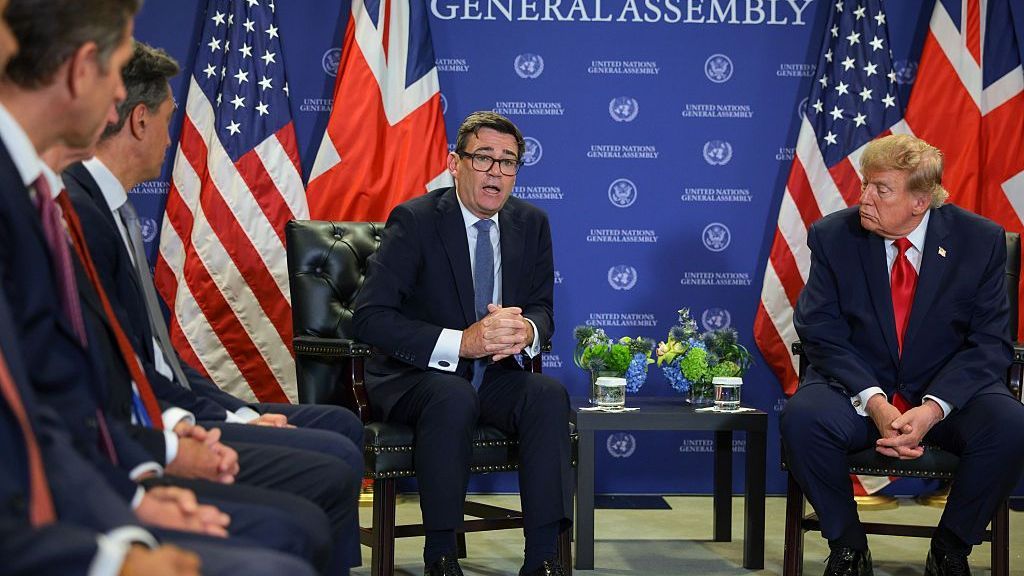
It was an unconventional diplomatic encounter held in a windowless, unremarkable basement meeting room down a dim corridor at the United Nations headquarters — far from the polished grandeur of the White House Oval Office. As a reporter crouched between a bank of press cameras, hoping to catch U.S. President Donald Trump’s attention for a question, I watched the former (and seeking re-election) president lean into a rare moment of measured cordiality. As anyone who has covered Trump knows, he can flip between sharp acerbity and genuine warmth at will, and on this occasion, he chose warmth.
Seated beside the most powerful leader in the world was Andy Burnham, who had only stepped into the role of UK Prime Minister months earlier after serving as a city mayor. Burnham had publicly stated ahead of the meeting that he was looking forward to the discussion, but even with that confident framing, a flicker of nervousness would have been understandable. Reporters in the room noted that he did appear slightly on edge when the press pool entered the space, but any tension was quickly defused by a steady stream of compliments from the U.S. president.
The original schedule called for journalists to join the two leaders just minutes after their first greeting, to open the meeting to press. Instead, the press pool was held outside while the pair held closed-door private talks first — an unexpected change that ended up working in reporters’ favor, leaving both leaders with more prepared comments about their discussions than they would have shared otherwise.
Burnham went into the encounter well aware that unscripted, live on-camera meetings with Trump are famously unpredictable: they can veer off into unplanned controversy at any moment, akin to riding a rollercoaster without a safety harness. Once the press was inside, I managed to get myself into Trump’s line of sight, and waited until Burnham finished his opening remarks to call out my question. I asked the U.S. president whether, despite their well-documented political differences, he believed Burnham was a leader the U.S. could work with.
Trump’s response was immediately warm. “I do, I think he’s a natural business person. We’ve had a lot of discussions even before this meeting. We’ve spoken to each other numerous times on the phone. Yeah, I think so, I think so. He gets it. He understands what he has to do.”
The open goodwill was clear, and it likely eased any pre-meeting jitters the Downing Street team had been feeling. The meeting was entirely in Trump’s hands: he controls the length of these public question sessions, which have sometimes stretched well past 30 minutes. This time, the neutral, low-key setting at the UN seemed to tone down the sense of high-stakes spectacle.
Even as the conversation turned to potentially divisive issues, the bonhomie held. A question about immigration, a longstanding point of policy friction between the two leaders’ positions, passed without incident. So did discussion of the Burnham government’s recent announcement — made by Foreign Secretary Ed Miliband, who was in attendance at the meeting — of new sanctions on Israeli settlements in the West Bank, a decision that drew fierce anger from the Israeli government.
But when the conversation turned to the future of the Chagos Islands, Trump could not hide his blunt disapproval of the previous UK government’s decision to cede sovereignty of the archipelago to Mauritius, while retaining a long-term lease for the critical British military base on Diego Garcia. He called the deal “terrible”, adding that he believed the new prime minister would revisit the agreement. Burnham simply replied “yep” to the president’s comment.
After the joint press availability, I spoke one-on-one with Prime Minister Burnham on behalf of all major broadcasters. Burnham framed the first meeting as “very encouraging”, noting that the pair “had established a good connection” to build on. When I pressed him on whether the Chagos Islands deal would be revised, he pointed out that the agreement had been finalized by the previous government, which he “inherited” upon taking office. “We’ve got to find a resolution, and so work will continue now…to see where that resolution might lead,” he said. That response strongly suggests the deal is set for renegotiation.
Few global leaders manage to avoid public flashpoints with the Trump administration, so future disagreements between the two leaders are almost inevitable. Burnham may even choose to take public stances that create friction in time, and issues like the Chagos deal could easily become a point of contention down the line. But for the moment, the first face-to-face meeting has left Burnham with a working relationship with Trump that he can build on. After the unpredictable, high-stakes encounter with Trump, the rest of Burnham’s UN meetings followed the traditional, predictable rhythm of standard diplomacy — a far cry from the wild ride he had just navigated successfully.
To stay updated on the inner workings of UK politics at Westminster and beyond, sign up for the *Politics Essential* newsletter.