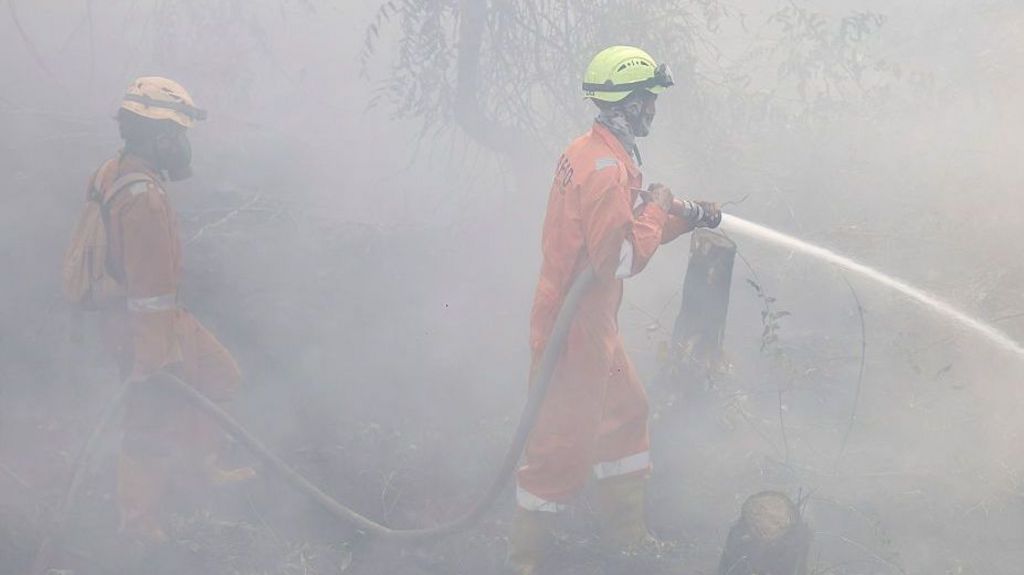
Indonesia is facing one of its worst wildfire crises in recent history, as blazes stoked by the extreme dry conditions of a “Godzilla” El Nino have swept across the archipelago for weeks, triggering a nationwide public health emergency and spreading toxic haze across Southeast Asia.
Indonesia’s Ministry of Health confirmed that as of recent reports, more than 175,000 people across the country have developed respiratory illnesses since August, with cases ranging from mild coughs and bronchitis to severe pneumonia. Alarmingly, over 40,000 of these confirmed cases involve toddlers, who are particularly vulnerable to the damaging effects of air pollution.
The unchecked blazes have sent thick plumes of toxic smoke across large swathes of Indonesia, as well as neighboring Malaysia, Singapore, and even parts of the Philippines. Air quality indices across affected regions have repeatedly plunged into the “unhealthy” range, forcing public health advisories and disrupting daily life for millions.
Authorities have deployed over 54,000 personnel and dozens of aircraft to conduct water bombing operations on the hardest-hit islands of Borneo and Sumatra. However, extinguishing the fires has proven an uphill battle, due to the vast area impacted and the challenging conditions of burning peatlands, which smolder deep underground and reignite easily. “From the air to the ground, all forces continue to move,” Indonesia’s Cabinet Secretary Teddy Indra Wijaya stated on Monday. “Everything is being done to extinguish the fires, reduce the impact of the smoke, and, most importantly, protect the public from the threat of forest and land fires.”
Wildfires are a recurring annual hazard during Indonesia’s dry season, which typically runs from July to October. But this year, the extreme weather event dubbed “Godzilla” El Nino has created unprecedentedly arid conditions that have supercharged the spread of fires. As of Wednesday, independent forest monitoring group Nusantara Atlas has detected approximately 734,000 fire hotspots across the country — a 30% increase from 2019, one of Indonesia’s most severe wildfire seasons on record. Since the start of the year, at least 895,657 hectares of land have burned — an area nearly six times the size of Greater London.
The disaster has already upended daily life across much of Indonesia, with widespread school closures and a sharp surge in hospital admissions for smoke-related illness. Health ministry data shows that the number of reported respiratory illness cases more than doubled between September 1 and September 9, jumping from 50,891 to 113,336.
Beyond human health impacts, the wildfires have also taken a devastating toll on regional wildlife, including the critically endangered Bornean orangutan. Late last month, an Indonesian wildlife foundation released footage showing an orangutan writhing on the ground in a West Kalimantan palm oil plantation — one of the worst-affected regions. Rescued by a local farmer, the great ape received emergency treatment for smoke-induced hypoxia, but ultimately succumbed to its injuries.
The ongoing crisis has sparked legal action against Indonesian authorities: last week, indigenous and civil society groups in West Kalimantan filed a class-action lawsuit against the national and local governments, accusing them of deliberate negligence for failing to prevent and properly address the wildfires. “This is a disaster that occurs every year. This recurring pattern proves our view that the defendants knew about the potential haze disaster and the risks of disaster from forest and land fires,” the group’s lawyer Glorio Sanen said in a statement.
In an effort to curb the blazes and alleviate the drought conditions fueling them, Indonesia has conducted multiple rounds of cloud-seeding operations, some in partnership with the Japan Self-Defense Forces, which deployed personnel to Borneo earlier this month to assist with firefighting. Cloud seeding works by introducing particles like salt crystals or silver iodide into existing clouds to encourage precipitation, though meteorologists remain divided on how effective the technique is for large-scale wildfire response.
Malaysia’s Sarawak state, one of the worst-hit areas outside Indonesia, also launched a five-day cloud-seeding operation earlier this month. Beyond tackling haze, the effort was intended to boost declining water levels at regional hydropower dams ahead of a forecasted severe dry spell in October. “October might be hotter and drier,” Sarawak’s Deputy Premier Douglas Uggah Embas told reporters. “We want to increase the water levels as much as possible while we still can.”
As of publication, the haze continues to spread across Southeast Asia, with Singapore issuing daily haze advisories and Philippine officials urging residents to limit outdoor exposure until air quality improves.