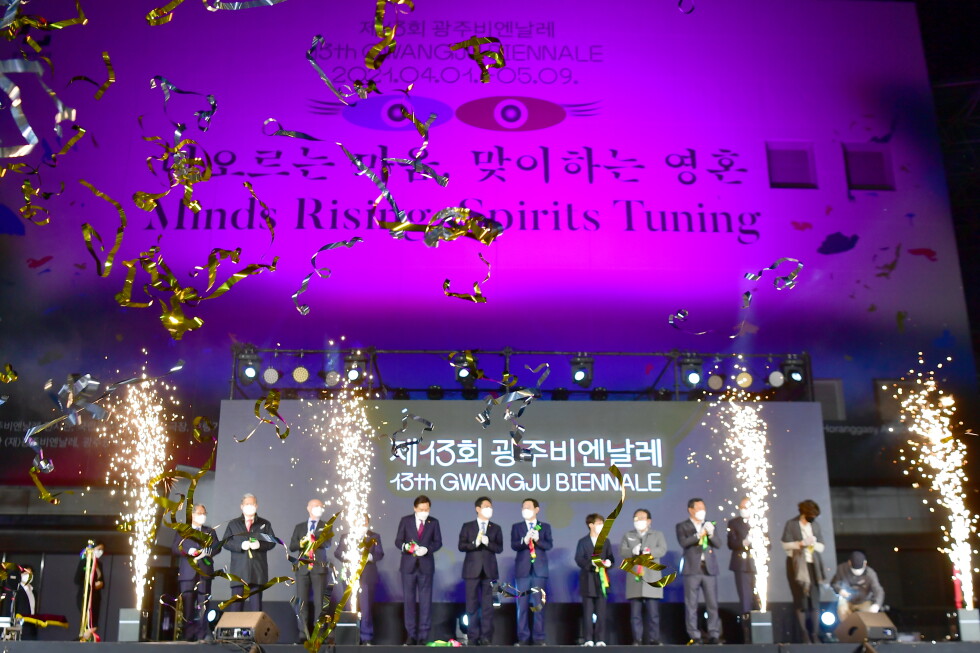
A diplomatic and cultural standoff has disrupted Asia’s leading contemporary art event, the Gwangju Biennale in South Korea, after a cohort of Chinese artists pulled out of the exhibition in protest of organizers’ decision to allow Taiwanese participants to exhibit under the label “Taiwan Pavilion.”
China has long upheld the one-China principle, which holds that the self-governing island of Taiwan is an inalienable part of Chinese territory. Beijing formally refers to the island as “China’s Taiwan region” and rejects any framing that suggests Taiwan has independent sovereign status. In comments released Thursday, China’s Foreign Ministry issued sharp criticism of the biennale’s organizing committee, accusing the group of “stubbornly clinging to the wrongful practice, allowing China’s Taiwan region to participate under a designation that is completely incompatible with its status.”
Ministry spokesperson Guo Jiakun added that Beijing expects the South Korean government to translate its formal political commitment to the one-China principle into tangible action. On the same day the ministry released its statement, the participating Chinese artists confirmed their withdrawal from the exhibition, which is scheduled to open Saturday and run through mid-November.
The contested “Taiwan Pavilion” is part of the biennale’s Pavilion Project, a parallel program featuring roughly 25 small national and institutional galleries hosted separate from the event’s main exhibition grounds. In an interview with reporters, Chinese curator Ruan Yuelai, speaking through an interpreter, framed the naming dispute as an unauthorized injection of political controversy into the cultural sphere. “The organizers of the Gwangju Biennale used an incorrect name for China’s Taiwan region over its participation in the exhibition, causing a political issue to spill over onto the realm of art,” Ruan explained. “The Chinese exhibition team cannot accept this and unanimously agreed to withdraw from the exhibition to express our strong protest.” As of Friday afternoon, the Chinese contingent had not yet removed the paintings, sculptures and other artworks originally prepared for display in the event’s China Pavilion.
The naming disagreement has a tangled recent history. Back in August, Taiwan’s Ministry of Culture confirmed the island’s participants had originally planned to exhibit under the “Taiwan Pavilion” banner, and even protested when organizers initially proposed rebranding their space as the “National Taiwan Museum of Fine Arts Pavilion.” In a statement released Wednesday, the biennale organizers offered a public apology “for causing concerns and confusion” among stakeholders in the Pavilion Project, acknowledging that disagreements over the naming had persisted between the event team and the Taiwanese museum.
Organizers clarified that they had signed a participation contract with the National Taiwan Museum of Fine Arts under the assumption that Taiwanese artists would exhibit under the museum’s widely used acronym, NTMoFA. Per the event team, the Taiwanese museum later demanded that the space be called “Taiwan Pavilion,” leaving organizers feeling pressured to accept the name change.
This latest dispute is part of a broader pattern of growing diplomatic pressure from Beijing over Taiwan’s international participation. Earlier this same week, China issued a formal warning of unspecified consequences after Taiwan’s foreign minister addressed a diplomatic forum in Palau. In May, Beijing pressured an African nation to bar Taiwanese activists from taking part in an international human rights conference. Beijing has ramped up coercive diplomacy targeting Taiwan in recent years, poaching the island’s remaining formal diplomatic allies; Taiwan now counts just 12 countries that officially recognize its sovereignty. The two sides have been politically separated since the end of the Chinese civil war in 1949.
It remains uncertain whether the current protest will escalate into a full-scale diplomatic rift between Beijing and Seoul. South Korea’s current liberal government has made improving bilateral ties with China a policy priority, and China is South Korea’s largest single trading partner. For its part, South Korea’s Foreign Ministry has moved to distance itself from the decision, noting that the naming choice was made exclusively by a non-governmental organizing body and has no connection to the South Korean government. The ministry added that Seoul hopes the dispute will not negatively impact bilateral cooperation and relations between the two countries.