The world’s most prestigious contemporary art event, the Venice Biennale, opens its 2025 edition this Saturday, marking one of the most politically charged and chaotic iterations in the exhibition’s decades-long history. What was meant to be a celebration of global artistic vision has been upended by geopolitical conflict after the awards jury stepped down en masse to protest the inclusion of Israeli and Russian national pavilions, leaving no Golden Lion awards granted by official adjudicators. Compounding the friction, large-scale public demonstrations have been staged outside the two contested pavilions, amplifying tensions that have split the global arts community.
While the jury framed its protest around its stance that only nations facing International Criminal Court investigations for alleged human rights violations should be excluded from awards consideration, the move has drawn further debate, with many critics arguing the United States should have been held to the same standard. Renowned British-Indian sculptor Anish Kapoor, one of the most high-profile voices in the protest, summed up the widespread frustration driving the unrest: “We are pushing back against the politics of hate and war that have plagued our world for far too long.”
In a sudden shift to an open, audience-driven selection process, visitors will now step into the jury’s role, casting votes for two top honors: best national pavilion from the 100 participating countries, and best participant in the Biennale’s central curated exhibition, titled *In Minor Keys*. Modeled after the fan-voted Eurovision Song Contest, the results will remain under wraps until the exhibition’s closing day on November 22.
Amid the political upheaval, the 2025 Biennale carries a historic legacy: it is the first major central exhibition curated by an African woman, the late Cameroonian curator Koyo Kouoh, who passed away one year ago before the show could be completed. Five collaborating curators stepped in to bring Kouoh’s vision to life, a vision centered on amplifying underrepresented minority perspectives from across the globe. The exhibition greets visitors with a towering, red feather-sculpted costume embroidered with glass beads, rooted in the Black Masking carnival culture of New Orleans, a tradition born from cultural practices brought to the Americas by enslaved Africans. In total, Kouoh selected 110 artists and collectives to participate, staying true to her core mission of carving out space for creators who are often sidelined by mainstream arts institutions. “She dedicated her practice to making space for every voice to shine, and that ethos runs through every corner of this exhibition,” explained co-curator Marie Helene Pereira.
Leading the slate of nationally curated pavilions, Britain’s representative, Turner Prize-winner Lubaina Himid, brings a deeply personal exploration of immigration, belonging and what it means to build a home in an adopted country. Titled *Predicting History: Testing Translation*, the presentation features vivid, brightly colored canvases that depict couples navigating the everyday dilemmas of being a newcomer. Himid, who was born in Zanzibar and has lived in Britain for more than 70 years, broke down the core tension of one standout work: “We have two architects debating where to build. One argues that building a permanent structure would prove they have contributed to the nation’s culture. The other says no – we need to build something we can escape from if we have to leave tomorrow.”
Off the main exhibition grounds, the Vatican has stepped in to offer visitors a quiet spiritual escape from the surrounding chaos with its pavilion, the *Mystic Garden*, installed on the grounds of the Discalced Carmelite order adjacent to Venice’s central train station. Guests wander through working vineyards, past a fruiting pomegranate tree and beds of fragrant herbs, wearing headphones that deliver a curated soundscape: reimagined compositions by 12th-century abbess, mystic and composer St. Hildegard of Bingen, reworked by contemporary artists including Brian Eno and Patti Smith. “Music helps us turn inward and connect with what Hildegard called the symphony that God placed within every life,” explained Father Ermanno Barucco, prior of the Carmelite order overseeing the installation.
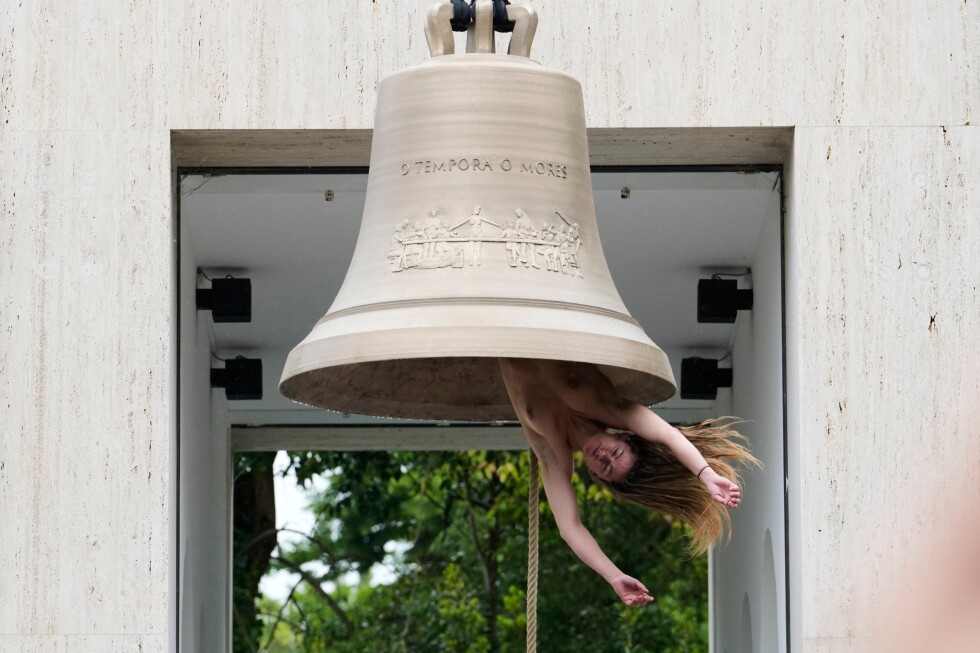
Austria’s pavilion has become one of the most talked-about presentations on the Giardini grounds thanks to its unflinching, provocative performance art, which uses unorthodox materials to critique overtourism and the commercialization of Venice. Outside the pavilion, a naked female performer hangs from a giant brass bell, acting as a human clapper that rings the instrument with every movement. Inside, another nude performer rides a Jet ski in circles inside a large water tank, a visual metaphor for Venice’s transformation into nothing more than a crowded amusement park for international tourists. In one of the exhibition’s most controversial pieces, a third nude performer breathes through a scuba regulator while submerged in a tank of filtered toilet water pulled from nearby facilities, for a project titled *Seaworld Venice*.
Against the backdrop of calls for boycott, Israeli pavilion artist Belu-Simion Fainaru, a Romanian-born Israeli, has centered his installation on the tension between love and war, rooted in Jewish mysticism. Water drips slowly from suspended glass tubes into a central pool, pausing every cycle for exactly 42 seconds – a reference to the 42-day divine creation of the world in Jewish mystical tradition. Locks of love, similar to those placed by romantic couples on European bridges, hang across the pavilion walls, engraved with the commandment “Love thy neighbor as thyself” in Hebrew and the hopeful phrase “This too shall pass.” Fainaru pushed back against calls to exclude Israel, framing his own participation as a political act in favor of dialogue: “I oppose boycotts, and I stand for open conversation. That is my political statement. The jury’s move to exclude Israel from awards is nothing less than discrimination.”
Closing out the slate of standout national presentations, the Estonian pavilion centers the unrecognized labor of women through a durational, living artwork. Artist Merike Estna is working on-site throughout the entire six-month run of the Biennale to complete a large-scale wall painting inside a converted former church that now operates as a community gymnasium. The layered history of the space mirrors Estna’s artistic practice, which builds deeply textured surfaces through repeated, spontaneous applications of paint over time. The daily act of painting is intentional, meant to draw attention to the underappreciated everyday work that sustains communities and the planet. Curator Natalia Sielewicz described the project as “the everyday feminism of sustaining life, of sustaining our planet.”