In the southwestern German town of Völklingen, sitting just kilometers from the French border, a one-of-a-kind artistic collaboration has kicked off against a backdrop of industrial history. Dozens of urban creatives from 17 nations have gathered at Völklingen Ironworks — a decommissioned 19th-to-20th century iron production facility preserved as one of Europe’s most extraordinary industrial heritage sites — to launch the 2026 Urban Art Biennale, an event that continues a 15-year tradition of pairing contemporary street and graffiti art with the ironworks’ sprawling, atmospheric abandoned spaces.
As a UNESCO World Heritage Site inscribed in 1994, Völklingen Hütte holds unique global significance: it is the only fully intact integrated ironworks from the 19th and 20th centuries remaining intact across Western Europe and North America. Industrial iron production halted here in 1986, and the entire site has been preserved exactly as it stood when operations shut down, with no major new constructions added after the mid-1930s. Today, the 6-hectare (nearly 15-acre) site operates as a public museum, where visitors still navigate a maze of cold furnaces, towering chimneys, and original warning signs marking hazards like crushing risks that once faced workers.
For event organizers and participating artists, the ironworks is far more than a novel exhibition space — it is the foundational origin of street and urban art itself. “This location is at the core of street art and graffiti art,” explained Ralf Beil, general director of the Völklingen Hütte museum. “It all began in industrial places like this. Artists love this place and they do works for the Völklinger Hütte, in the Völklinger Hütte, with the Völklinger Hütte.”
This year’s biennale features 50 commissioned site-specific works, each tailored to the ironworks’ unique industrial character, with a deliberate rejection of commercialized art to prioritize pure, place-driven creation. Standout works range from provocative installations to large-scale interventions that play off the site’s layers of history. France-based artist Tomas Lacque has created an installation featuring a small van, a mound of tires, children’s toys, and debris coated entirely in a layer of paint. Placed in a cavernous hall that once housed active iron furnaces, the piece evokes the imagery of fossil fuel-powered transportation frozen and covered in ash, echoing the way ancient Roman Pompeii was preserved after volcanic eruption.
Spanish artist Ampparito has intervened directly into the site’s architecture, painting the phrase “no hay nada de valor” — translated as “There is nothing of value here” — in massive white lettering across the roof of one of the ironworks’ huge industrial sheds. The work is designed to be viewed from a 148-foot (45-meter) high viewing platform, turning a structural element of the former factory into a large-scale conceptual statement.
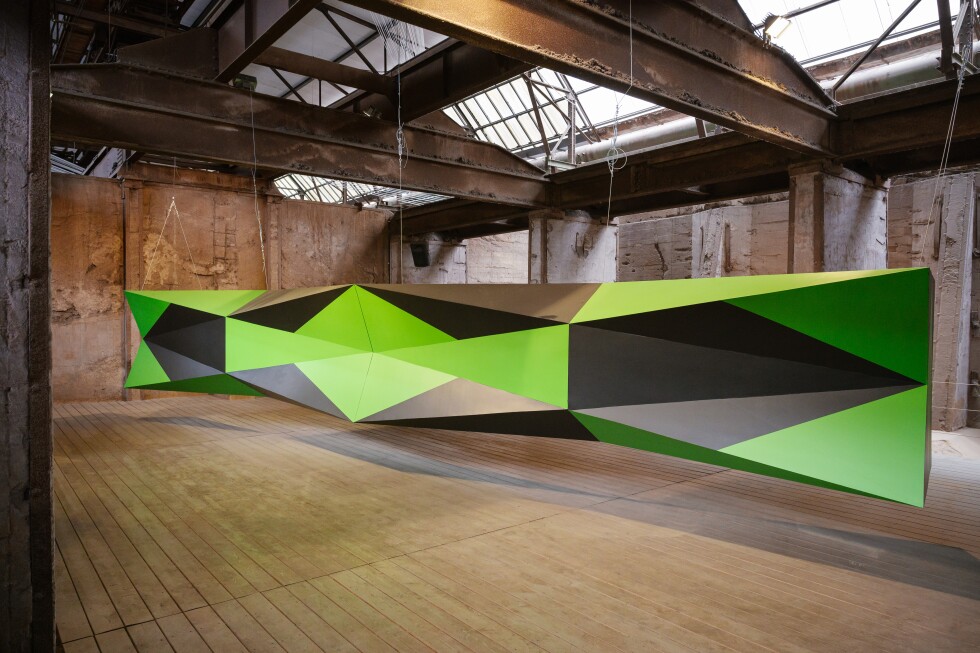
Other contributors include Dutch artist Boris Tellegen, better known by his artistic moniker Delta, who installed a massive black-and-green wooden sculpture that anchors and illuminates one of the ironworks’ interior halls. The France-based collective Vortex-X, which specializes in upcycling salvaged industrial materials, stretched sweeping arcs of white industrial fabric across an entire hall for their work titled *Memory in transit*, creating a dynamic installation that evokes movement and the passage of time at the dormant site.
Participating artists have emphasized the unique tension and beauty of creating contemporary work in a space that retains the grit and memory of its working past. British artist Remi Rough, who contributed small, sharply clean and clinical paintings that intentionally contrast with the site’s weathered texture, noted the unexpected aesthetic appeal of the abandoned facility: “It’s so dusty and it’s so old, but it’s beautiful, you know, there’s beauty in decay. I think what I’ve done makes you kind of just perceive it in a bit of a different way.”
Danish artist Anders Reventlov echoed the respect many creators hold for the site’s working history, saying he felt humbled by the opportunity to create work in a space that was once a brutal workplace. “As somebody told me … it was hell to work here. Now it’s not hell. It’s like a nice place, people walking around, there are bees, there are beautiful flowers, but yeah, we still remember the history and that’s super important.”
Beil emphasized that the biennale’s commitment to site-specificity rules out pre-made commercial works, keeping the focus entirely on art that responds to this one-of-a-kind location. “This is an installation for the space,” he said. “This is pure art.”
The 2026 Urban Art Biennale opens to the public on Saturday and will run through November 15, welcoming visitors to explore the intersection of contemporary urban art and 20th-century industrial heritage.