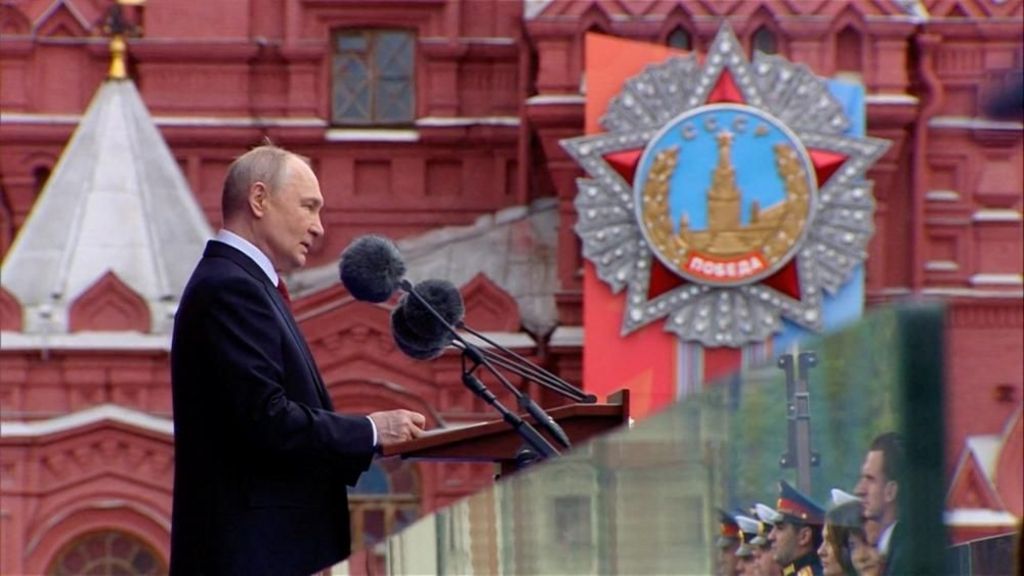
On May 9, Russia marked its most sacred national holiday — Victory Day, commemorating the Soviet Union’s historic defeat of Nazi Germany in World War II — with a drastically modified parade on Moscow’s Red Square that reflected the ongoing realities of the four-year-plus full-scale invasion of Ukraine. For the first time in nearly 20 years, no modern military hardware rolled across the iconic square, a change framed by Russian officials as a practical response to battlefield demands and heightened security risks amid the ongoing conflict.
The event, held under tightened security protocols prompted by concerns over potential Ukrainian drone attacks, still saw thousands of uniformed military personnel march past the reviewing stand, where Russian President Vladimir Putin was joined by a small contingent of visiting world leaders. Unlike the 2025 80th anniversary parade, which drew high-profile attendees including Chinese President Xi Jinping and Brazilian President Luiz Inácio Lula da Silva, only three foreign leaders attended this year’s ceremony: Belarusian President Alexander Lukashenko, Laotian President Thongloun Sisoulith, and Malaysia’s King Sultan Ibrahim. In a notable development, North Korean soldiers also took part in the march, a visible sign of the deepening military ties between Moscow and Pyongyang.
Putin opened his annual address by honoring the sacrifices of Soviet World War II veterans, before framing his so-called “special military operation” in Ukraine as a direct continuation of that generation’s legacy. “The great feat of the generation of victors inspires the soldiers carrying out the goals of the special military operation today,” Putin told the assembled crowd. He went on to frame the conflict as a defensive struggle against a Western-backed threat, claiming: “They are confronting an aggressive force armed and supported by the whole bloc of Nato. And despite this, our heroes move forward.”
The Russian leader extended his praise to Russian civilians contributing to the war effort, highlighting the work of factory workers, scientists, military engineers, war correspondents, medical workers, and educators. “No matter how military tactics change, the future of the country is being provided for by the people,” he added. Following the address, traditional ceremonial cannon salutes rang out across Red Square, and a military brass band performed, before Russian state media broadcast footage of Russian soldiers deployed on the front lines in Ukraine to viewers at home.
Across the rest of Russia, Victory Day celebrations were muted and uneven. Pre-parade events were held earlier in far-eastern cities including Vladivostok, where thousands of locals joined the traditional Immortal Regiment march, carrying portraits of relatives who fought in World War II. While some regional parades did include military vehicles, Russian state media confirmed that most were vintage World War II-era models rather than modern weapons systems. Many smaller cities and towns across the country canceled public parades and large-scale celebrations entirely amid security concerns.
Russian officials have openly defended the decision to scale back the Moscow parade, arguing that the country’s active military equipment is needed far more on the Ukrainian front lines than in a ceremonial display. “Our tanks are busy right now. They are fighting. We need them more on the battlefield than on Red Square,” Russian MP Yevgeny Popov told the BBC earlier in the week, echoing comments from other government figures who cited the “current operational situation” as the core reason for the changes.
The 2026 celebrations unfolded against the backdrop of a temporary truce announced days earlier by then-U.S. President Donald Trump, after which Russia and Ukraine agreed to a three-day ceasefire covering the Victory Day holiday period. While the ceasefire largely held during parade events, both sides had already exchanged numerous accusations of widespread violations across frontline positions in the days leading up to the holiday. Kyiv had initially called for a longer indefinite truce starting May 6, a proposal Moscow did not agree to, setting the terms for the limited three-day cessation of hostilities.