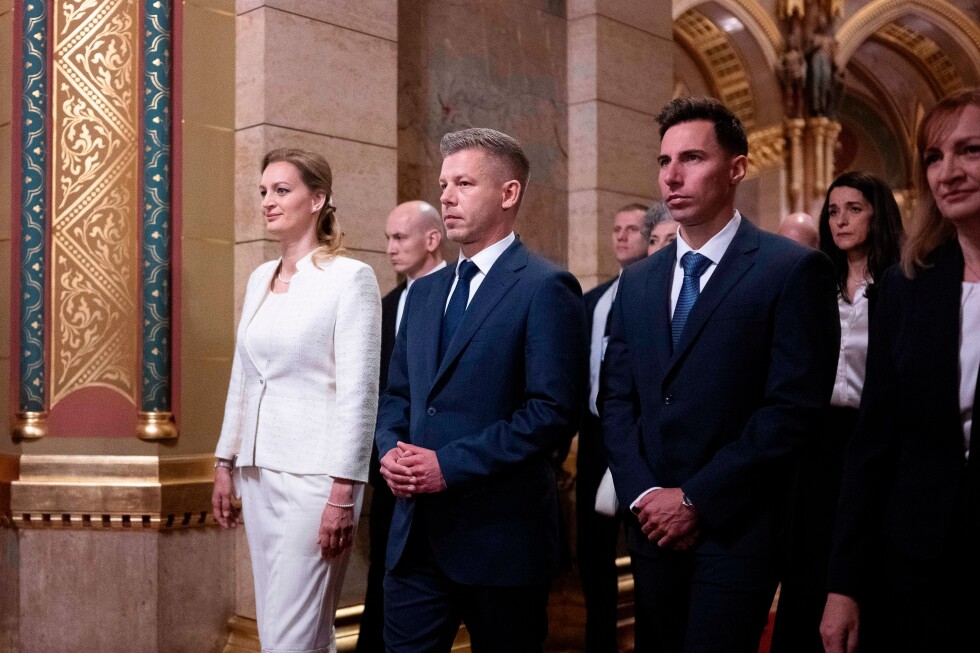
BUDAPEST, Hungary — In a historic shift that reshapes Hungary’s political landscape and its role in the European Union, Péter Magyar took the oath of office as Hungary’s new prime minister Saturday, walking through the doors of Budapest’s iconic neo-Gothic Parliament building to formally close 16 years of Viktor Orbán’s nationalist-populist governance.
Magyar’s newly formed center-right Tisza Party delivered a historic upset last month, defeating Orbán’s long-ruling Fidesz in a landslide election that sent shockwaves across Central Europe. Tisza secured a governing majority of 141 seats in the 199-seat national parliament — a result unmatched by any single party in Hungary’s post-Communist era. Orbán’s Fidesz-KDNP alliance, which held 135 seats in the previous legislature, will now occupy just 52 seats, with the far-right Mi Hazánk (Our Homeland) party taking the remaining six. For the first time since Hungary established its first post-Communist parliament in 1990, Orbán will not participate in the inaugural session. Following his election defeat, Orbán announced he would step away from the prime minister’s office to focus on rebuilding his right-wing political base.
The 45-year-old Magyar, a former insider within Orbán’s party who only launched Tisza in 2024, campaigned on a promise of radical systemic change. A core pillar of his platform is rooting out systemic official corruption, which he has repeatedly argued has stifled economic opportunity for ordinary Hungarians for more than a decade.
To mark the end of the Orbán era, Magyar has called on Hungarians across the country to join an all-day “regime-change celebration” outside Parliament on the day of his inauguration. After delivering his oath of office at approximately 3 p.m. local time, Magyar is scheduled to address the gathered crowd to outline his administration’s early priorities. Budapest’s liberal mayor Gergely Karácsony has also organized a public celebration along the banks of the Danube River Saturday evening, inviting all Hungarians to mark the political transition. In a social media post, Karácsony framed the gathering as a tribute to Hungarians who had faced repercussions under Orbán’s rule — including dismissed teachers, targeted journalists, persecuted minority groups and marginalized religious communities. “We can finally leave this era behind us — but first, let us remember the everyday heroes and express our gratitude with a farewell to the system,” Karácsony wrote.
Among the new administration’s most pressing foreign policy priorities is repairing Hungary’s frayed relationship with the European Union, a tie Orbán pushed to the breaking point through years of confrontational rhetoric, repeated vetoes of key EU policy decisions and a gradual geopolitical alignment with Russia. Unlocking roughly €17 billion ($20 billion) in frozen EU development funds, withheld from Hungary during Orbán’s tenure over widespread rule-of-law and corruption violations, sits at the top of Magyar’s policy agenda. The injection of funds is widely viewed as critical to jumpstarting Hungary’s stagnant economy, which has seen little to no growth over the past four years. As a tangible signal of his government’s commitment to realigning with EU institutions, Tisza officials confirmed the EU flag will be raised once again on Parliament’s facade — 11 years after Orbán’s administration ordered it removed.
Political analysts say the election of Magyar and the collapse of Orbán’s long-standing hold on power marks a dramatic shift not just for Hungary, but for the entire European Union. For years, Orbán’s open defiance of EU norms and frequent vetoes of bloc-wide policies on climate, migration and sanctions against Russia gridlocked EU decision-making, and his exit is expected to ease long-running political tensions within the 27-member bloc.